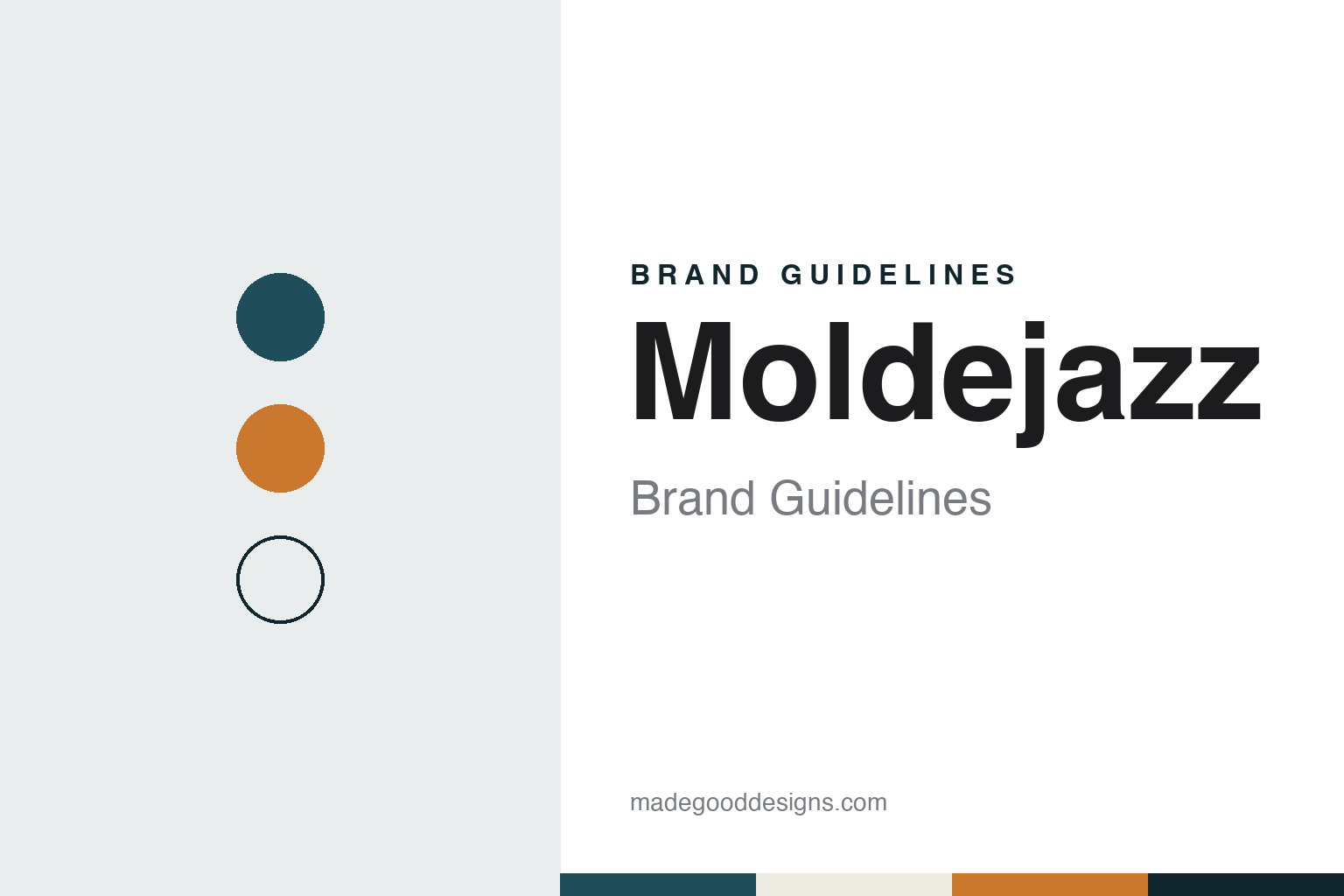
Moldejazz Brand Guidelines
Molde’s July jazz week, held every year since 1961.
Aa
Two constants: a Moldejazz fjord teal and copper palette and a Festival grotesque register. Abstract homage — not a Moldejazz poster or mark; no logo, artwork or programme is reproduced.
Storyville
A jazz club in a fjord town.
Moldejazz began in 1961 in Molde, a town on the Romsdal fjord in western Norway. Its full name is the Molde International Jazz Festival, shortened in English sources to MIJF, but the festival presents itself as Moldejazz, written as one word. Norway’s National Library, describing the festival archive it received in April 2020, says Moldejazz was established by the Storyville Jazz Club in Molde and is held each year in week 29, the third full week of July.
Norwegian Wikipedia, citing a 1966 report in the local newspaper Romsdals Budstikke, adds that the festival grew large enough by 1968 to be separated from the club as an organisation of its own. That organisation now has its own board and a festival director. In January 2026 NRK, the Norwegian broadcaster, reported that Linda Melsom, from Oslo, had been appointed festival director from April 2026, and that the summer 2026 festival was the 66th edition. A 2023 NRK report described the festival as held every year since 1961.
The club’s name survives inside the festival. Writing for DownBeat in August 2016, Josef Woodard described an intimate top-floor venue called Storyville, named in honour of the Molde club that started the festival. That year, he wrote, was the first with Hans-Olav Solli officially in charge as director, and the festival ran from 16 to 23 July.
Between 1999 and 2015 Moldejazz was one of Norway’s national “knutepunkt” festivals, a status Norwegian Wikipedia records for those years; the term translates roughly as “hub festival.”
Colour
Plassen, the cathedral and the museum hill.
Moldejazz does not have a single festival site. It spreads its concerts across the town centre, and the venues are part of how audiences know it. The main addition in recent years was Plassen, a multi-purpose culture house that, DownBeat reported in 2016, had been built a few years earlier and housed the festival’s central offices and two of its key venues. One is the stage of the theatre company Teatret Vårt; the other is the Storyville room on the top floor.
Other stages are older buildings. Molde Cathedral, built in 1957, according to DownBeat, is used for quieter concerts; in 2023 NRK reported that the artist in residence closed her week there with a solo concert. Up the hill, the open-air Romsdal Museum, with its old timber houses, serves as an outdoor venue for larger bookings, DownBeat wrote. Alexandraparken, a park in the town, hosts big evening shows; NRK listed a concert there on the opening day in 2023, and the festival’s website now lists it with its own sponsored stage. The festival’s website also lists the Bjørnsonhuset concert hall among its venues.
The festival’s signature idea is the artist in residence. Each year one musician plays several concerts across the week, often with different groups and new commissions. Norwegian and English Wikipedia list the role from 2000, when it was held by Chick Corea. DownBeat called the role “much-admired” and described how the Norwegian violinist Ola Kvernberg, resident in 2016, appeared in a chamber-orchestra band, a percussion project and duets. In 2023, NRK reported, the guitarist Hedvig Mollestad played eight concerts in six days, including works written for the festival.
The week opens and moves with a parade. NRK reported that the 2023 festival opened on a Monday in July with a parade through the town and music. Norwegian Wikipedia records that, since 1995, the festival has run Jazzlogen with the band Ytre Suløens Jassensemble for young musicians aged 14 to 20 from the county, who also play in the daily parade.
Typography
Design and documentation.
A jazz festival changes its line-up every year, so the parts of its identity that last tend to sit elsewhere. Many began with one person or one small group: a promoter, a publisher, a club owner or a city-centre association that put a name on a weekend and kept booking it. That origin often stays in the festival’s own telling, in the name of a prize, a hall or a history page, long after the organisation has passed to a foundation, a non-profit society or a concert company.
Place does much of the remaining work. Some festivals are tied to one town or one site, an amphitheatre, a fairground, a park or a congress centre, and audiences come to know the building as well as the music. Others spread across a whole city, using clubs, concert halls, squares and harbour fronts at once, so that the city itself becomes the venue. In both cases the stage names matter: a hall named after a river, a stage named after a founder or a square known by its street name becomes part of the vocabulary that returning visitors use.
The annual poster is the object people take home. Many festivals commission a different artist or designer each year, or run a competition among art students, and the run of posters becomes a record of the festival’s history that people collect and museums sometimes keep. Names change too: a title sponsor’s name can be attached to the front of a festival’s name for a period of years and later removed, while the core name stays.
Then there is the practical layer that audiences handle every day of the festival: the printed programme or app, the day schedule laid out stage by stage, wristbands and passes, maps and venue signage. With many concerts running at once, this material is how most visitors actually meet the festival’s typography and colours, and, like the poster, it is often redesigned from one edition to the next.
Aa
A festival grotesque — one word, Moldejazz. (Specimen set in Archivo, a sans STAND-IN; NOT the Moldejazz logo.)
Moldejazz
Week 29, every year.
Moldejazz keeps its own record. The National Library’s catalogue, printed in September 2022, describes the archive the festival handed over in April 2020: board and operating papers from 1961 to 2020, artist correspondence and contracts, festival posters, programmes and other printed matter, the festival newspaper Fire Flate, press cuttings, photographs from concerts and recordings from a stage called Naustet Vårt. The same transfer included the records of Molde Forum AS, a stage-technology company that operated from 1990 to 2020 and was wholly owned by Moldejazz, the catalogue says. Norway’s National Library thus holds the paper record, while the festival’s own website now carries a searchable archive of the artists it has presented since 1961, by year and venue.
That printed layer — posters, programmes, a daily paper — is where the festival’s identity lives from year to year, alongside its name. The current website sets the festival’s week, “Alltid uke 29” (always week 29), as a fixed line, and lists each concert by day, time and venue, with passes for the arena stages and for the artist in residence. Its live recordings are listed from 1973 onward. English Wikipedia names a live album recorded at the festival, A Molde Concert, from 1981.
Concerts have been broadcast through the European Broadcasting Union since 1974, and NRK covers the festival, English Wikipedia says. A local award, the Molderosen, was established in 1967 and is given at the festival each year, the same page records, citing the Molde city museum.
For a design guide, Moldejazz shows how a festival can make a fixed week and a ring of town venues into its identity, with one musician each year at the centre. Compare Pori Jazz, another Nordic jazz festival held in July since the 1960s, and Øya, the Oslo music festival, also in Norway. For this guide we use a fjord teal, a night blue and a copper with a sans, an unofficial interpretation; no product or logo is reproduced.
Explore & save
Keep Moldejazz’s identity on hand — save it to a board in the Made Good inspiration library.
Moldejazz identity set
Pin the Moldejazz fjord teal and copper palette and the Festival grotesque register to your own board.
Source & notes
Frequently Asked Questions
What font can I use to match the Moldejazz look?
This guide describes Moldejazz’s type as “A festival grotesque — one word, Moldejazz”. Its type specimen is set in Archivo from Google Fonts as a stand-in; Archivo is not Moldejazz’s own lettering.
What colours are in the Moldejazz palette?
This guide’s Moldejazz palette is Fjord teal #1F4E5A, Night water #10262C, Mountain mist #EDEAE2, Parade copper #C9782E and Paper #F7F5F0. The tones are the guide’s own unofficial interpretation, not official Moldejazz hex codes.