Detroit Jazz Festival Brand Guidelines
Hart Plaza, Labor Day and a Montreux link from 1980.
Aa
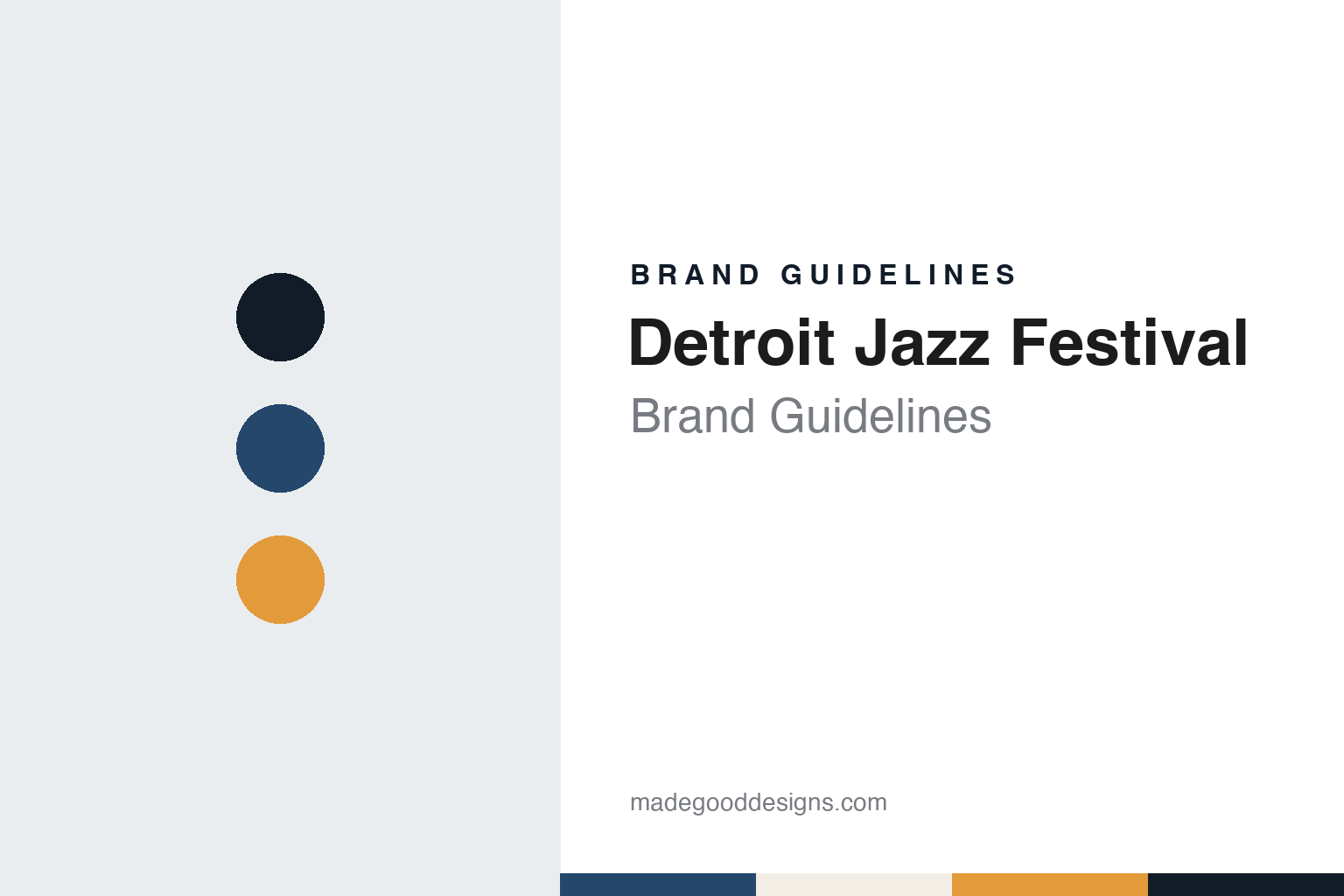
Two constants: a Detroit river blue and brass amber palette and a Riverfront sans register. Abstract homage — not a Detroit Jazz Festival poster or mark; no logo, artwork or photograph is reproduced.
Montreux-Detroit, 1980
A civic group, a Swiss partner and a riverfront plaza.
The Detroit Jazz Festival was formed in 1980 by Robert McCabe and the civic group Detroit Renaissance, in an effort to bring more visitors to the city, according to the Detroit Historical Society’s Encyclopedia of Detroit. DownBeat, writing in August 2019 as the festival reached its 40th edition, said McCabe had arrived in Detroit in 1971 to run Detroit Renaissance, and that the festival was modelled on the jazz festival at Montreux in Switzerland.
That model came with a partnership. From 1980 to 1991 the event was known as the Montreux-Detroit jazz festival, and the Detroit Historical Society says the link allowed the two festivals to share performers and commissioned poster art. DownBeat adds that in 1979, before the first edition, McCabe set up an exchange programme in which American high-school jazz bands performed in Switzerland, and staged a series of concerts in Detroit. English Wikipedia records that the association with Montreux ended after the 1991 festival, and that the Music Hall Center for the Performing Arts took over production from 1992 while the Montreux-Detroit name stayed in use until 1999.
The festival takes place in downtown Detroit over the Labor Day weekend, starting on the Friday evening and running for four days. Its home is Hart Plaza, the open civic plaza on the Detroit riverfront, and for many years a second site sat around Campus Martius Park, with a stage in Cadillac Square at the head of Woodward Avenue, English Wikipedia says. DownBeat credits the artistic director of 2000 to 2005 with expanding the festival to Campus Martius and adding two stages.
Colour
Title names, a foundation and a director.
The name has followed the festival’s partners. English Wikipedia records that the event was called the Ford Detroit International Jazz Festival from 2000 to 2004, under a sponsorship agreement with the Ford Motor Company; from 2005 it was the Detroit International Jazz Festival, the Detroit Historical Society says, and since 2012 it has been the Detroit Jazz Festival. (DownBeat gives 2011 for the present name.)
In 2006 Gretchen Valade, then chair of the Detroit label Mack Avenue Records, founded the Detroit International Jazz Festival Foundation, a 501(c)(3) non-profit organisation that took over the festival’s management and production, according to the Detroit Historical Society. The same source says the foundation also presents concerts and events through the year. The foundation also works with Wayne State University: the Gretchen C. Valade Jazz Center on the university’s Midtown campus opened in August 2024, English Wikipedia says, and has hosted part of the festival each year since.
The saxophonist Chris Collins was appointed artistic director in 2011 and later also became president of the foundation, the Detroit Historical Society says. DownBeat lists him among five artistic directors the festival has had, and credits his predecessors with the festival’s artist-in-residence programme, begun in the early 2000s; the violinist Regina Carter was the first resident, and the bassist Stanley Clarke held the role at the 40th edition in 2019. The festival has also commissioned new works from visiting musicians, DownBeat reported.
The festival is described by the Detroit Historical Society as a free music festival, and BridgeDetroit reported in August 2025 that it is supported by donors and sponsors with no admission charge. The 2020 edition was held virtually, streamed online and on radio, the Detroit Historical Society says.
Typography
How jazz festivals build an identity.
A jazz festival rarely owns the ground it stands on, yet the ground often does most of the work of making it recognisable. An open-air amphitheatre, a grove of pines by the sea, a park beside a river, a village square under a marquee or a whole small town handed over for a week in summer: audiences remember the setting long after a particular evening’s line-up has blurred, and the festival name tends to fuse with the name of the place.
Inside that setting, stages are given names of their own, after a garden, a building, a street or a hall, and those names become part of the vocabulary regulars use when they plan a day. The annual poster does a similar job over time. Many festivals commission a different illustrator, painter or designer every year, so a run of posters becomes a visual archive that collectors keep and that the festival itself often reprints, exhibits or sells.
Behind the name there is usually a founder or a small founding group, and later an organisation that keeps it going: a non-profit association, a foundation, a tourist office or a public cultural body linked to the town. Changes in that structure seldom change what audiences see, but they shape who books the music, who commissions the poster and who looks after the archive of past editions.
Then there is the practical layer, the part visitors handle with their own hands. Printed programme books and day-by-day schedules, wristbands and passes, site maps, information points, signs that point from one stage to the next, and now festival apps all carry the same name, colours and lettering. This guide looks at how each festival’s identity holds together across those pieces, and keeps to what dated sources record about them.
Aa
A riverfront sans — a city name carried since 1980. (Specimen set in Archivo, a sans STAND-IN; NOT the Detroit Jazz Festival logo.)
Detroit Jazz Festival
Named stages, a poster and a programme book.
The festival’s stages carry partner names. BridgeDetroit, previewing the 46th festival in August 2025, described a footprint that ran from Hart Plaza up Woodward Avenue, lined with food vendors, to Cadillac Square, where the JPMorgan Chase stage stood; that year the Detroit Jazz Hall inside the Valade Jazz Center became an official fourth stage for high-school band showcases, and a late set each night, the Midtown After Hours Special, moved the evening up to the campus. The pianist Jason Moran was the 2025 artist-in-residence. The same report said the festival streamed every stage live online, with three camera angles on each, from the opening downbeat to the close on the Monday.
For the 47th festival, from 4 to 7 September 2026, the foundation said in June 2026 that all three main stages would be gathered at Hart Plaza: the Carhartt Amphitheater Stage, the JPMorganChase Stage and the Waterfront Stage, with further concerts at the Detroit Jazz Hall. In September 2026 the foundation said that more than 300,000 people had attended downtown and that seven livestream feeds had carried the festival online, and that a new late-night club series had opened at the Valade Jazz Center.
The printed layer is part of the identity. The festival’s website offers an official annual poster each year — the 2026 edition was billed as the 47th annual poster — alongside a free digital program book for the festival weekend, a map and schedule page, and a campaign called Keep It Free. The poster tradition reaches back to the Montreux years, when the two festivals shared commissioned poster art, according to the Detroit Historical Society. The festival’s address is detroitjazzfest.org.
For a design guide, Detroit Jazz Festival shows how a civic plaza, a fixed holiday weekend and a run of annual posters can hold a festival steady through several names and organisers. Compare Montreux Jazz Festival, its partner from 1980 to 1991, and Ford, whose name the festival carried from 2000 to 2004. For this guide we use a river blue, a concrete pale and a brass amber with a sans, an unofficial interpretation; no product or logo is reproduced.
Explore & save
Keep Detroit Jazz Festival’s identity on hand — save it to a board in the Made Good inspiration library.
Detroit Jazz Festival identity set
Pin the Detroit river blue and brass amber palette and the Riverfront sans register to your own board.
Source & notes
Frequently Asked Questions
What font can I use to match the Detroit Jazz Festival look?
This guide describes Detroit Jazz Festival’s type as “A riverfront sans — a city name carried since 1980”. Its type specimen is set in Archivo from Google Fonts as a stand-in; Archivo is not Detroit Jazz Festival’s own lettering.
What colours are in the Detroit Jazz Festival palette?
This guide’s Detroit Jazz Festival palette is River blue #24476B, Night steel #121C29, Plaza concrete #F2EEE6, Brass amber #E39A3B and Cadillac teal #5E9C9A. The tones are the guide’s own unofficial interpretation, not official Detroit Jazz Festival hex codes.
When was Detroit Jazz Festival founded?
Detroit Jazz Festival was founded in 1980 (Montreux-Detroit), in Detroit, Michigan.
Who founded Detroit Jazz Festival?
Detroit Jazz Festival was founded by Robert McCabe and Detroit Renaissance in 1980 (Montreux-Detroit).