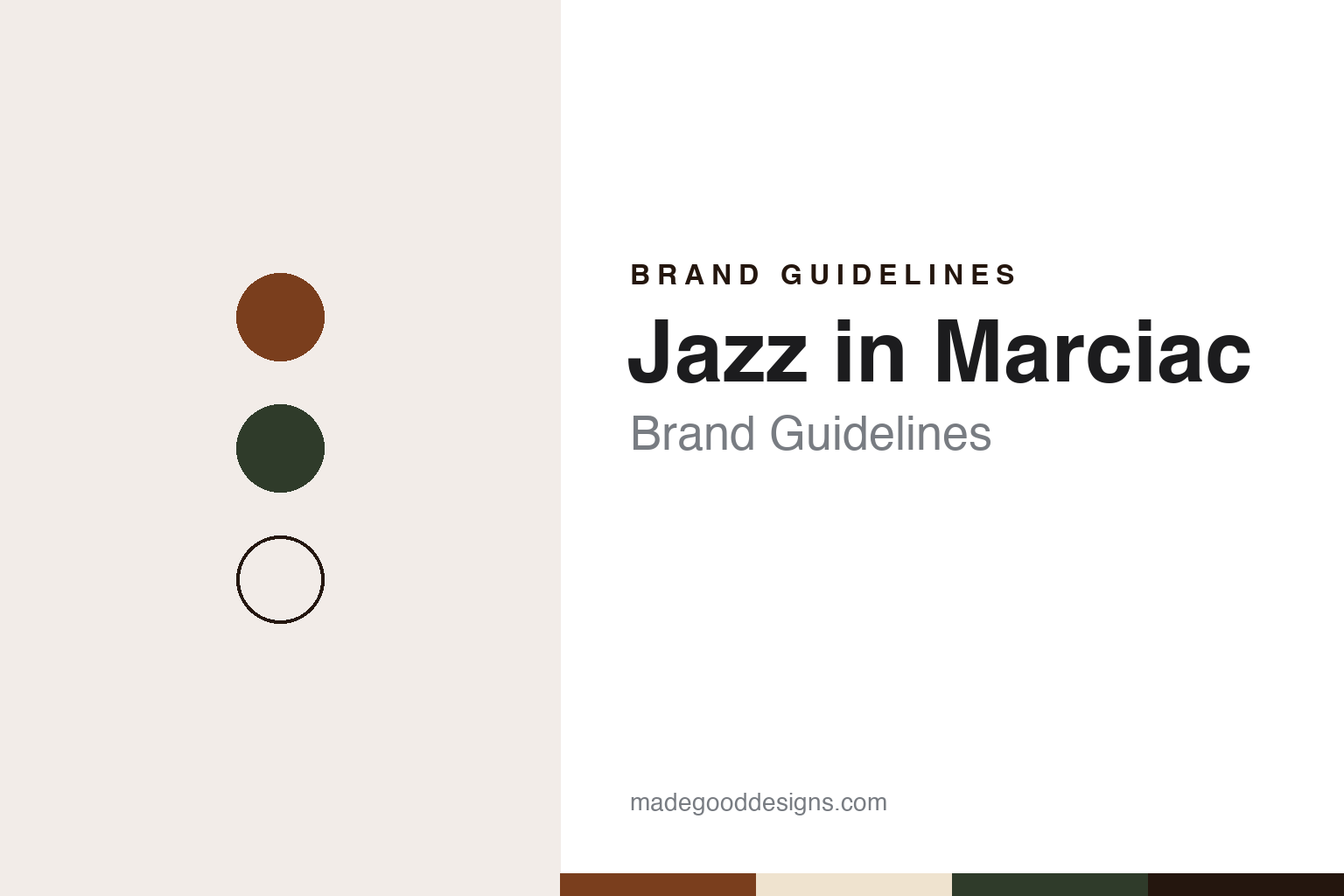
Jazz in Marciac Brand Guidelines
A Gers village, a marquee and a square since 1978.
Aa
Two constants: a Jazz in Marciac brick, vine green and arcade stone palette and a Village serif register. Abstract homage — not a Jazz in Marciac poster or mark; no logo or artwork is reproduced.
One evening in August
A youth club, two teachers and a New Orleans band.
Jazz in Marciac began as a single evening. French Wikipedia says that in 1978, at the instigation of Jean-Louis Guilhaumon and André Muller, the Foyer des jeunes et de l’éducation populaire de Marciac, the village youth and community club, put on a one-day festival of New Orleans jazz that ended with a concert by the clarinettist Claude Luter in the village arena. A history note by Guilhaumon on the site of the French national audiovisual archive, the INA, describes the two founders at the time as a young secondary-school head and a primary-school teacher.
The festival’s own archive gives the date of that first evening as 13 August 1978, with four acts on the bill, Claude Luter and the Jazzouillis Orchestra among them. French Wikipedia adds that the event was created by a handful of enthusiasts after a concert by the musician Bill Coleman, who lived in the Gers.
It grew quickly. In 1979, French Wikipedia says, the festival ran for three days and invited Coleman and another musician living in the department; the concerts were then held in a warehouse on the edge of the village. A regional television report broadcast on FR3 Toulouse on 16 August 1980, now held by the INA, presented what it called the third edition: musical groups strolling through the bastide and along the lake, and Guilhaumon interviewed as president of the organising association.
The programme stayed close to New Orleans and traditional jazz in those years while widening its formats, French Wikipedia says, with concerts in the street, gospel masses and partnerships with the Plaimont wine cooperative. The festival was first run by the Foyer des jeunes; it became an association under France’s 1901 law on associations in 1988. French Wikipedia describes Guilhaumon as its president, and a 2011 regional television report held by the INA introduced him as the festival’s director.
Colour
The marquee, the square and the hall.
The festival’s main stage is a tent. French Wikipedia says the chapiteau stage appeared in 1984, at first a circus big top holding several thousand people, and was replaced from the 2000s by a marquee 100 metres long that can seat about 6,000. The evening concerts are held there; the festival’s own site lists two stages, Le Chapiteau and Le Bis.
Le Bis is the free festival. During the three weeks, French Wikipedia says, the village’s main square, which has kept its medieval arcades, hosts the free “festival off” under a tent at its centre, while restaurants and pop-up taverns in the village serve meals with musicians playing.
The run lengthened in steps. French Wikipedia says the festival grew to eight days in 1992 and to 16 evenings in 2009. The festival’s archive shows the 1988 edition running from 9 to 14 August; by 2026, the 48th edition ran from 20 July to 5 August, with concerts on every evening in between. The festival’s year-by-year archive has no 2020 entry, and French Wikipedia says the 2020 edition was not held.
Since 1991, according to French Wikipedia, the trumpeter Wynton Marsalis has been the festival’s appointed ambassador, a role Coleman held before him, and has been present at every edition; he wrote a Marciac Suite, and a statue of him stands on the pavilion of the L’Astrada hall.
L’Astrada is the festival’s year-round venue. A FR3 Toulouse report of 2 July 2011, held by the INA, described the new 500-seat hall opening in time for the festival’s 34th edition; French Wikipedia dates its inauguration to May 2011 and says it lets Jazz in Marciac run a cultural season outside the festival weeks. L’Astrada’s own note on the INA site says its name means “destiny” in Occitan, that building work ran from December 2009 to April 2011, and that since January 2017 it has been run as a public cultural cooperation body whose members are the State, the Occitanie region, the Gers department and the local community of communes.
Typography
Design and documentation.
A jazz festival rarely owns the ground it stands on, yet the ground often does most of the work of making it recognisable. An open-air amphitheatre, a grove of pines by the sea, a park beside a river, a village square under a marquee or a whole small town handed over for a week in summer: audiences remember the setting long after a particular evening’s line-up has blurred, and the festival name tends to fuse with the name of the place.
Inside that setting, stages are given names of their own, after a garden, a building, a street or a hall, and those names become part of the vocabulary regulars use when they plan a day. The annual poster does a similar job over time. Many festivals commission a different illustrator, painter or designer every year, so a run of posters becomes a visual archive that collectors keep and that the festival itself often reprints, exhibits or sells.
Behind the name there is usually a founder or a small founding group, and later an organisation that keeps it going: a non-profit association, a foundation, a tourist office or a public cultural body linked to the town. Changes in that structure seldom change what audiences see, but they shape who books the music, who commissions the poster and who looks after the archive of past editions.
Then there is the practical layer, the part visitors handle with their own hands. Printed programme books and day-by-day schedules, wristbands and passes, site maps, information points, signs that point from one stage to the next, and now festival apps all carry the same name, colours and lettering. This guide looks at how each festival’s identity holds together across those pieces, and keeps to what dated sources record about them.
Aa
A village serif — a marquee and an arcaded square. (Specimen set in DM Serif Display, a serif STAND-IN; NOT the Jazz in Marciac logo.)
Jazz in Marciac
Three letters and a village.
The name is short and fixed to the place. French Wikipedia gives the abbreviation JIM, and the festival uses the English “in” rather than the French “à” where French festival names such as Jazz à Vienne and Jazz à Juan use “à.” The festival numbers its editions: 2026 was the 48th.
The festival also documents itself as a series. Its website keeps an archive by year from 1978 to 2026, each page listing the acts and dates of that summer, and it offers a downloadable programme for 2026 and a festival newspaper, Le Journal de Jazz in Marciac. A body of books follows the story: Jazz in Marciac. Une belle aventure jazziste, a text-and-photograph book published in Bordeaux in 1986, and Le Fabuleux Destin de Marciac, published in 2014, both listed by French Wikipedia. The departmental archives of the Gers hold the association’s papers, according to the INA note.
Education sits alongside the concerts. The INA note by Guilhaumon describes the jazz initiation workshops at the Marciac secondary school, which the festival has supported from its early years, and the festival’s site lists workshops, volunteering and a programme for school pupils among its activities.
That gives a designer three fixed elements to work with: a bastide village with an arcaded square, a 100-metre marquee, and a numbered edition each summer, from a single August evening in 1978 to more than two weeks of concerts.
For a design guide, Jazz in Marciac shows how a festival can take the name of a small village and keep the village at its centre. Compare Jazz à Vienne, another French summer jazz festival built around one main stage, and Jazz à Juan, the July festival on the Mediterranean coast. For this guide we use a brick red, a vine green and a warm stone with a serif, an unofficial interpretation; no product or logo is reproduced.
Explore & save
Keep Jazz in Marciac’s identity on hand — save it to a board in the Made Good inspiration library.
Jazz in Marciac identity set
Pin the Jazz in Marciac brick, vine green and arcade stone palette and the Village serif register to your own board.
Source & notes
Frequently Asked Questions
What font can I use to match the Jazz in Marciac look?
This guide describes Jazz in Marciac’s type as “A village serif — a marquee and an arcaded square”. Its type specimen is set in DM Serif Display from Google Fonts as a stand-in; DM Serif Display is not Jazz in Marciac’s own lettering.
What colours are in the Jazz in Marciac palette?
This guide’s Jazz in Marciac palette is Gascon brick #7A3E1D, Vine green #2F3B2A, Arcade stone #EFE3CF, Armagnac gold #B9832F and Paper #F8F4EC. The tones are the guide’s own unofficial interpretation, not official Jazz in Marciac hex codes.
When was Jazz in Marciac founded?
Jazz in Marciac was founded in 1978 (13 August, one evening), in Marciac, Gers.
Who founded Jazz in Marciac?
Jazz in Marciac was founded by Jean-Louis Guilhaumon and André Muller in 1978 (13 August, one evening).