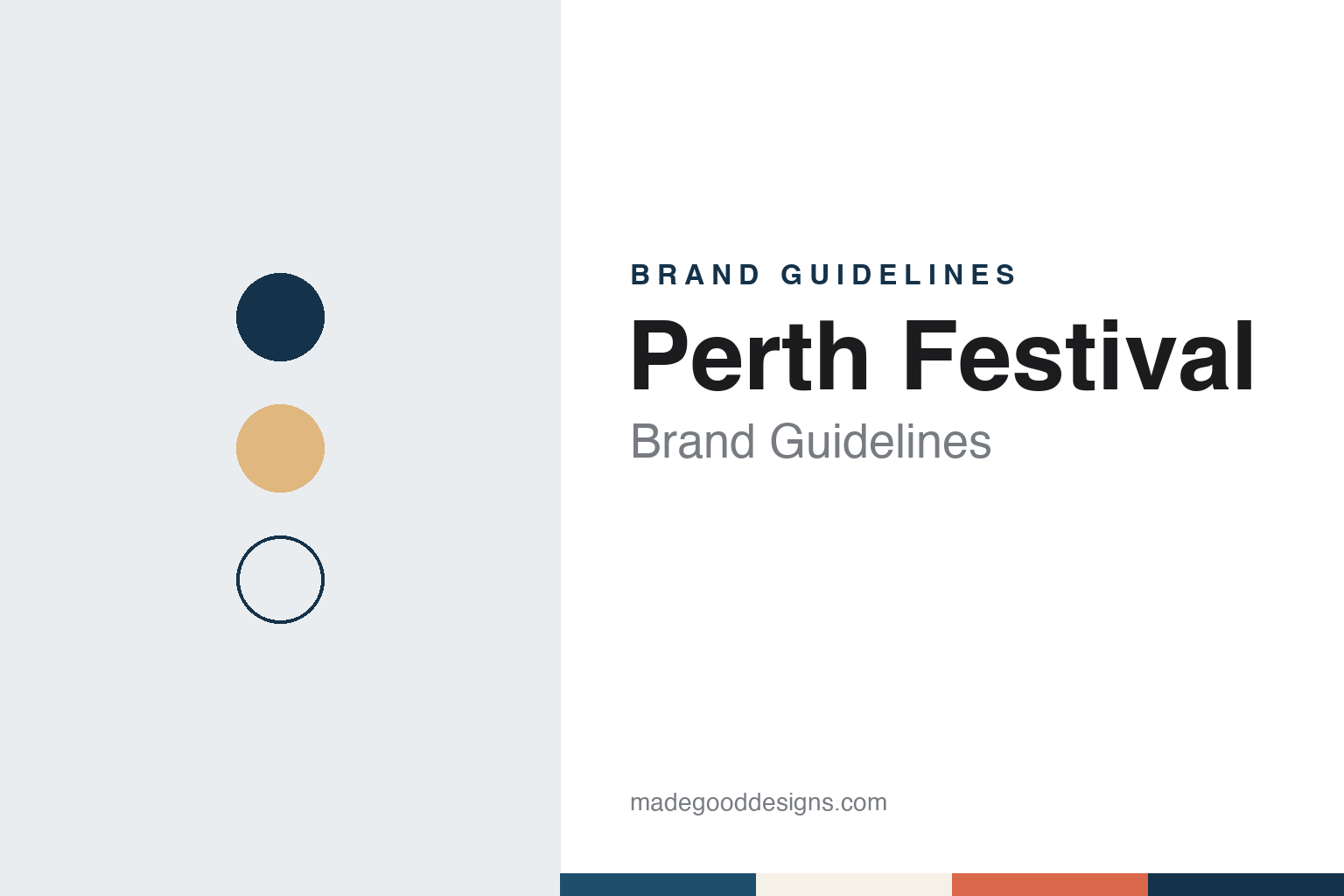
Perth Festival Brand Guidelines
A university summer school that grew into a city-wide February festival.
Aa
Two constants: a river blue, sand and coral palette and an open grotesque sans register. Abstract homage — not a Perth Festival poster or mark; no logo, artwork or campaign image is reproduced.
A summer school festival
A university, a professor and a January programme in 1953.
Perth Festival began at the University of Western Australia in 1953. English Wikipedia, citing a speech in the Australian Senate in April 2000, names its founder as Fred Alexander, then a professor and the university’s Director of Adult Education, who had attended the Edinburgh Festival in 1951 and wanted to bring cultural events from British, European, American, Asian and Australian sources to Perth. The first festival, held in January 1953, presented theatre, ballet and film, and was tied to the university’s summer school for students in the long holidays.
The university stayed at the centre of the event. A news release from the University of Western Australia in May 2018 described the festival as founded by the university in 1953, and the festival’s own website says the same today, adding that it is a not-for-profit organisation that brings performance, music, film, visual arts and literary events to the city each summer. English Wikipedia says the festival has operated from the university’s Nedlands campus since 1953, and that it is run in partnership with the state government and the City of Perth.
Film has been part of the programme from the start. According to English Wikipedia, the early screenings were held at the Somerville Auditorium on the university campus, and a French film festival was held within the programme in 1957. The festival’s website in November 2026 lists the season as Lotterywest Films at Somerville, a run of international films that begins in late November and continues through the summer, well before and after the main festival weeks; the website presents it as cinema under the stars among the Somerville pines.
The festival moved off campus during the 1960s. English Wikipedia says it expanded across the city in that decade, and quotes a 1973 Western Australian government booklet that described the event as “culture in shirtsleeves”, with audiences on lawns and in open amphitheatres for films, concerts and plays on summer nights. The same article notes that the New Fortune Theatre, a stage in the university’s Arts Building built as a replica of London’s Fortune Playhouse, opened in 1964 with a production of Hamlet.
Colour
Three names for one festival.
The festival has changed its name twice. Through much of its history it was called the Festival of Perth. In 1999 the newly appointed artistic director announced a new name, the Perth International Arts Festival, often shortened to PIAF, which English Wikipedia says was used from 2000 to 2017, spanning the festival’s fiftieth anniversary in 2003. For the 2018 edition the then artistic director Wendy Martin and the board shortened the name to Perth Festival, English Wikipedia says, citing Limelight’s report of the 2018 programme in November 2017. English Wikipedia notes that the registered company name was still Perth International Arts Festival in 2020, described as the organiser of Perth Festival.
A state lottery has been part of the identity since 2004. English Wikipedia, citing the Lotterywest annual report for 2003–04, says the festival began carrying Lotterywest branding that year, with the lottery acknowledged as its principal partner, and the film season took the Lotterywest name at the same time. In November 2026 the festival’s website still presents its film programme as Lotterywest Films and its East Perth Power Station season as a Lotterywest Community Experience.
The festival is led by an artistic director appointed for a set term. A University of Western Australia release of 9 May 2018 announced the appointment of the artistic director for 2020 to 2023, succeeding Wendy Martin after the 2019 festival, and described that year as the festival’s 65th anniversary. Anna Reece is artistic director for the festivals from 2025 to 2028, according to the festival’s website and The Guardian. A festival announcement on 3 November 2025 said a new chief executive would start in January 2026, and gave the dates of the 2026 festival as 6 February to 1 March, the second programme under Reece.
The organisation is governed by a board. The festival’s website lists eight board members, a chair among them, and a staff team that runs programming, marketing, ticketing and production. It also names a Noongar Advisory Circle, which The Guardian described in February 2025 as working with the artistic director on the history of a new festival site.
Typography
Festivals and the city.
International arts and theatre festivals usually present themselves through a place and a season before anything else. Many take the simplest possible name, a city followed by the word “festival”; others add a season, a language or a coined word, and the open-access events that grow up beside them often borrow the word “fringe” or “Off”. The name tends to stay fixed for decades, while almost everything else about the festival changes from one edition to the next.
Behind most of these names sits a non-profit body rather than a company: an association, a foundation, a trust or a company limited by guarantee, often with a board on which a city, a region or a national arts body takes an institutional seat. A director or artistic director, appointed for a set term, shapes each programme, and the festival’s character can shift noticeably when that post changes hands.
The programmes themselves are usually spread across a city. Theatre, dance, music and visual art share the dates, and the venues range from established theatres and concert halls to courtyards, cloisters, chapels, quarries, warehouses and streets. Two models sit side by side. A curated festival invites every production it shows; an open-access fringe lets any company register and find its own venue, so the programme grows from the bottom up and the organiser mainly coordinates listings, ticketing and information.
Visually, this makes a festival identity unusually changeable. The fixed elements are often few: the name, the dates and sometimes a signature venue or ritual. Around them, a new programme, poster or campaign image is made for each edition, often commissioned from a visual artist or a design studio, so that the festival looks different every year while remaining recognisable by its place in the calendar and in the city.
Aa
An open grotesque sans for a summer festival. (Specimen set in Archivo, a sans STAND-IN; NOT the Perth Festival logo or campaign lettering.)
Perth Festival
A power station, a river and a new campaign.
The festival’s recent identity is tied to an industrial building. The Guardian reported on 9 February 2025 that the East Perth Power Station, a coal-fired plant built between 1913 and 1916 on the bank of the Derbarl Yerrigan, the Swan River, and decommissioned in 1981, had been turned into a major performance venue for the following four years of the festival. The paper described a main stage set against the building’s brutalist facade, a free world-music programme in a piazza on the riverbank and projections by First Nations artists on the walls, and said the site opened to the public on 7 February 2025 for three weeks. Anna Reece told The Guardian that festivals work well in places with character and stories rather than pop-up sites.
The site returned for later editions. In November 2026 the festival’s website announced the power station for the 2027 festival from 5 to 28 February, alongside The Embassy, a late-night music lounge inside the old Perth Town Hall, and the Sanctum Series of concerts in St Mary’s Cathedral and the ballroom of Government House. The festival’s website also credits Reece with introducing two strands, Karla Bidi and Boorloo Contemporary.
The visual identity was redrawn in late 2024. Mumbrella reported on 26 November 2024 that Perth Festival had unveiled new branding and a summer campaign made with Hypnosis, a creative agency based in Perth. The report said the rebrand drew on the artistic vision Reece set for 2025 to 2028, summed up in the line “truth tellers, mischief makers, sand dunes, and salty air”, and was meant to encourage people to treat the festival as a whole rather than as a set of separate events. The festival’s about page repeats that line and speaks of summer, sand dunes, salty air and the river.
The programme mixes art forms. English Wikipedia lists contemporary and classical music, dance, theatre, literature and ideas, visual arts and large public works, with the main events in February and March and the film season from November to April. A literature strand, run for years as the Perth Writers Festival and later as Perth Writers Week, was presented in 2020 as a Literature & Ideas Weekend, the same article says.
For a design guide, Perth Festival shows how a university event can carry a city’s summer, the river and its venues into one name that has been shortened over time. Compare the Edinburgh International Festival, which its founder visited in 1951, and the Adelaide Fringe, another Australian summer arts festival. For this guide we use a river blue, a sand and a coral with a grotesque sans, an unofficial interpretation; no product or logo is reproduced.
Explore & save
Keep Perth Festival’s identity on hand — save it to a board in the Made Good inspiration library.
Perth Festival identity set
Pin the Swan River blue, dune sand and summer coral palette and the open grotesque sans register to your own board.
Source & notes
Frequently Asked Questions
What font can I use to match the Perth Festival look?
This guide describes Perth Festival’s type as “An open grotesque sans for a summer festival”. Its type specimen is set in Archivo from Google Fonts as a stand-in; Archivo is not Perth Festival’s own lettering.
What colours are in the Perth Festival palette?
This guide’s Perth Festival palette is Swan River blue #1F4E6B, Deep harbour #14324A, Salt white #F6F1E7, Dune sand #E0B77E and Summer coral #D9674A. The tones are the guide’s own unofficial interpretation, not official Perth Festival hex codes.
When was Perth Festival founded?
Perth Festival was founded in 1953, in Perth, Western Australia.
Who founded Perth Festival?
Perth Festival was founded by University of Western Australia (Fred Alexander) in 1953.