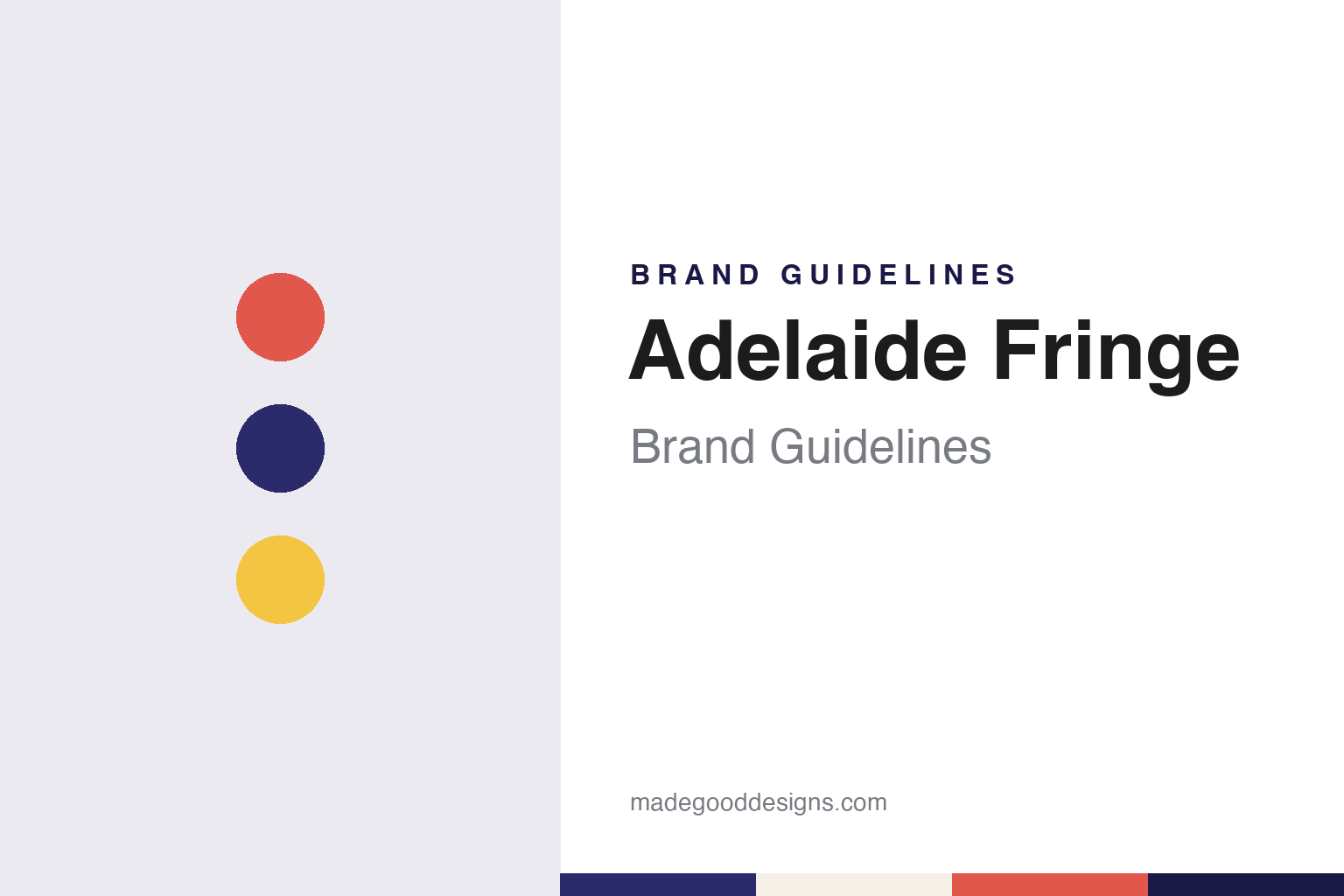
Adelaide Fringe Brand Guidelines
An open-access festival that fills Adelaide every February and March.
Aa
Two constants: an indigo, coral and yellow palette and a Poster grotesque register. Abstract homage — not an Adelaide Fringe poster or mark; no logo or artwork is reproduced.
Beside the Festival
Unofficial events, 1960.
Adelaide Fringe began as a side-effect. In 1960 the city held the Adelaide Festival of Arts, a curated programme, and, according to English Wikipedia, a number of local artists who were not included staged their own exhibitions, plays and events alongside it. Those “unofficial fringe activities” are counted as the start of the Fringe. Like the Festival of Arts, it ran every two years, at first for about two weeks and later for three.
It took fifteen years to become an organisation. In 1975, English Wikipedia says, the Fringe was incorporated as an association named Focus Inc., with the writer and director Frank Ford as its founding chairman, and the first independently organised Fringe, the Focus festival, followed in 1976 with its own dedicated poster. The name changed with the posters: “Adelaide Festival Fringe” in 1982, “Adelaide Fringe Festival” in 1994, and plain Adelaide Fringe from 2000. International artists were admitted from 1988, and the organisation introduced its own ticketing system, FringeTix, in 1998.
The Fringe became annual in 2007 and has run for about four weeks each February and March since 2013, Wikipedia says. It remains a separate organisation from the Adelaide Festival, whose programme runs at the same time of year; the overlapping weeks, with other events, are known locally as “Mad March.” The organiser today is Adelaide Fringe Inc., governed by the Adelaide Fringe Board, which employs a chief executive, Wikipedia says.
Colour
Open access, parks and hubs.
The Fringe is open access: there is no curator choosing the programme, English Wikipedia notes, and artists register and present their own shows. That model shapes everything about how the festival looks and feels. Its programme runs across comedy, cabaret, circus and physical theatre, dance, film, theatre, puppetry, music, magic, visual art and design, in hundreds of venues ranging from theatres, pubs and galleries to warehouses, laneways and tents in the park lands that surround the city centre.
The park lands hold the festival’s venue hubs, clusters of temporary venues. The Garden of Unearthly Delights, a fenced garden of tents in Rundle Park / Kadlitpina, was first used in 2000, when it had a single Spiegeltent; Gluttony, in Rymill Park / Murlawirrapurka, began in 2010; and a smaller hub, Fool’s Paradise, has run in Victoria Square / Tarndanyangga since 2023, according to Wikipedia. Established venues such as Holden Street Theatres in Hindmarsh, the Bakehouse Theatre and the German Club have also regularly hosted Fringe events, Wikipedia says.
The festival also reaches beyond the city. In February 2020, the Fringe’s 60th anniversary year, ABC News reported that half of its venues that year were outside the city centre, with satellite hubs at Stirling, Gawler and Murray Bridge and “Fringe on Tour” events in towns including Mount Gambier, Whyalla and Port Augusta; the satellite events were community-led and open access, the festival’s head of programs told ABC. The same report said the World Fringe Congress, a meeting of fringe organisers from more than 40 festivals, was being held in Adelaide that week, and that the Fringe had sold a record 835,000 tickets in 2019.
Leadership has changed recently. Heather Croall, appointed chief executive and director in February 2015, stepped down in November 2025 to become director of Carrick Hill, the historic house museum, InDaily reported; an acting chief executive delivered the 2026 festival, which ran from 20 February to 22 March. In May 2026 InDaily reported that Marc Carnes, a Canadian arts leader who had been chief executive of CKUA Radio in Alberta and board chair of the Edmonton International Fringe Theatre Society, had been appointed chief executive from 1 July 2026.
Typography
Design and documentation.
International arts and theatre festivals usually present themselves through a place and a season before anything else. Many take the simplest possible name, a city followed by the word “festival”; others add a season, a language or a coined word, and the open-access events that grow up beside them often borrow the word “fringe” or “Off”. The name tends to stay fixed for decades, while almost everything else about the festival changes from one edition to the next.
Behind most of these names sits a non-profit body rather than a company: an association, a foundation, a trust or a company limited by guarantee, often with a board on which a city, a region or a national arts body takes an institutional seat. A director or artistic director, appointed for a set term, shapes each programme, and the festival’s character can shift noticeably when that post changes hands.
The programmes themselves are usually spread across a city. Theatre, dance, music and visual art share the dates, and the venues range from established theatres and concert halls to courtyards, cloisters, chapels, quarries, warehouses and streets. Two models sit side by side. A curated festival invites every production it shows; an open-access fringe lets any company register and find its own venue, so the programme grows from the bottom up and the organiser mainly coordinates listings, ticketing and information.
Visually, this makes a festival identity unusually changeable. The fixed elements are often few: the name, the dates and sometimes a signature venue or ritual. Around them, a new programme, poster or campaign image is made for each edition, often commissioned from a visual artist or a design studio, so that the festival looks different every year while remaining recognisable by its place in the calendar and in the city.
Aa
A poster grotesque — loud enough for a lamppost banner. (Specimen set in Archivo Black, a sans STAND-IN; NOT the Adelaide Fringe logo.)
Adelaide Fringe
A poster made new each year.
The Fringe’s most visible design habit is its annual poster. The 1976 Focus festival had the first dedicated poster, Wikipedia says, and the posters have tracked the festival’s changes of name since; in the 2010s the image came from an open poster competition. In October 2011 ABC News reported that an Adelaide artist’s design of cartoon “monsters” had won the competition for the 2012 Fringe, noting that the Fringe “has a history of the weird and colourful when it comes to posters.” In November 2013 ABC reported that the 2014 poster, by a South Australian graphic designer, was built from colliding red and blue spots, answering a set theme of “two-colour collision” and limited, she said, to two colours.
In both years the poster came from an open competition, much as the programme comes from open registration. The name around it has become simpler over time, from Focus to Adelaide Festival Fringe to Adelaide Fringe, while the poster changes every year. The festival also uses the short form “Fringe” for its own products, such as FringeTix, and the parks give it a second visual language each night: tents, Spiegeltents, lights and entrance arches at the Garden of Unearthly Delights and Gluttony.
Adelaide Fringe is also distinct from other Australian fringes. ABC’s 2020 report contrasted it with Perth’s Fringe World Festival, which ran a curated regional tour; Adelaide’s is organised by Adelaide Fringe Inc., and its official partnership with the Edinburgh Festival Fringe dates from August 2016, according to English Wikipedia.
For a design guide, Adelaide Fringe shows how an open-access festival can hand its look to a fresh artist each year and still be recognised by its name, its season and its parks. Compare Edinburgh Festival Fringe, the open-access festival it partners with, and Perth Festival, another Australian festival. For this guide we use an indigo, a coral and a yellow with a sans, an unofficial interpretation; no product or logo is reproduced.
Explore & save
Keep Adelaide Fringe’s identity on hand — save it to a board in the Made Good inspiration library.
Adelaide Fringe identity set
Pin the Adelaide Fringe indigo, coral and yellow palette and the Poster grotesque register to your own board.
Source & notes
Frequently Asked Questions
What font can I use to match the Adelaide Fringe look?
This guide describes Adelaide Fringe’s type as “A poster grotesque — loud enough for a lamppost banner”. Its type specimen is set in Archivo Black from Google Fonts as a stand-in; Archivo Black is not Adelaide Fringe’s own lettering.
What colours are in the Adelaide Fringe palette?
This guide’s Adelaide Fringe palette is Night-hub indigo #2B2A6B, Deep ink #1A1946, Parkland cream #F6F1E8, Poster coral #E2574C and Lantern yellow #F4C542. The tones are the guide’s own unofficial interpretation, not official Adelaide Fringe hex codes.
When was Adelaide Fringe founded?
Adelaide Fringe was founded in 1960, in Adelaide, South Australia.