Singapore International Festival of Arts Brand Guidelines
A national arts festival that became an independent, commissioned one.
Aa
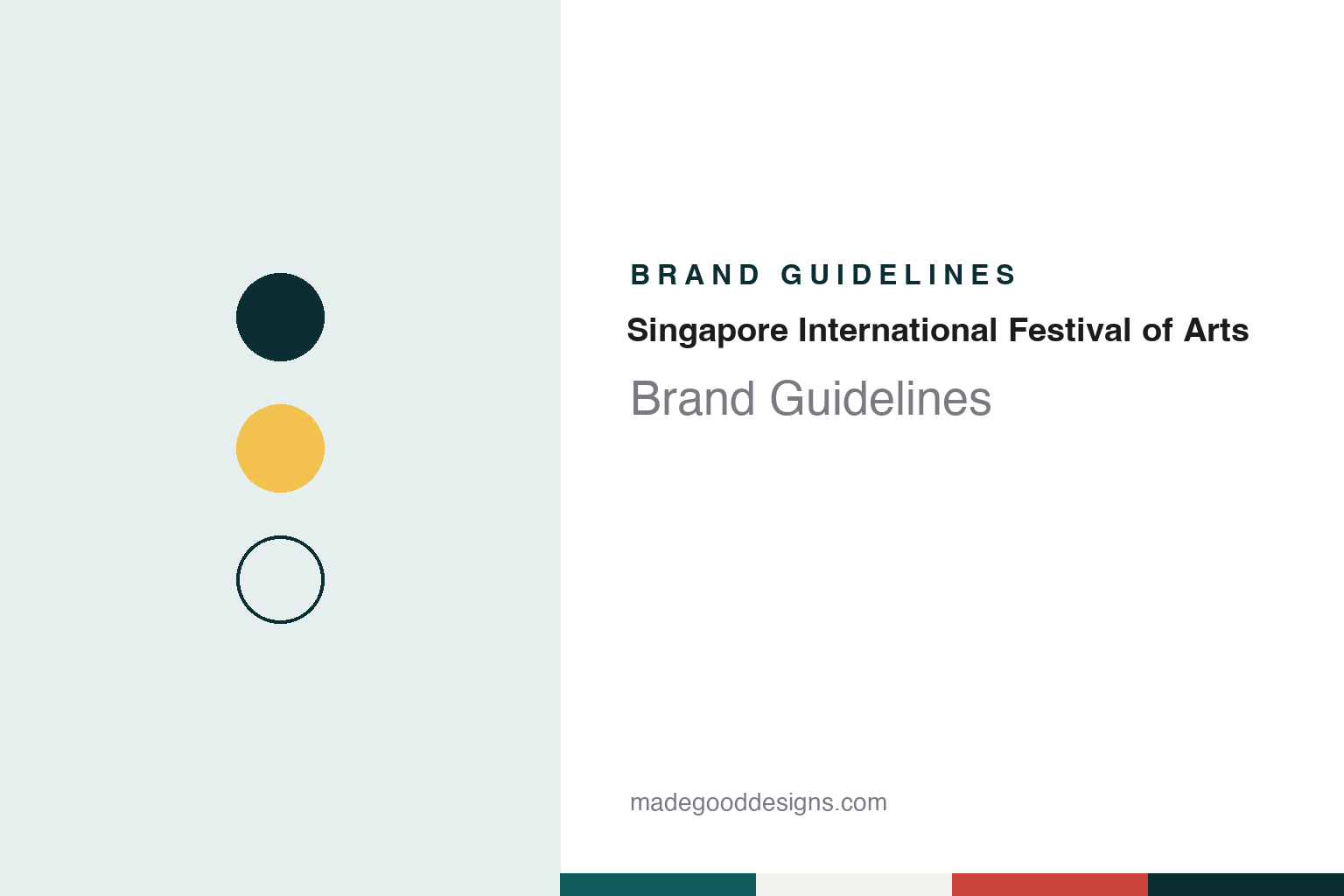
Two constants: a teal, yellow and red palette and a geometric grotesque sans register. Abstract homage — not a SIFA poster or mark; no logo, artwork or campaign image is reproduced.
The Singapore Arts Festival
A national festival from 1977, every two years and then every year.
The Singapore International Festival of Arts, known as SIFA, began as the Singapore Arts Festival in 1977. English Wikipedia says it started as a national festival to celebrate the arts of Singapore’s different communities and was organised by the National Arts Council. It was held every two years until 1999, when, according to the same article, which cites the National Library Board’s Infopedia, the Festival of Asian Performing Arts and the Festival of Arts were merged into a single annual event.
Several editions used outdoor sites. English Wikipedia records that the 2008 edition took water as its theme, opening with a performance staged in the Singapore River at Boat Quay from 23 to 25 May and closing with a show at Bedok Reservoir in June. The 2010 edition ran under the title Between You and Me and added an outreach programme, and the 2011 edition, held from 13 May to 5 June under the title I Want To Remember, opened with an outdoor performance in Esplanade Park.
The festival was run by staff of the arts council for most of these years. English Wikipedia lists the directors of each edition from 1982, with a single director for the 2010 to 2012 editions. In 2012, the same article says, the National Arts Council set up an independent company, Arts Festival Limited, to take over the organisation of the festival.
The way the festival relates to the arts council changed with that move. Writing in The Nation of Thailand on 19 September 2014, a critic reported that the festival had become independent and that, instead of being organised and produced by the National Arts Council, it was now commissioned by the council. The festival has kept that model since: its media releases of 2025 and 2026 describe SIFA as organised by the Arts House company and commissioned by the National Arts Council.
Colour
A new name in 2014.
The festival took its current name for the 2014 edition. Coconuts Singapore reported on 16 June 2014 that the Singapore International Festival of Arts, previously known as the Singapore Arts Festival, would run from 21 June to 21 September that year at venues including 72-13, the Drama Centre, the Victoria Theatre and the School of the Arts. The opening production was Facing Goya, an opera staged with the Singapore Symphony Orchestra.
The 2014 edition had a new director as well as a new name. The Nation reported that the theatre director Ong Keng Sen led the festival and directed its opening production, and that the performance programme ran for six weeks from 12 August under the theme “Legacy and the Expanded Classics”, after a strand of talks, discussions, film screenings and performances called OPEN that began in late June. Ong told the paper that the old short form, SAF, was also the abbreviation of the Singapore Armed Forces, and that the new name made clear that the event was both a Singapore festival and an international one. The paper said the edition spread 12 productions over six weeks and that about three quarters of the programme was international that year.
The festival has since been led by directors appointed for set terms. English Wikipedia lists Ong as festival director from 2014 to 2017, followed by directors for 2018 to 2021 and 2022 to 2025. A SIFA media release dated 5 February 2025 announced that Chong Tze Chien, a playwright and theatre director, would lead the festival from 2026 to 2028, and gave the dates of the 48th edition as 16 May to 1 June 2025.
The organiser has also changed its name. The February 2025 release was issued by Arts House Limited; by 2026 the festival’s website and media releases name the organiser as Arts House Group. The company describes itself as a not-for-profit body that presents two national festivals, SIFA and the Singapore Writers Festival, and manages venues including The Arts House at the Old Parliament, the Victoria Theatre and Victoria Concert Hall and the Drama Centre.
Typography
Festivals and the city.
International arts and theatre festivals usually present themselves through a place and a season before anything else. Many take the simplest possible name, a city followed by the word “festival”; others add a season, a language or a coined word, and the open-access events that grow up beside them often borrow the word “fringe” or “Off”. The name tends to stay fixed for decades, while almost everything else about the festival changes from one edition to the next.
Behind most of these names sits a non-profit body rather than a company: an association, a foundation, a trust or a company limited by guarantee, often with a board on which a city, a region or a national arts body takes an institutional seat. A director or artistic director, appointed for a set term, shapes each programme, and the festival’s character can shift noticeably when that post changes hands.
The programmes themselves are usually spread across a city. Theatre, dance, music and visual art share the dates, and the venues range from established theatres and concert halls to courtyards, cloisters, chapels, quarries, warehouses and streets. Two models sit side by side. A curated festival invites every production it shows; an open-access fringe lets any company register and find its own venue, so the programme grows from the bottom up and the organiser mainly coordinates listings, ticketing and information.
Visually, this makes a festival identity unusually changeable. The fixed elements are often few: the name, the dates and sometimes a signature venue or ritual. Around them, a new programme, poster or campaign image is made for each edition, often commissioned from a visual artist or a design studio, so that the festival looks different every year while remaining recognisable by its place in the calendar and in the city.
Aa
A geometric grotesque sans for a city festival. (Specimen set in Space Grotesk, a sans STAND-IN; NOT the SIFA logo or campaign lettering.)
SIFA
A village on the lawn and a title for each edition.
Each edition carries its own title. The 2014 festival used “Legacy and the Expanded Classics”, The Nation reported, and the festival’s 2026 materials ran under the call “Let’s Play!”, the first edition under Chong Tze Chien. That pattern, a title and a campaign made new for each festival, shapes how the event looks from year to year, rather than one fixed image repeated every season.
The 2026 edition centred on the Civic District. A SIFA media release dated 4 June 2026 said the festival ran from 15 to 30 May 2026 and that its Festival Village returned to the Empress Lawn, set against the Civic District and flanked by arts venues, in the release’s words, as a meeting place with free performances over three weekends. The release said the festival also reached Nexus in Punggol Digital District with a strand called Festival Play!Ground, and that it used nine venues in all. The organiser counted 21 local productions, 11 international works and 12 festival commissions, and said that more than 100,000 people attended across the edition.
The venues place SIFA among the city’s historic theatres. The festival’s 2026 venue listings include the Drama Centre Theatre, inside the National Library building, alongside venues in the Civic District, and the organiser manages the Victoria Theatre and Victoria Concert Hall and The Arts House nearby. The 2027 festival is listed on its website for 21 May to 5 June.
The festival also keeps a programme between editions. Its website lists a digital strand, SIFA Digital, with free online programmes listed as ongoing, a strand for children called Little SIFA, roadshows and a volunteer programme.
For a design guide, SIFA shows how a renamed festival can keep its history while each edition adds a new title and look. Compare the Singapore Writers Festival, presented by the same organiser, and the Edinburgh International Festival, which a critic in The Nation set alongside SIFA in 2014. For this guide we use a teal, a yellow and a red with a geometric sans, an unofficial interpretation; no product or logo is reproduced.
Explore & save
Keep Singapore International Festival of Arts’s identity on hand — save it to a board in the Made Good inspiration library.
SIFA identity set
Pin the civic teal, play yellow and curtain red palette and the geometric grotesque sans register to your own board.
Source & notes
Frequently Asked Questions
What font can I use to match the Singapore International Festival of Arts look?
This guide describes Singapore International Festival of Arts’ type as “A geometric grotesque sans for a city festival”. Its type specimen is set in Space Grotesk from Google Fonts as a stand-in; Space Grotesk is not Singapore International Festival of Arts’ own lettering.
What colours are in the Singapore International Festival of Arts palette?
This guide’s Singapore International Festival of Arts palette is Civic teal #0F5C5A, Night lawn #0B2E33, Colonnade white #F4F2EC, Play yellow #F2C14E and Curtain red #C8433A. The tones are the guide’s own unofficial interpretation, not official Singapore International Festival of Arts hex codes.
When was Singapore International Festival of Arts founded?
Singapore International Festival of Arts was founded in 1977 (as the Singapore Arts Festival), in Singapore.