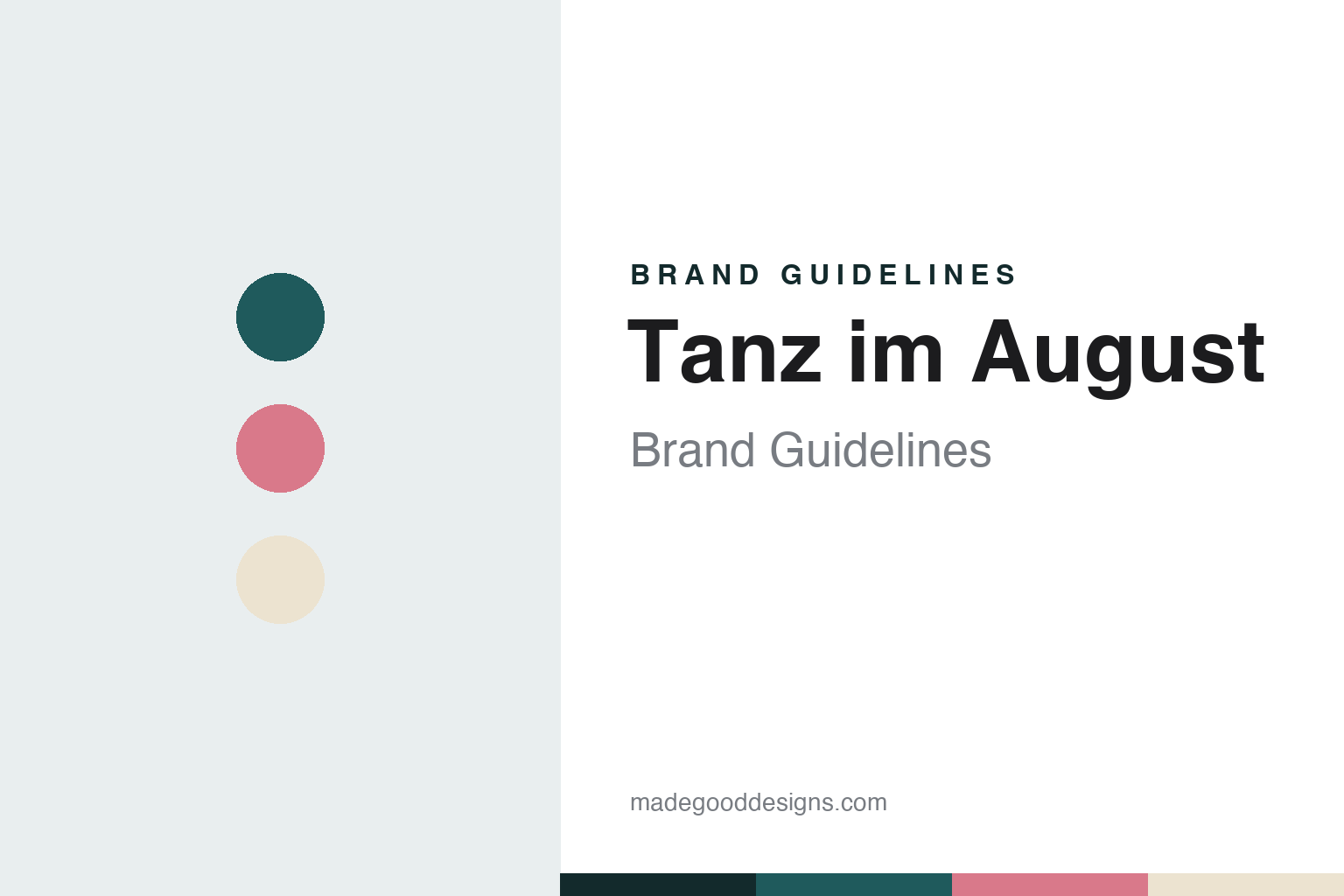
Tanz im August Brand Guidelines
Berlin’s summer festival of contemporary dance.
Aa
Two constants: a deep teal, coral pink and sand palette and a display serif register. Abstract homage — not a Tanz im August poster or mark; no logo or campaign image is reproduced.
West Berlin
A summer festival for contemporary dance.
Tanz im August — “Dance in August” — is an international festival of contemporary dance held each summer in Berlin. English and German Wikipedia say it was founded in 1988 by Nele Hertling in what was then West Berlin, and list her as its artistic director from 1989 to 2003. The festival gives 1989 as its founding year on its own “About us” page, and its numbering follows that date: it called its 2025 edition the 37th and its 2026 edition the 38th. Wikipedia records a 30th-anniversary programme in 2018, for which a journalist assembled an archive of the festival’s production history, now published in the festival’s online magazine.
The festival is presented today by HAU Hebbel am Ufer, the Berlin theatre whose three stages, HAU1, HAU2 and HAU3, form its base. Its press releases call it “a festival by HAU Hebbel am Ufer,” and its own pages describe Tanz im August as part of HAU, presenting work in collaboration with venues across the city.
After Hertling, Wikipedia’s list of artistic directors shows teams of four or five co-directors from 2003 to 2013, a single director in 2013, another from 2014 to 2022, and Ricardo Carmona from 2023; German Wikipedia says he was appointed for the 2023 edition. The Berliner Zeitung described Carmona in August 2024 as a Portuguese curator who had lived in Berlin for twelve years and had long been HAU’s dance curator, then directing the festival for the second time.
The festival’s about page describes its aims plainly: to show international companies alongside recent work by Berlin artists, with German and world premieres, and to invite audiences to meet the artists through talks and other formats.
Colour
Stages across the city.
The festival runs for several weeks around August and uses HAU’s three stages together with other venues across Berlin. Wikipedia names among them the Haus der Berliner Festspiele, the Sophiensæle, the Radialsystem, the Volksbühne, the Deutsches Theater and the Schaubühne am Lehniner Platz. The list changes from year to year: the festival’s closing release for 2025 named Alte Münze, HAU1, HAU2 and HAU3, the Haus der Berliner Festspiele, the Radialsystem, the Sophiensæle, the St. Elisabeth-Kirche and the open expanse of Tempelhofer Feld, where a free outdoor dance battle was staged with a partner organisation for the third time.
The programme mixes international companies with new projects by Berlin artists, collaborations with international guests, co-productions, world premieres and German premieres, Wikipedia says. Among the companies it lists as past guests is Tanztheater Wuppertal. In 2019, according to German Wikipedia, the 31st edition showed 70 performances of 31 productions at eleven venues, with 160 artists from 15 countries.
The 2020 edition moved largely online, German Wikipedia says. In 2021 a reduced 33rd edition used outdoor sites such as the open-air stage in Weißensee and the Gärten der Welt, while HAU2 and the Haus der Berliner Festspiele were closed for renovation.
Recent editions have presented fewer, larger productions. Der Tagesspiegel reported in June 2024 that the 36th edition comprised 18 productions, three of them world premieres and ten German premieres. For 2025 the festival reported 20 productions at ten venues over three weeks, 54 performances in all, and around 18,800 visitors, figures from its own closing release of 29 August 2025.
Around the stage programme sit smaller formats. Since 2016, Wikipedia says, a “Bibliothek im August” at HAU2 has offered books that festival artists recommend as having shaped their work; since 2014 the festival has published a Magazin im August; and from 2015 it showed a retrospective of a living artist every other year, each with a publication on that artist’s work. The 2025 release adds artist talks, workshops, audio description, relaxed performances, podcast episodes and festival parties.
The festival also works with partners from the city’s dance scene. Its 2025 closing release says a long-standing collaboration with Tanzfabrik Berlin continued that year with a jointly hosted workshop, that two further partner organisations ran workshops of their own, and that around 140 participants took part in the workshops in total. The same release counted more than 600 visiting professionals from the national and international dance scene and around 90 accredited journalists over the three weeks.
Typography
Design and documentation.
Dance festivals usually name themselves in one of a few plain ways. Some join a place to the word for dance, as Montpellier Danse and Tanz im August do; some add the word “festival,” as the American Dance Festival and the Holland Dance Festival do; and some use a coined or borrowed name, such as ImPulsTanz, Julidans or Jacob’s Pillow, which takes its name from a rock on a Massachusetts farm.
Their calendars are just as recognisable. Many run for a few weeks in summer, as Jacob’s Pillow does in the Berkshire hills and the American Dance Festival does in Durham, North Carolina; others fill the autumn, and a biennale, as its name says, comes round every second year. Festivals are run by their own organisations rather than by the companies that perform in them: Jacob’s Pillow has its own board, and it was the American Dance Festival’s board that accepted the bid to move the festival to Duke University in 1978.
Their programmes tend to mix invited companies with teaching. The American Dance Festival runs its summer school alongside its performances, as it has done in some form since its Bennington summers of the 1930s, and Jacob’s Pillow keeps a school, an archive and residencies on the same hilltop as its stages. Performances move between theatres, studios, outdoor stages and city sites, from a free outdoor stage facing the hills to a site-specific work staged in a downtown office tower.
Visually, a festival often renews itself each edition, with a new poster, campaign image or photograph of movement, while the name and the place stay fixed. This guide sets out what can be documented about each festival — when it began, who runs it, where it happens and how it describes its programme — and treats the colours and type shown here as an unofficial interpretation, not the festival’s own identity.
Aa
A light display serif for a festival named after its month. (Specimen set in Instrument Serif, a serif STAND-IN; NOT the Tanz im August logo.)
Tanz im August
A plain German name and a new image each summer.
The name is plain German and states the month: Tanz im August, “Dance in August.” The festival keeps the German name in its English materials too, and pairs it with the line “International Festival Berlin.” Each edition brings a new campaign image. Der Tagesspiegel described the 2024 image campaign as a varied underwater flora of algae and sea anemones, presented by the artistic director and the festival’s dramaturg at a press talk in HAU2. The colours and type in this guide are our own interpretation rather than the festival’s.
The dates stay close to the name. The festival gave the 37th edition as 13 to 30 August 2025, and its website says the 38th edition took place from 13 to 29 August 2026.
For a design guide, Tanz im August shows how a festival can take its whole identity from a month and a city, renewing its image each summer while the name stays fixed. Compare ImPulsTanz, Vienna’s summer festival of performances and workshops, and Tanztheater Wuppertal, one of the companies Wikipedia lists among the festival’s guests. For this guide we use a deep teal, a coral pink and a warm sand with a serif, an unofficial interpretation; no product or logo is reproduced.
Explore & save
Keep Tanz im August’s identity on hand — save it to a board in the Made Good inspiration library.
Tanz im August identity set
Pin the Tanz im August deep teal, coral pink and sand palette and the display serif register to your own board.
Source & notes
Frequently Asked Questions
What font can I use to match the Tanz im August look?
This guide describes Tanz im August’s type as “A light display serif for a festival named after its month”. Its type specimen is set in Instrument Serif from Google Fonts as a stand-in; Instrument Serif is not Tanz im August’s own lettering.
What colours are in the Tanz im August palette?
This guide’s Tanz im August palette is Deep teal #1F5A5C, Night water #132A2C, Coral pink #D9798A, August sand #ECE3D0 and Paper #F7F5F0. The tones are the guide’s own unofficial interpretation, not official Tanz im August hex codes.
When was Tanz im August founded?
Tanz im August was founded in 1988 (Wikipedia) / 1989 (festival), in West Berlin, Germany.
Who founded Tanz im August?
Tanz im August was founded by Nele Hertling in 1988 (Wikipedia) / 1989 (festival).