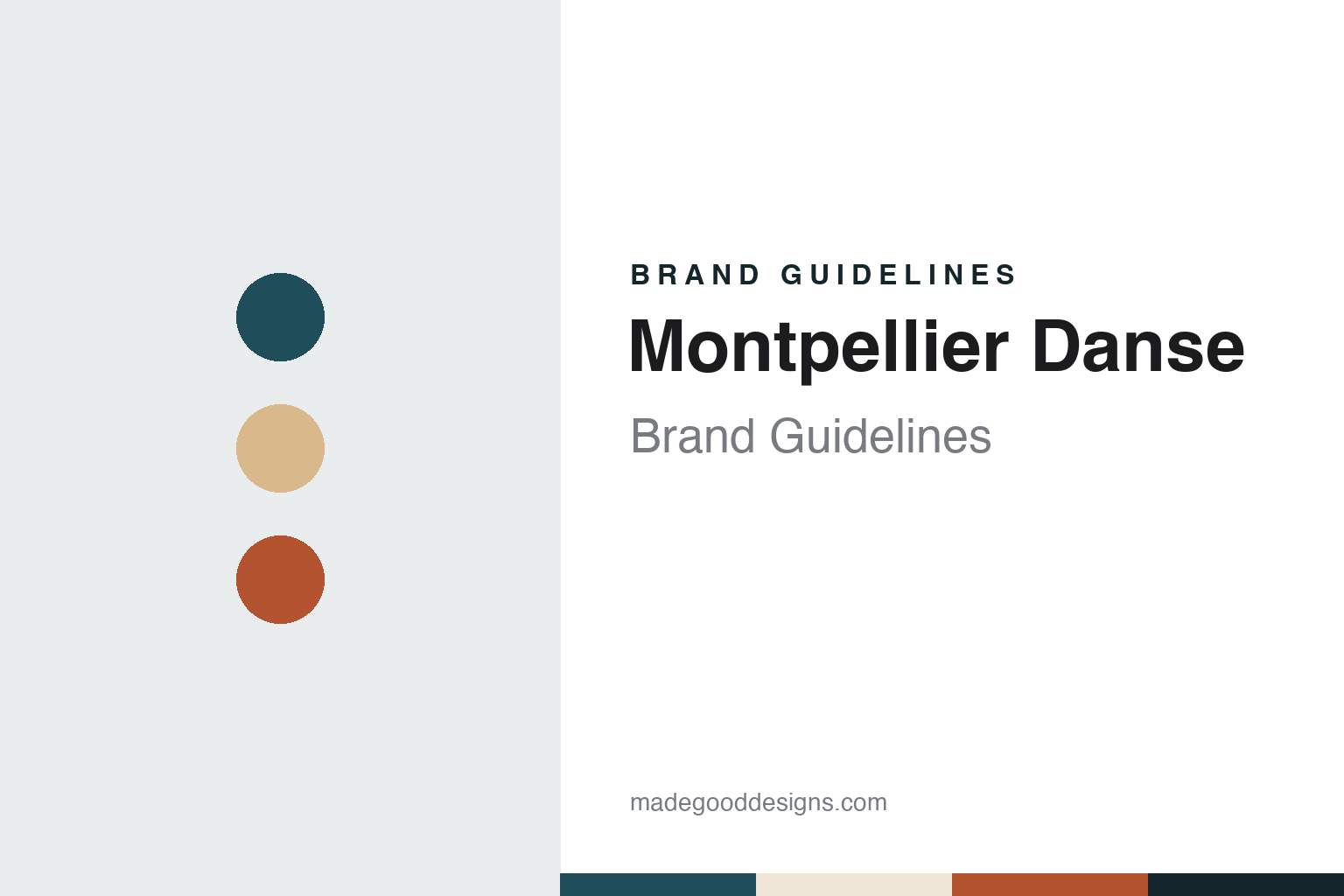
Montpellier Danse Brand Guidelines
A summer dance festival that grew up inside a former convent.
Aa
Two constants: a teal, limestone and terracotta palette and an open sans display register. Abstract homage — not a Montpellier Danse poster or mark; no logo, photograph or campaign image is reproduced.
A festival born with a choreographic centre
A choreographer, a city and a summer in 1981.
Montpellier Danse is a contemporary dance festival held each summer in Montpellier, in the south of France. French Wikipedia says it was created in July 1981 on the impulse of the choreographer Dominique Bagouet, who had just taken charge of the new Centre chorégraphique national de Montpellier, with strong support from the city. The New York Times, in a 2024 interview, gives the same founding year and says Bagouet asked Jean-Paul Montanari, who was then working in theatre, to come and help him.
French Wikipedia says Montanari has directed the festival since 1983. The organisation’s own history, published on the Agora website, says Bagouet and Montanari programmed the editions of the 1980s together, and that Bagouet soon handed Montanari the running of the new festival. The same history describes the early aim as winning a wide public for an art form that had been little shown in the region, with classical, neo-classical and traditional dance from many countries on the bill alongside new French work.
The festival grew within a national wave of new regional choreographic centres. The New York Times describes the 1980s in France as a period when such centres, each led by a choreographer, were set up across the country, and says Montpellier’s was led by Bagouet. French Wikipedia places the festival in the same movement, as an extra stage for the Nouvelle danse française, the new French dance of which Bagouet was one of the main figures.
From the start, performances were spread across different venues in the city, French Wikipedia says. Its history page adds that the festival and season now use about a dozen halls besides their own building. In 1996 a winter season was added to the summer festival, according to both French Wikipedia and the organisation, so that Montpellier Danse became a year-round programme rather than a single summer event.
Colour
From the Cour des Ursulines to the Agora.
The festival’s home is a building in the old town of Montpellier that began as a convent. The Agora’s own timeline says the Ursuline sisters founded a convent there in 1641 and that the present building went up between 1654 and 1680, with a garden added in 1680 on the spot where the open-air theatre now stands. In the nineteenth century a round stone courtyard, the rotunda, was built in local Castries stone.
The dance story of the building starts in 1986. That year, the timeline says, the city of Montpellier bought the site and the festival put up a stage and seating in the rotunda, then called the Cour des Ursulines, to show performances there. The building was listed as a historic monument in 1991. Restoration came in stages: the choreographic centre moved into the earliest restored part in 1997, Montpellier Danse moved into the second wing in 2001, and the whole building was finished in 2010 as the Agora, cité internationale de la danse. The organisation says the completed building added two studios and around a dozen rooms where visiting artists can stay, and that the courtyard became a summer theatre, the Théâtre de l’Agora. A West Pavilion with a further studio and exhibition room followed in 2024.
The New York Times credits Montanari with persuading the city to give the festival and the choreographic centre a permanent home in the Agora. In an April 2026 interview on the Agora website, the new directors describe the building as having eight studios and an open-air theatre.
The programme has long looked beyond France. The organisation’s history says the Merce Cunningham company came in 1985, part of a turn towards the American modern masters that began in 1982; The New York Times also dates Cunningham’s first visit to 1985, and reports that his piece Ocean filled a 6,000-seat theatre at the festival in 1998. The same history notes a hip hop strand from 1991, revisited in 2004, and a look back at American post-modern dance in 1996.
Typography
Design and documentation.
Dance festivals usually name themselves in one of a few plain ways. Some join a place to the word for dance, as Montpellier Danse and Tanz im August do; some add the word “festival,” as the American Dance Festival and the Holland Dance Festival do; and some use a coined or borrowed name, such as ImPulsTanz, Julidans or Jacob’s Pillow, which takes its name from a rock on a Massachusetts farm.
Their calendars are just as recognisable. Many run for a few weeks in summer, as Jacob’s Pillow does in the Berkshire hills and the American Dance Festival does in Durham, North Carolina; others fill the autumn, and a biennale, as its name says, comes round every second year. Festivals are run by their own organisations rather than by the companies that perform in them: Jacob’s Pillow has its own board, and it was the American Dance Festival’s board that accepted the bid to move the festival to Duke University in 1978.
Their programmes tend to mix invited companies with teaching. The American Dance Festival runs its summer school alongside its performances, as it has done in some form since its Bennington summers of the 1930s, and Jacob’s Pillow keeps a school, an archive and residencies on the same hilltop as its stages. Performances move between theatres, studios, outdoor stages and city sites, from a free outdoor stage facing the hills to a site-specific work staged in a downtown office tower.
Visually, a festival often renews itself each edition, with a new poster, campaign image or photograph of movement, while the name and the place stay fixed. This guide sets out what can be documented about each festival — when it began, who runs it, where it happens and how it describes its programme — and treats the colours and type shown here as an unofficial interpretation, not the festival’s own identity.
Aa
An open, wide sans for a festival that spreads across a city. (Specimen set in Syne, a sans STAND-IN; NOT the Montpellier Danse logo or lettering.)
Montpellier Danse
Numbered editions and a new structure.
The festival has played with how it names itself. Its history page says that around the turn of the 2000s the yearly count was restarted, so that editions were called Montpellier Danse 01, Montpellier Danse 02 and so on. Today the organisation counts from 1981 again: the April 2026 interview on the Agora website calls that summer’s festival the 46th edition.
The organisation changed shape in 2025. The Agora timeline says that in September 2025 the two associations that had shared the building, Montpellier Danse and the Centre chorégraphique national de Montpellier Occitanie, merged into a single body, the Agora, Cité Internationale de la Danse, which now runs the festival, the season, the choreographic centre and its training courses. The New York Times reported in 2024 that Montanari had announced he would step down after directing the festival for 41 years. The Agora website now presents a collegial direction of four co-directors, and the 2026 festival was programmed by that team, according to the April 2026 interview, which also mentions a prelude in nearby Sète and several shows at the Domaine d’O.
No festival poster, photograph or lettering is reproduced in this guide. What the history offers a designer is a set of clear facts to build on: a stone courtyard turned into a stage, a festival that moved through a dozen halls, and a calendar that pairs a summer festival with a winter season.
For a design guide, Montpellier Danse shows how a festival identity can lean on a place — a former convent with a round courtyard — rather than on a single fixed image. Compare the Biennale de la danse de Lyon, which French Wikipedia says was modelled partly on Montpellier Danse, and the Merce Cunningham Dance Company, a regular guest from 1985. For this guide we use a deep teal, warm limestone and terracotta with a wide sans, an unofficial interpretation; no product or logo is reproduced.
Explore & save
Keep Montpellier Danse’s identity on hand — save it to a board in the Made Good inspiration library.
Montpellier Danse identity set
Pin the Montpellier Danse teal, limestone and terracotta palette and the open sans display register to your own board.
Source & notes
Frequently Asked Questions
What font can I use to match the Montpellier Danse look?
This guide describes Montpellier Danse’s type as “An open, wide sans for a festival that spreads across a city”. Its type specimen is set in Syne from Google Fonts as a stand-in; Syne is not Montpellier Danse’s own lettering.
What colours are in the Montpellier Danse palette?
This guide’s Montpellier Danse palette is Garrigue teal #1F4E5A, Night stone #14262B, Limestone #EFE6D8, Terracotta #B4532F and Sand #D9B98C. The tones are the guide’s own unofficial interpretation, not official Montpellier Danse hex codes.
When was Montpellier Danse founded?
Montpellier Danse was founded in July 1981, in Montpellier, France.
Who founded Montpellier Danse?
Montpellier Danse was founded in July 1981 by Dominique Bagouet, choreographer.
Where is Montpellier Danse based?
Montpellier Danse is based in Agora, Cité Internationale de la Danse (former Ursuline convent).