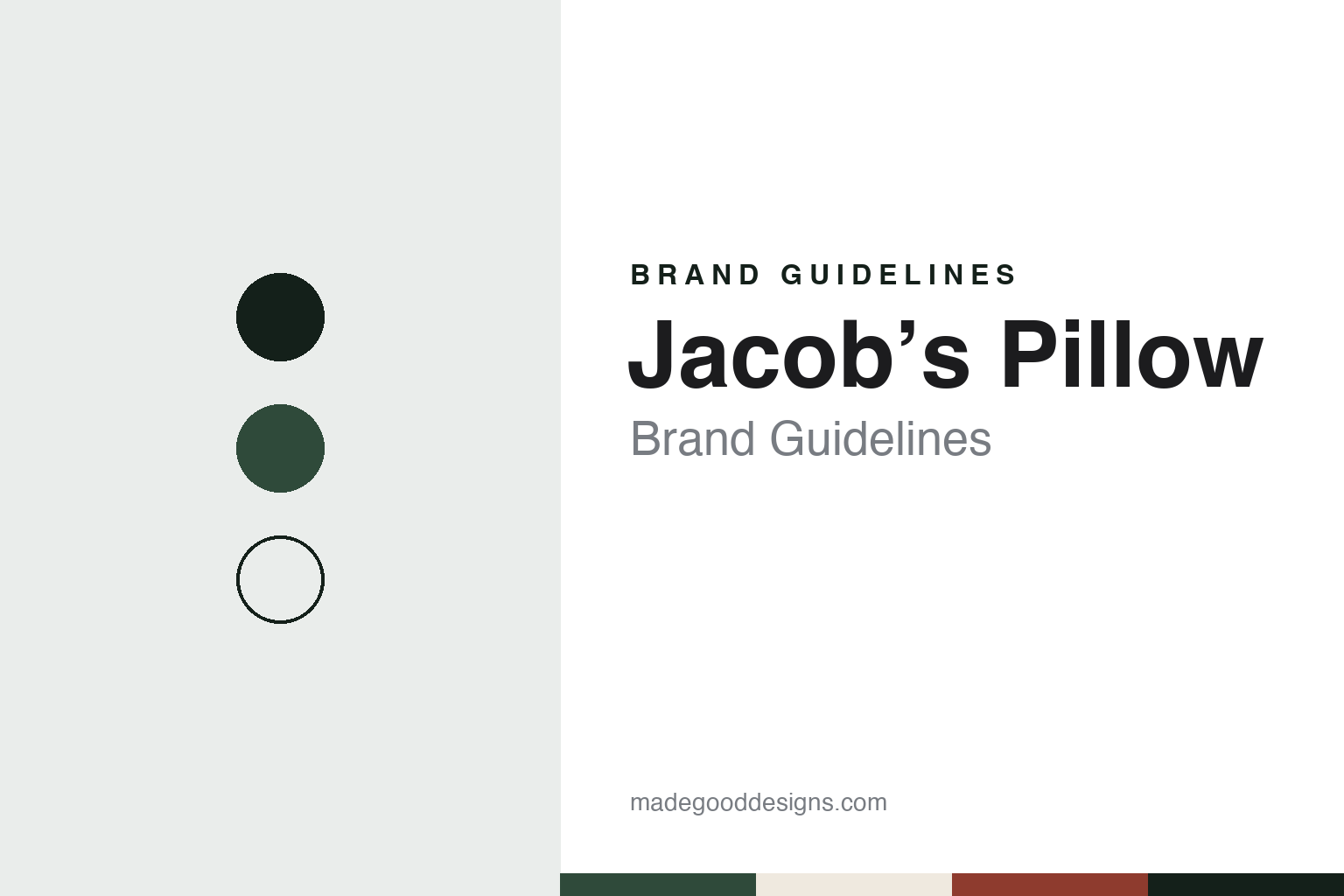
Jacob’s Pillow Brand Guidelines
Ted Shawn’s 1931 hilltop farm and its summer dance festival.
Aa
Two constants: a Jacob’s Pillow hill green and barn red palette and a Classic serif register. Abstract homage — not a Jacob’s Pillow asset or mark; no poster, photograph or logo is reproduced.
A farm in Becket
Ted Shawn’s hilltop retreat in the Berkshires.
Jacob’s Pillow is a dance centre, school and performance site in Becket, Massachusetts, in the Berkshire hills of western Massachusetts. Its name is older than its dance. English Wikipedia says the hilltop farm was settled in 1790, that the zigzag road climbing to it became known as “Jacob’s Ladder,” after the Biblical story, and that a pillow-shaped rock on the property gave the farm the name “Jacob’s Pillow.”
The dancer and choreographer Ted Shawn bought the farm in 1931 as a dance retreat, English Wikipedia says. Shawn had earlier led the Denishawn company and school, which, the same article says, trained dancers including Martha Graham. On the farm he built up an all-male company, Ted Shawn and His Men Dancers, whose members put up many of the early buildings on the site. English Wikipedia’s article on Shawn dates the company’s opening performance at the farm to 14 July 1933 and its last there, a homecoming performance, to 31 August 1940. The same article says the teas Shawn held for visitors grew, over time, into the Jacob’s Pillow Dance Festival.
In 1940 Shawn leased the property to another dance teacher for a summer festival. Supporters then raised money to buy the farm and to build a theatre, and the festival was revived with Shawn kept on as its director, English Wikipedia says. The Ted Shawn Theatre opened on 9 July 1942, according to American Theatre, which gave the date in November 2024. In 1967 the board appointed a longtime collaborator of Shawn’s as executive director, while Shawn kept the title of founding director.
Colour
Three stages on a hill.
The festival runs through the summer on the Pillow’s campus. American Theatre reported in November 2024 that the 2025 edition, the festival’s 93rd summer, was set for nine weeks, from 25 June to 24 August 2025, with performances on the campus alongside streamed and online events.
The oldest of the three is the Ted Shawn Theatre, which American Theatre called the Pillow’s flagship festival venue. English Wikipedia says it was renovated in 2022, gaining an orchestra pit, a deeper stage, more height above the stage and a new lower level with dressing rooms and wardrobe space. The second is outdoors: the Henry J. Leir Stage, home of the Inside/Out performance series of free shows by established and emerging artists, set against a view across the Berkshire hills, English Wikipedia says.
The third is the Doris Duke Theatre. The original Duke, a flexible black-box studio theatre, opened in 1990, Pointe reported. A new building on the same site opened with a week of performances from 6 to 13 July 2025, Pointe reported that month. It was designed by the Dutch architecture firm Mecanoo, working with the architecture and landscape practice Marvel and the theatre and acoustics consultants Charcoalblue, and it seats between 220 and 400 people. American Theatre gave its size as about 20,000 square feet, against roughly 8,500 for the earlier building. According to Pointe, the design rests on four pillars — Indigenous design values, environmental sustainability, accessibility and technology — and the landscape includes an Indigenous garden reflecting the Muh-he-con-ne-ok, or Mohican, history of the land. Its technical systems include spatial sound, livestreaming and new video and lighting equipment, the magazine said.
Teaching sits beside the stages. The School at Jacob’s Pillow, based in the Perles Family Studio, runs a conservatory-style curriculum of five programmes — Ballet, Contemporary Traditions, Cultural Traditions and Tap/Musical Theatre, plus a choreography fellowship — according to English Wikipedia, which says its dancers take studio classes six days a week, give weekly public performances and attend the festival’s shows.
Typography
Dance festivals.
Dance festivals usually name themselves in one of a few plain ways. Some join a place to the word for dance, as Montpellier Danse and Tanz im August do; some add the word “festival,” as the American Dance Festival and the Holland Dance Festival do; and some use a coined or borrowed name, such as ImPulsTanz, Julidans or Jacob’s Pillow, which takes its name from a rock on a Massachusetts farm.
Their calendars are just as recognisable. Many run for a few weeks in summer, as Jacob’s Pillow does in the Berkshire hills and the American Dance Festival does in Durham, North Carolina; others fill the autumn, and a biennale, as its name says, comes round every second year. Festivals are run by their own organisations rather than by the companies that perform in them: Jacob’s Pillow has its own board, and it was the American Dance Festival’s board that accepted the bid to move the festival to Duke University in 1978.
Their programmes tend to mix invited companies with teaching. The American Dance Festival runs its summer school alongside its performances, as it has done in some form since its Bennington summers of the 1930s, and Jacob’s Pillow keeps a school, an archive and residencies on the same hilltop as its stages. Performances move between theatres, studios, outdoor stages and city sites, from a free outdoor stage facing the hills to a site-specific work staged in a downtown office tower.
Visually, a festival often renews itself each edition, with a new poster, campaign image or photograph of movement, while the name and the place stay fixed. This guide sets out what can be documented about each festival — when it began, who runs it, where it happens and how it describes its programme — and treats the colours and type shown here as an unofficial interpretation, not the festival’s own identity.
Aa
A classic serif — a hilltop farm, a road and a rock. (Specimen set in Fraunces, a serif STAND-IN; NOT the Jacob’s Pillow logo.)
Jacob’s Pillow
A landmark site with its own archive.
The site itself carries a federal designation. The National Park Service’s list of National Historic Landmarks records the Jacob’s Pillow Dance Festival in Becket as designated on 27 May 2003; English Wikipedia describes the listing as a National Historic Landmark District and quotes the designation’s description of “an exceptional cultural venue that holds value for all Americans.”
The Pillow also keeps its own record. English Wikipedia says the core of its archives was assembled by Shawn himself, that volunteers and staff have added to it since the 1930s, and that a director of preservation post was created in 1991. The collection takes in films and videos reaching back to 1894, historic photographs and negatives, printed material, trunks of costumes dating from 1915 and a library of books, and much of it is catalogued and reachable through the Pillow’s website. It is housed in Blake’s Barn, an 18th-century building moved to the site and refitted for preservation work, with space for exhibitions and lectures and a reading room with video stations, according to the same article.
The organisation is led today by Pamela Tatge, its executive and artistic director, as named by American Theatre in November 2024 and by Pointe in July 2025. Both describe the festival as a summer of performances spread across the campus, with the new Doris Duke Theatre set aside for work that mixes dance and technology.
For a design guide, Jacob’s Pillow shows how a festival can take its name, and much of its character, from a place: a farm road, a rock and a hilltop of barns, studios and stages. Compare the American Dance Festival, another American summer dance festival that began in the 1930s, and the Martha Graham Dance Company, founded by a dancer trained at Denishawn. For this guide we use a hill green, a barn red and a linen white with a serif, an unofficial interpretation; no product or logo is reproduced.
Explore & save
Keep Jacob’s Pillow’s identity on hand — save it to a board in the Made Good inspiration library.
Jacob’s Pillow identity set
Pin the Jacob’s Pillow hill green and barn red palette and the Classic serif register to your own board.
Source & notes
Frequently Asked Questions
What font can I use to match the Jacob’s Pillow look?
This guide describes Jacob’s Pillow’s type as “A classic serif — a hilltop farm, a road and a rock”. Its type specimen is set in Fraunces from Google Fonts as a stand-in; Fraunces is not Jacob’s Pillow’s own lettering.
What colours are in the Jacob’s Pillow palette?
This guide’s Jacob’s Pillow palette is Hill green #2F4A3A, Night ink #14201A, Barn linen #EFE9DF, Barn red #8E3B2E and Paper #F8F6F1. The tones are the guide’s own unofficial interpretation, not official Jacob’s Pillow hex codes.
Who founded Jacob’s Pillow?
Jacob’s Pillow was founded by Ted Shawn.