Lux Helsinki Brand Guidelines
Light art for the darkest weeks of the Helsinki year.
Aa
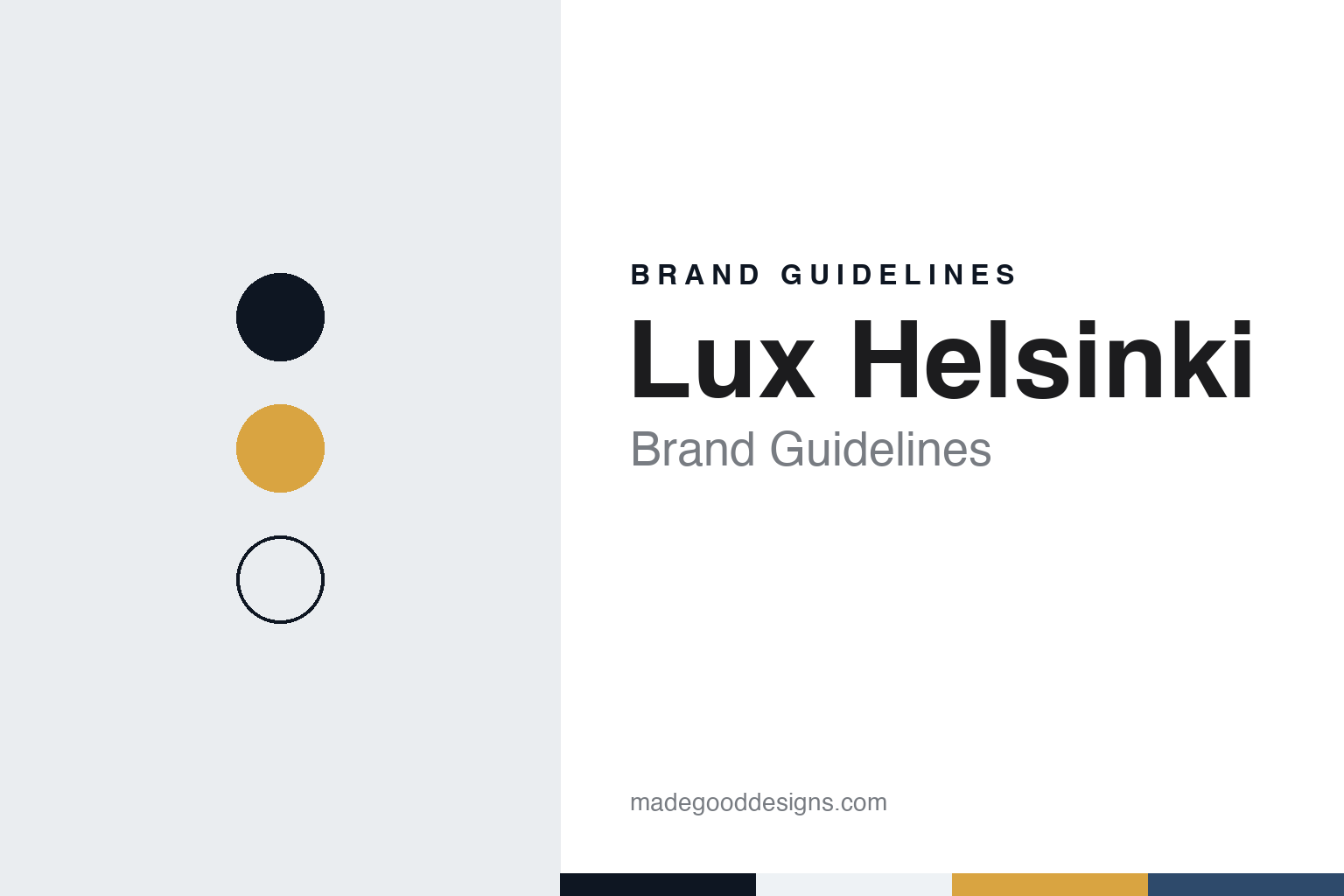
Two constants: a polar night, snow and lantern amber palette and a soft display serif register. Abstract homage — not a Lux Helsinki artwork or mark; no installation, logo or poster is reproduced.
Light in January
A city festival in the dark weeks after New Year.
Lux Helsinki is a light art festival held each year in Helsinki at the start of January, when the Finnish capital has only a few hours of daylight. Finnish Wikipedia dates the first event to 2009 and says it was founded by the City of Helsinki and the municipal energy company Helsingin Energia. The national broadcaster Yle reported in January 2016 that light events had been held in Helsinki for more than twenty years and that the festival had run under the name Lux Helsinki since 2012; the festival’s own website also dates it from 2012.
The early editions centred on a single artist. Finnish Wikipedia says the 2009 event showed Valon vuodenaika (“Season of Light”) by the lighting designer Mikki Kunttu on Senate Square, and that in 2010 Kunttu’s works were shown again, at Parliament House and on Senate Square. From 2011 the programme widened to several artists from Finland and abroad, at sites including Kaisaniemi Park and Unioninkatu.
The format grew from there. In 2012, according to Finnish Wikipedia, Hesperia Park became a Lantern Park filled with lamps and lanterns by different makers, and a work lit the tower of the Olympic Stadium. The 2013 edition had 13 works, among them a moving light work on a tram, the Lux Ratikka, made by students of the Theatre Academy, and drew more than 100,000 visitors, the same article says.
In 2014, Finnish Wikipedia says, the sixth edition ran from 4 to 8 January at 11 sites, from Senate Square and the Music Centre to the National Museum, and added an indoor light art exhibition, Lux IN, in the Cable Factory. Yle reported 220,000 visitors for the 2015 edition and, in January 2016, more than 400,000 between the Wednesday and the Saturday of that year’s festival, which it described as organised by the City of Helsinki.
Colour
Routes, lanterns and projections.
Lux Helsinki is laid out as a walk. Finnish Wikipedia describes a programme of buildings lit in changing colours, video projections with music, kinetic light works and installations by Finnish and international artists, mostly in the city centre, on view roughly from five to ten in the evening and free to visit, either on a self-guided walk or on a guided tour. English Wikipedia also gives free entry and the City of Helsinki as organiser.
Some works have travelled to Helsinki from other festivals. Finnish Wikipedia says that the 2014 edition showed Corazón, a heart-shaped work by a Spanish fashion designer and the production company D-Facto, on the upper steps of Helsinki Cathedral, which had been seen at Lyon’s Fête des Lumières in 2012, and Urban Flipper by the French studio CT Light Concept, which turned the façade of the New Student House into a giant pinball game first shown in Lyon in 2011.
The festival’s artistic direction has passed between lighting professionals. Finnish Wikipedia names the Theatre Academy’s professor of lighting design and a lighting designer and theatre consultant as earlier artistic directors, and the light artist Juha Rouhikoski as artistic director from 2023. In September 2026 the festival announced that the light-art curator Mia Kivinen, a consulting curator for Lux since 2022, had been appointed artistic director; the same announcement said the festival is organised and produced by the Helsinki Events Foundation (Helsingin tapahtumasäätiö).
The 2016 edition, Finnish Wikipedia says, broadened the event into a city festival, with street food on Senate Square and a pedestrianised Annankatu, a light-themed panel discussion, short films, workshops and free daily guided walks in Finnish, Swedish, English and Russian. The Lantern Park returned in later years: in 2018, the same article says, lanterns made by students of Aalto University and local schools hung in Koulupuistikko.
Typography
Light festivals and their cities.
Light festivals usually name themselves in one of two ways. Some join a city’s name to a word for light, as Lyon’s Fête des Lumières and the Festival of Lights in Berlin do; others use a coined word, as Vivid Sydney and GLOW Eindhoven do, with the city added alongside. Most are held on autumn or winter evenings, when it is dark early: Lyon’s festival runs over four evenings around 8 December, while Sydney’s takes place in May and June, the start of the southern winter.
The organisers are mostly public bodies. The Fête des Lumières is organised by the City of Lyon, and Vivid Sydney is owned, managed and produced by Destination NSW, the New South Wales Government’s tourism and major events agency. Other festivals are run by foundations, non-profit organisations or production companies working with their city.
The format is broadly shared. Visitors follow a route of installations through a city centre, usually on foot, and the largest works are projections on landmark buildings: a cathedral, a town hall, an opera house. The works come from invited artists, lighting designers and studios, and many festivals name each work and its makers in a printed or online programme and on a map of the route.
Each edition brings new works and, often, a new theme, poster or campaign image, so a festival’s look can change completely from year to year while its name, its route and its main buildings stay the same. This guide sets out what can be checked about each festival: who started it and when, who organises it now, where it takes place and how its works and imagery are described in dated sources.
Aa
A soft display serif for a winter evening walk. (Specimen set in Fraunces, a serif STAND-IN; NOT the Lux Helsinki logo.)
Lux Helsinki
Six winter days and a theme.
The 2026 edition ran for six days, from 6 to 11 January, which the festival says was a longer run made at the public’s request. In its closing report the festival gave an estimate of about 450,000 visitors and listed 20 works at sites including Kansalaistori, Hietalahdentori, the Old Church Park and the Kanneltalo cultural centre, under the theme “Stop time!”; light art in that theme was also shown in ten city-centre art galleries.
The same report named Chapters, a projection by a Finnish artist on Hietalahdentori, and Mycelium Network, a British artist’s installation of fibre-optic strands tracing a fungal network through the Old Church Park, among the works most visited. It also said that some festival works were being kept as permanent public light art through a partnership with the city’s urban environment division: Soleil nuit Albireo by a French artist was to stay on Hietalahdentori from the 2026 edition, alongside two works kept from 2025.
Finnish Wikipedia’s captions add other pieces from recent years, among them Whale Ghost by the French studio Pitaya, a kinetic work about 18 metres long that moved in the wind above visitors in Töölönlahti Park in 2023.
The festival’s look therefore depends less on a fixed graphic system than on its setting: snow, early darkness, the granite and stucco of the centre, and the shifting colours and projections laid over them for a few nights each January.
For a design guide, Lux Helsinki shows how a city-run festival can build its identity on season and place, with each edition adding a theme to the same winter streets. Compare Lyon’s Fête des Lumières, whose works have travelled to Helsinki, and Helsinki Design Week, another festival in the same city. For this guide we use a polar night blue, snow and a lantern amber with a serif, an unofficial interpretation; no product or logo is reproduced.
Explore & save
Keep Lux Helsinki’s identity on hand — save it to a board in the Made Good inspiration library.
Lux Helsinki identity set
Pin the Lux Helsinki polar night, snow and lantern amber palette and the soft display serif register to your own board.
Source & notes
Frequently Asked Questions
What font can I use to match the Lux Helsinki look?
This guide describes Lux Helsinki’s type as “A soft display serif for a winter evening walk”. Its type specimen is set in Fraunces from Google Fonts as a stand-in; Fraunces is not Lux Helsinki’s own lettering.
What colours are in the Lux Helsinki palette?
This guide’s Lux Helsinki palette is Polar night #0E1622, Harbour blue #2E4A6B, Lantern amber #D9A441, Snow #EEF2F5 and Paper #F8F7F5. The tones are the guide’s own unofficial interpretation, not official Lux Helsinki hex codes.
Who founded Lux Helsinki?
Lux Helsinki was founded by City of Helsinki and Helsingin Energia.