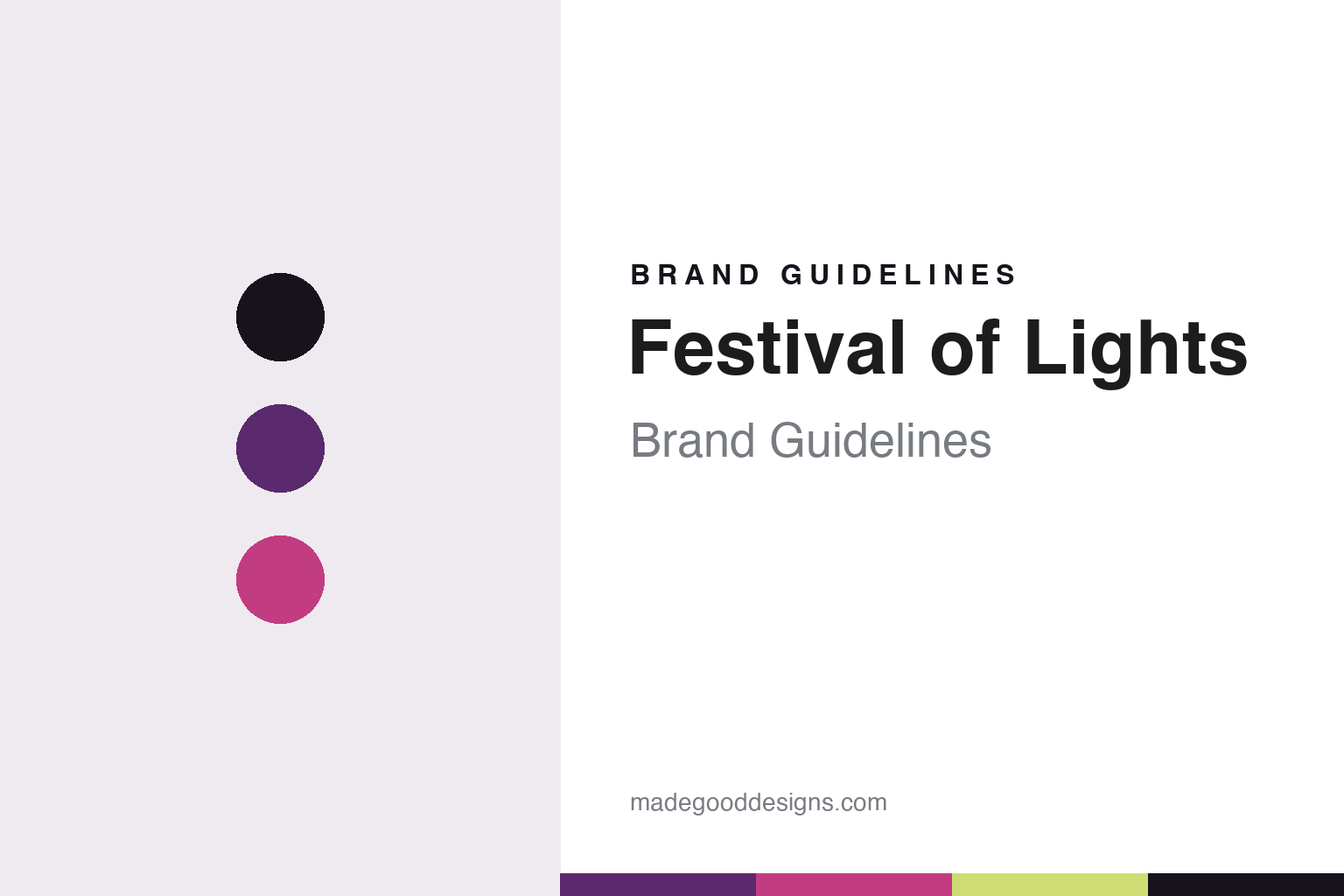
Festival of Lights Brand Guidelines
Berlin’s autumn nights of projected landmarks.
Aa
Two constants: a violet, magenta and lime palette and a projection sans register. Abstract homage — not a Festival of Lights asset; no projection, poster or logo is reproduced.
Berlin, 2005
A lighting designer, an agency and a city’s landmarks.
The Festival of Lights — styled “Festival of Lights Berlin” on its own English pages — first took place in Berlin in 2005. German Wikipedia names its initiators and organisers up to 2009 as the City Stiftung Berlin, the property investor Union Investment Real Estate, the lighting designer Andreas Boehlke and the event organiser Birgit Zander with her agency Zander & Partner Event-Marketing. Since 2010, it says, Zander & Partner has been the sole producer, and the organiser has been Festival of Lights International Productions GmbH. The festival’s key facts for 2026 give the same pairing: the company as organiser, Zander & Partner as producer and Birgit Zander as artistic director.
The format was set early: landmarks, buildings, streets and squares lit with illuminations, light-art projections and, increasingly, 3D video mapping, for around ten autumn nights, free to view. German Wikipedia describes the 2008 edition opening on 14 October with a light-fountain show, “Flames of Water,” in front of Humboldt University in Mitte, with 49 landmarks and squares lit or projected on, the towers of the Nikolaikirche lit in white for the first time and a 7.5-kilometre “Light Run” past illuminated buildings. Museums, theatres and long-established businesses opened their doors for a night of light-themed events.
Die Welt previewed the seventh edition in October 2011: more than 80 illuminations and installations over twelve nights, opening at Potsdamer Platz. There an oversized sculpted mask in front of the Kollhoff Tower received projected portraits of visitors, photographed in the nearby arcades, as “Faces of Berlin.” The painter and media designer Teresa Mar covered the Berliner Dom in changing colours inspired by a chameleon, and Boehlke, described by the paper as a co-initiator involved from the start, curated a “Light Gallery” on the Kurfürstendamm for the boulevard’s 125th anniversary, alongside lighting at the Fernsehturm, the Siegessäule, the Tempodrom and the Brandenburg Gate.
Colour
A motto a year, landmarks every year.
Each edition has its own motto, German Wikipedia says. In 2017 it was “Creating Tomorrow,” with work at the Berliner Dom; that year brought a 360-degree staging on Bebelplatz with a 3D video mapping for the 275th anniversary of the State Opera, and a first 3D video mapping on the Altes Stadthaus. English Wikipedia gives 2.3 million visitors for that thirteenth edition, citing visitBerlin.
A fixed part of the programme is a projection-mapping strand in which artists from many countries present 3D video mappings; German Wikipedia puts the number of sites lit across the city at between 40 and 50. The organiser lists further events within the festival — a grand opening, concerts, a night of open doors and guided “LightSeeing” tours.
The Berliner Kurier reported on the 21st edition in October 2025: from 8 to 15 October, from seven to eleven each evening, at about 40 sites under the motto “Let’s shine together.” The Fernsehturm became a screen for six artist studios from six countries; Potsdamer Platz, the Brandenburg Gate and the Berliner Dom were lit, the cathedral that year also inside, where three-dimensional light projections accompanied ambient sets by DJs as “Dome of Beats and Lights.” New sites included the THF Tower at the former Tempelhof airport, and the Konzerthaus on the Gendarmenmarkt returned after a longer pause.
The 22nd edition ran from 9 to 18 October 2026 under the motto “Colours of Love,” the festival website says. The city portal berlin.de described ten artists and creative studios interpreting the theme on the Berliner Dom, building the cathedral’s curved forms, columns and reliefs into their projections, with a 180-degree staging on Bebelplatz and light shows on the Fernsehturm nearby. The “Festival of Lights in Concert” inside the cathedral, unlike the open-air works, was ticketed.
Typography
How light festivals present themselves.
Light festivals usually name themselves in one of two ways. Some join a city’s name to a word for light, as Lyon’s Fête des Lumières and the Festival of Lights in Berlin do; others use a coined word, as Vivid Sydney and GLOW Eindhoven do, with the city added alongside. Most are held on autumn or winter evenings, when it is dark early: Lyon’s festival runs over four evenings around 8 December, while Sydney’s takes place in May and June, the start of the southern winter.
The organisers are mostly public bodies. The Fête des Lumières is organised by the City of Lyon, and Vivid Sydney is owned, managed and produced by Destination NSW, the New South Wales Government’s tourism and major events agency. Other festivals are run by foundations, non-profit organisations or production companies working with their city.
The format is broadly shared. Visitors follow a route of installations through a city centre, usually on foot, and the largest works are projections on landmark buildings: a cathedral, a town hall, an opera house. The works come from invited artists, lighting designers and studios, and many festivals name each work and its makers in a printed or online programme and on a map of the route.
Each edition brings new works and, often, a new theme, poster or campaign image, so a festival’s look can change completely from year to year while its name, its route and its main buildings stay the same. This guide sets out what can be checked about each festival: who started it and when, who organises it now, where it takes place and how its works and imagery are described in dated sources.
Aa
A bold projection sans for mottos written in light. (Specimen set in Archivo, a sans STAND-IN; NOT the Festival of Lights logo.)
Festival of Lights
A name run as a brand.
The festival treats its name as a brand. Both the English and German Wikipedia articles note that Festival of Lights is a registered trademark, and the organiser’s own pages describe it as an international marketing and communication platform: partners can have their own buildings lit within the programme, and the format is licensed to other cities. Its “Festival of Lights on Tour” pages list editions elsewhere, including Brunswick and Zagreb.
The organiser’s key facts for 2026 give around 3 million visitors a year across ten nights, spread all over Berlin, with free admission for visitors; the figure is the festival’s own. The full map of venues is published online each year, the Berliner Kurier noted in 2025, and the festival’s communication runs from a printed programme booklet and newsletter to trailers, projections and merchandise, its key facts say.
The look of the festival, as its sources describe it, is the look of the buildings it lights. The Brandenburg Gate, the dome, columns and reliefs of the Berliner Dom and the Fernsehturm carry changing projections from year to year, while the motto, set out on the website and in the programme, gives each edition its own theme.
For a design guide, the Festival of Lights shows how an annual motto and a fixed set of landmarks can carry a festival identity from year to year. Compare Fête des Lumières in Lyon, whose older roots German Wikipedia sets beside Berlin’s, and Lumiere, the Artichoke light festival that German Wikipedia notes began in Durham in 2009. For this guide we use a midnight violet, a projection magenta and a lime light with a sans, an unofficial interpretation; no product or logo is reproduced.
Explore & save
Keep Festival of Lights’s identity on hand — save it to a board in the Made Good inspiration library.
Festival of Lights identity set
Pin the Festival of Lights violet, magenta and lime palette and the projection sans register to your own board.
Source & notes
Frequently Asked Questions
What font can I use to match the Festival of Lights look?
This guide describes Festival of Lights’ type as “A bold projection sans for mottos written in light”. Its type specimen is set in Archivo from Google Fonts as a stand-in; Archivo is not Festival of Lights’ own lettering.
What colours are in the Festival of Lights palette?
This guide’s Festival of Lights palette is Midnight violet #5B2A6E, Ink #17121C, Projection magenta #C23C82, Lime light #CFDC74 and Paper #F7F6F3. The tones are the guide’s own unofficial interpretation, not official Festival of Lights hex codes.
When was Festival of Lights founded?
Festival of Lights was founded in 2005, in Berlin, Germany.