Festival TransAmériques Brand Guidelines
Montreal’s spring festival of dance and theatre.
Aa
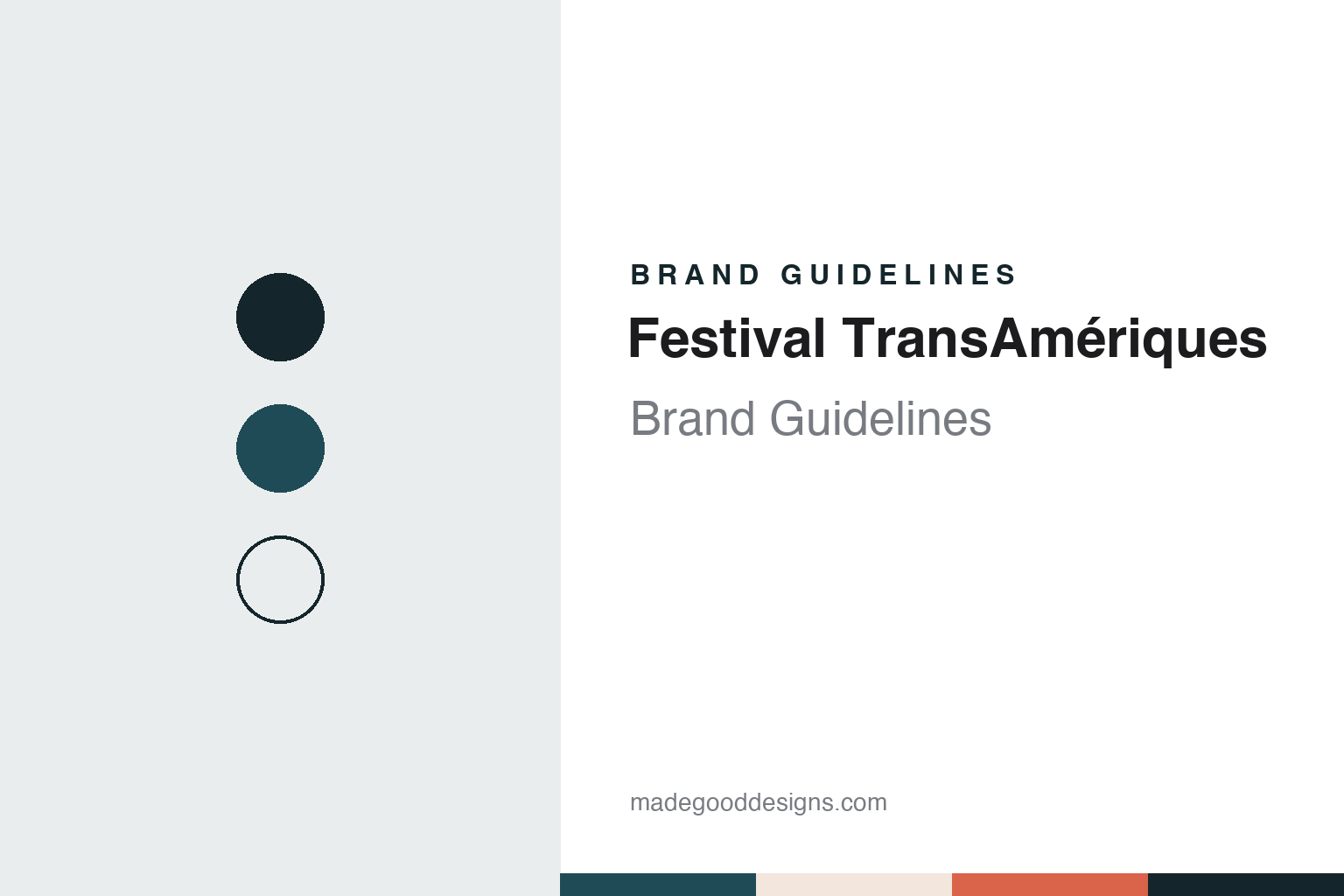
Two constants: a deep teal, sand and coral palette and a Bold grotesque register. Abstract homage — not a Festival TransAmériques poster or mark; no logo or campaign image is reproduced.
From the Americas
A theatre festival founded in 1985.
The Festival TransAmériques, known as the FTA, is an international festival of contemporary dance and theatre held each spring in Montreal. It began in 1985 as the Festival de théâtre des Amériques, a theatre festival founded by Marie-Hélène Falcon, who led it as general and artistic director until 2014, French Wikipedia says. Place des Arts, the Montreal arts complex that hosts part of the programme, also dates the festival’s opening edition to 1985.
In its early decades the festival was not held every year. French Wikipedia records that between 1985 and 2006 it presented 232 productions from 31 countries, and describes its aims in that period as supporting contemporary creation by co-producing new work, building international exchanges and giving Quebec artists a springboard abroad. Those aims, in the encyclopedia’s summary, set the pattern of a festival that both presents touring work and helps make new pieces.
The name points to its geography. “TransAmériques” takes in the whole continent rather than one country, and the festival’s 2026 programme returns to that idea, describing the name as a continental inheritance and presenting artists from across North, Central and South America and the Caribbean alongside work from Quebec and the rest of Canada. Co-producers from Europe are also credited in the 2026 programme.
Colour
Dance joins theatre, 2007.
The festival took its present form in May 2007, when the Festival de théâtre des Amériques became the Festival TransAmériques. French Wikipedia says that from then on dance held a place as important as theatre, following the end of Montreal’s Festival international de nouvelle danse, which had run from 1982 to 2003, and that the festival became annual. Since 2007 the FTA has been a yearly event, and its editions are numbered from that change.
Its season sits at the start of Montreal’s festival summer. The Belgian daily La Libre Belgique reported that the 2019 edition was held in Montreal from 22 May to 4 June; French Wikipedia gives the 19th edition as 22 May to 5 June 2025, with about twenty dance and theatre productions and other live-arts activities. The festival’s own programme for 2026 gives the 20th edition as running from 28 May to 10 June 2026, with 25 productions and a range of free activities, according to a welcome message printed in it.
The programme is spread across the city’s stages. The 2026 programme lists performances at Place des Arts, including its Cinquième Salle and Studio-Théâtre, and at Usine C, Espace Go, Duceppe, Prospero, the Monument-National, La Chapelle and the Centre du Théâtre d’Aujourd’hui. Free outdoor pieces took place at the Place des Festivals and Place d’Armes, presented with the Partenariat du Quartier des spectacles. Place des Arts describes a typical edition as around twenty productions from Quebec and abroad, together with workshops, debates and activities that bring artists and audiences together.
The festival has a parallel event. La Libre Belgique described the OFFTA in 2019 as a separate “off” festival running alongside the FTA, focused on performance; it is its own event and is not part of the FTA’s programme.
Leadership has changed twice since the founding era. After Falcon’s tenure ended in 2014, an artistic director and co-general director led the festival until 2021, French Wikipedia says. Since 2021 artistic direction has been shared by Martine Dennewald and Jessie Mill; the 2026 programme lists Dennewald as co-executive director and co-artistic director, Mill as co-artistic director, and a second co-executive director who oversees administration.
Typography
How festivals present themselves.
International arts and theatre festivals usually present themselves through a place and a season before anything else. Many take the simplest possible name, a city followed by the word “festival”; others add a season, a language or a coined word, and the open-access events that grow up beside them often borrow the word “fringe” or “Off”. The name tends to stay fixed for decades, while almost everything else about the festival changes from one edition to the next.
Behind most of these names sits a non-profit body rather than a company: an association, a foundation, a trust or a company limited by guarantee, often with a board on which a city, a region or a national arts body takes an institutional seat. A director or artistic director, appointed for a set term, shapes each programme, and the festival’s character can shift noticeably when that post changes hands.
The programmes themselves are usually spread across a city. Theatre, dance, music and visual art share the dates, and the venues range from established theatres and concert halls to courtyards, cloisters, chapels, quarries, warehouses and streets. Two models sit side by side. A curated festival invites every production it shows; an open-access fringe lets any company register and find its own venue, so the programme grows from the bottom up and the organiser mainly coordinates listings, ticketing and information.
Visually, this makes a festival identity unusually changeable. The fixed elements are often few: the name, the dates and sometimes a signature venue or ritual. Around them, a new programme, poster or campaign image is made for each edition, often commissioned from a visual artist or a design studio, so that the festival looks different every year while remaining recognisable by its place in the calendar and in the city.
Aa
A bold grotesque — the register of a dance-and-theatre programme. (Specimen set in Archivo, a sans STAND-IN; NOT the Festival TransAmériques logo.)
FTA
Danse + théâtre.
The FTA presents itself in two languages. Its 2026 programme is printed in French and English side by side, with headings such as “Édito / Preface” and “Infos pratiques / Practical Information,” and production credits given in both languages; its website, fta.ca, runs French and English versions. The opening essay of the 2026 programme also appears in Spanish, and some production pages add Portuguese, in keeping with the continental name.
The cover of the 2026 programme reduces the identity to a few elements: the full name, the edition number, the web address and the line “danse + théâtre,” with the dates set beneath. The short form FTA appears throughout the programme and the festival’s own pages, and the plus sign joining dance and theatre recurs as a device in its listings. The programme also groups its free outdoor events under the bilingual heading “Terrains de jeu / FTA Playgrounds” and includes an eco-manifesto and a section on outreach, organised in the same bilingual pattern.
Each production in the programme carries a full credit block in capitals, naming choreography, lighting, sound, set and costume design and the companies that co-produced it, many of them other festivals in Europe and the Americas. Co-production was already among the aims French Wikipedia describes for its early years.
The festival’s calendar position shapes how it is presented. Place des Arts calls it one of the early major events of the Montreal spring, opening the city’s festival season, and its outdoor programme in the Quartier des spectacles brings part of the festival into public squares. Ticketed performances sit in theatres of very different sizes, from the halls of Place des Arts to studio spaces such as La Chapelle, so a single edition moves between large and small rooms across the city.
For a design guide, Festival TransAmériques shows how a festival can carry a continental name, a two-language voice and a simple “dance + theatre” line through one programme. Compare Luminato, Toronto’s June arts festival, and Festival d’Avignon, the French theatre festival held in a city’s historic venues. For this guide we use a deep teal, a warm sand and a coral with a sans, an unofficial interpretation; no product or logo is reproduced.
Explore & save
Keep Festival TransAmériques’s identity on hand — save it to a board in the Made Good inspiration library.
Festival TransAmériques identity set
Pin the deep teal, sand and coral palette and the Bold grotesque register to your own board.
Source & notes
Frequently Asked Questions
What font can I use to match the Festival TransAmériques look?
This guide describes Festival TransAmériques’ type as “A bold grotesque — the register of a dance-and-theatre programme”. Its type specimen is set in Archivo from Google Fonts as a stand-in; Archivo is not Festival TransAmériques’ own lettering.
What colours are in the Festival TransAmériques palette?
This guide’s Festival TransAmériques palette is Deep teal #1F4B57, Night ink #14262B, Warm sand #F3E6DD, Coral #D9644A and Paper #FAF7F3. The tones are the guide’s own unofficial interpretation, not official Festival TransAmériques hex codes.
When was Festival TransAmériques founded?
Festival TransAmériques was founded in 1985 (as Festival de théâtre des Amériques), in Montreal, Quebec.