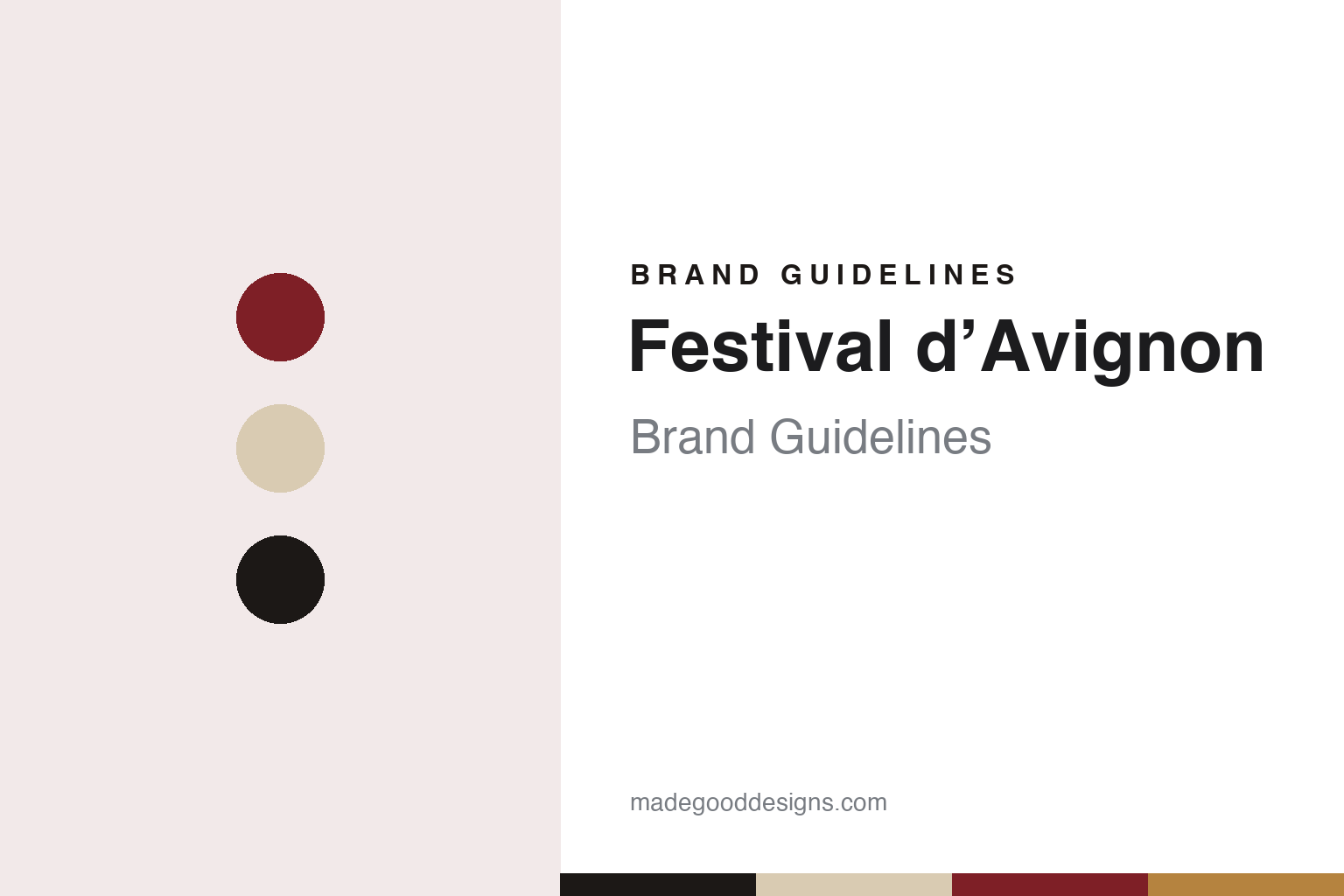
Festival d’Avignon Brand Guidelines
A week of drama in a papal courtyard that became a July city of theatre.
Aa
Two constants: a garnet, limestone and ink palette and a courtyard serif register. Abstract homage — not a Festival d’Avignon poster or mark; no logo, poster or programme is reproduced.
A week of drama
Three productions, three venues, September 1947.
The Festival d’Avignon began as something smaller. In 1947 an art critic and a poet who were mounting a modern-art exhibition in the great chapel of the Palais des Papes suggested that the actor, director and company leader Jean Vilar stage plays in the city. French Wikipedia says Vilar at first doubted the idea could work technically, but the town council agreed, the Cour d’honneur of the palace was fitted out, and “Une semaine d’art en Avignon” ran from 4 to 10 September 1947. It offered three new productions, among them a French Richard II, in three places: the palace courtyard, the municipal theatre and the orchard of Urban V. French Wikipedia puts the audience at 4,800.
Vilar returned the next year and built a troupe of actors who came back each summer. The event took the name Festival d’Avignon in July 1954, according to French Wikipedia, and from 1951 its productions came largely from the Théâtre National Populaire, which Vilar then ran in Paris. Around 1958 the festival began sounding trumpets before each performance, a fanfare drawn from incidental music written for one of its stagings; French Wikipedia says the trumpets still announce performances.
The festival widened in the 1960s. In 1966 it grew to a month and added dance; in 1967 Vilar opened a second stage in the Cloître des Carmes, and the Célestins cloister, the municipal theatre and the chapel of the Pénitents blancs followed by 1971. Cinema previews and music were added in the same years. A separate, independent “Off” festival, run by its own organisation and open to companies that are not in the official programme, grew up alongside it from 1966, English Wikipedia says; it remains a different event.
Colour
An association, a board and a director.
Vilar led the festival until 1971; a designated successor from his circle ran it from 1971 to 1979 under the more modest title of administrator, French Wikipedia says. In 1980 it became an association under France’s 1901 law. English and French Wikipedia describe a board made up of the French state, the city of Avignon, the Vaucluse département and the Provence-Alpes-Côte d’Azur region, together with seven public figures with theatre experience. It is this board that votes on the appointment of the festival’s director.
The venue list kept growing. Since 1985 the Carrière de Boulbon, a quarry outside the city, has served as an open-air stage, and French Wikipedia now counts more than 30 venues in Avignon and the surrounding area: cloisters, chapels, gymnasiums, gardens, quarries and churches as well as theatres. From 2004 the directors invited one or two associate artists to shape each edition, and they moved the offices from Paris to Avignon; their term also produced La FabricA, a rehearsal and residency building in the city. For the 60th edition in 2006, French Wikipedia records 133,760 tickets issued against 152,000 seats, plus 15,000 entries to free exhibitions, readings and talks.
The theatre director and writer Olivier Py directed the editions of 2014 to 2022, having taken up the post in September 2013 — an artist at the head of the festival again, as in Vilar’s day, French Wikipedia notes. The 2020 edition did not take place, English Wikipedia records. On 5 July 2021 the board named the Portuguese director and playwright Tiago Rodrigues, then artistic director of the Teatro Nacional Dona Maria II in Lisbon, who took office on 1 September 2022; his opening edition ran from 5 to 25 July 2023. Portugal’s public broadcaster RTP reported on 30 September 2025 that the board had renewed him for a four-year term from 1 September 2026 to 2030.
Rodrigues gave each edition a guest language: English in 2023, Spanish in 2024, Arabic in 2025 and Korean in 2026, according to RTP and the Lisbon daily Observador. In 2024 the dates moved earlier, to 29 June–21 July, because of the Paris Olympic Games, French Wikipedia says. The 80th edition ran from 4 to 25 July 2026, RTP reported in December 2025.
Typography
How arts festivals present themselves.
International arts and theatre festivals usually present themselves through a place and a season before anything else. Many take the simplest possible name, a city followed by the word “festival”; others add a season, a language or a coined word, and the open-access events that grow up beside them often borrow the word “fringe” or “Off”. The name tends to stay fixed for decades, while almost everything else about the festival changes from one edition to the next.
Behind most of these names sits a non-profit body rather than a company: an association, a foundation, a trust or a company limited by guarantee, often with a board on which a city, a region or a national arts body takes an institutional seat. A director or artistic director, appointed for a set term, shapes each programme, and the festival’s character can shift noticeably when that post changes hands.
The programmes themselves are usually spread across a city. Theatre, dance, music and visual art share the dates, and the venues range from established theatres and concert halls to courtyards, cloisters, chapels, quarries, warehouses and streets. Two models sit side by side. A curated festival invites every production it shows; an open-access fringe lets any company register and find its own venue, so the programme grows from the bottom up and the organiser mainly coordinates listings, ticketing and information.
Visually, this makes a festival identity unusually changeable. The fixed elements are often few: the name, the dates and sometimes a signature venue or ritual. Around them, a new programme, poster or campaign image is made for each edition, often commissioned from a visual artist or a design studio, so that the festival looks different every year while remaining recognisable by its place in the calendar and in the city.
Aa
A high-contrast serif for a stone courtyard. (Specimen set in Cormorant Garamond, a serif STAND-IN; NOT the Festival d’Avignon logo.)
Festival d’Avignon
A palace wall, a fanfare and a yearly poster.
For a designer, the Festival d’Avignon’s strongest visual asset is a place rather than a mark. The Cour d’honneur is an open courtyard enclosed by the high limestone walls of a fourteenth-century papal palace, and French Wikipedia describes it as the cradle of the festival. The city itself is listed by Unesco as a World Heritage site, the same article notes, and the festival’s many venues, from cloisters to a quarry, give each edition a series of stone backdrops rather than a single theatre.
The identity also has a sound. The trumpet fanfare played before performances since about 1958 gives the festival a sound that is the same in every venue. Each edition has its own festival poster; French Wikipedia notes that wines sold on opening nights carry a label reproducing it, and that the festival keeps a shop on the place de l’Horloge. Archives covering Vilar’s work and the roughly 3,000 events staged since 1947 are kept at the Maison Jean-Vilar in Avignon, in a branch of the Bibliothèque nationale de France.
For a design guide, the Festival d’Avignon shows how a festival can be identified by a venue, a season and a ritual sound, with the yearly poster changing around them. Compare the Paris autumn festival in our Festival d’Automne à Paris guide and another curated summer festival in our Edinburgh International Festival guide. For this guide we use night garnet, palace limestone and courtyard ink with Provençal ochre and a high-contrast serif, an unofficial interpretation; no product or logo is reproduced.
Explore & save
Keep Festival d’Avignon’s identity on hand — save it to a board in the Made Good inspiration library.
Festival d’Avignon identity set
Pin the garnet, limestone and ink palette and the courtyard serif register to your own board.
Source & notes
Frequently Asked Questions
What font can I use to match the Festival d’Avignon look?
This guide describes Festival d’Avignon’s type as “A high-contrast serif for a stone courtyard”. Its type specimen is set in Cormorant Garamond from Google Fonts as a stand-in; Cormorant Garamond is not Festival d’Avignon’s own lettering.
What colours are in the Festival d’Avignon palette?
This guide’s Festival d’Avignon palette is Night garnet #7E1F26, Courtyard ink #1C1816, Palace limestone #D9CBB2, Provençal ochre #B5833F and Programme paper #F7F3EC. The tones are the guide’s own unofficial interpretation, not official Festival d’Avignon hex codes.
When was Festival d’Avignon founded?
Festival d’Avignon was founded in 1947 (as a week of drama), in Avignon, France.
Who founded Festival d’Avignon?
Festival d’Avignon was founded by Jean Vilar in 1947 (as a week of drama).