Festival d’Automne à Paris Brand Guidelines
An autumn festival with no stage of its own, spread across Paris.
Aa
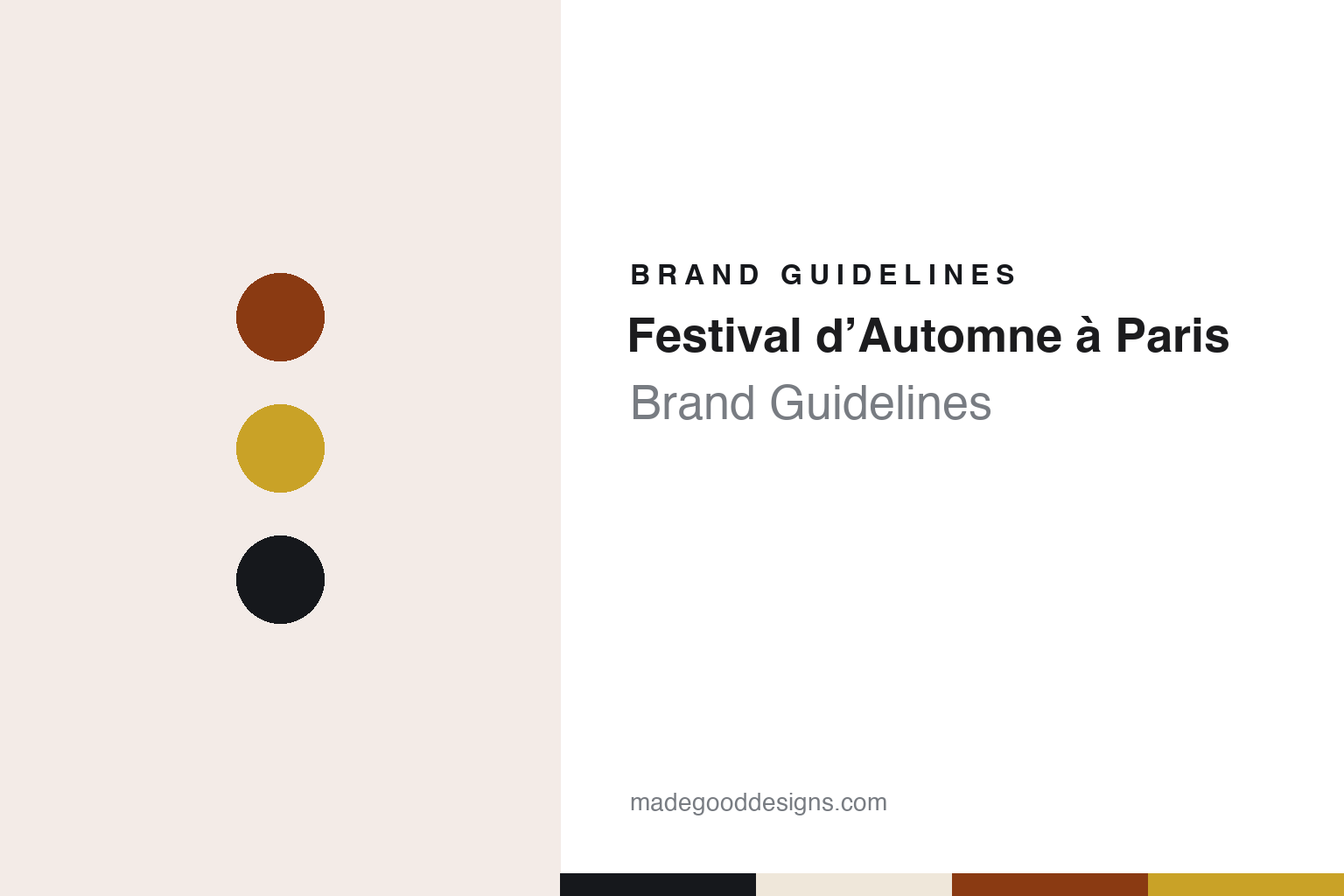
Two constants: a rust, gold and slate palette and a poster grotesque register. Abstract homage — not a Festival d’Automne à Paris poster or mark; no logo, poster or programme is reproduced.
A festival without a stage
Contemporary work across Paris, from 1972.
The Festival d’Automne à Paris was created in 1972 by Michel Guy, with the backing of the culture ministry, French Wikipedia says; it had been planned from 1970 as a Paris festival devoted to contemporary art in all its forms. Its opening edition largely brought together two existing events, an international dance festival and the Semaines musicales internationales de Paris, and it opened with a sound-and-light work at the Roman baths of Cluny before closing at the Théâtre des Champs-Élysées.
From the start the festival had no venue of its own. French Wikipedia describes a small team that used the whole city: established stages such as the Théâtre des Champs-Élysées, the Athénée, the Opéra-Comique and the Théâtre de la Ville, and less usual sites including the then-closed Bouffes du Nord, the keep of the Château de Vincennes, the Sainte-Chapelle and the chapels of the Sorbonne and the Pitié-Salpêtrière hospital. It worked with the national drama centres and the suburban theatres of Gennevilliers, Nanterre, Aubervilliers, Bobigny and Saint-Denis, and co-produced with other festivals, Avignon’s among them. The Paris Opéra hosted contemporary choreographers in 1980 as part of the programme.
French Wikipedia sets out the founding programme as five aims: commissioning new work, setting up working links between French and foreign artists, presenting experimental work, bringing significant work unseen in France to Paris, and showing cultures from outside the West. Cinema became a larger strand from 1981, in partnership with the Cahiers du cinéma and the Cinémathèque française. French Wikipedia adds that in its first decade the festival’s work ran in parallel with the creation of new Paris institutions for contemporary work, including the Centre Pompidou, the music research institute IRCAM and the Ensemble intercontemporain.
Colour
Directors, an association and a network of venues.
Michel Guy led the festival for most of its first two decades; the theatre site Sceneweb, reviewing a history of the festival in September 2016, noted that he left in 1974 for a government post, when another director took over, and returned as director in 1977. That same director led it again from 1992 to 2009, and the festival’s two artistic directors then ran it on an interim basis. In April 1992 an association of friends of the festival was set up to widen its circle of supporters. On 4 May 2011, French Wikipedia says, Emmanuel Demarcy-Mota, director of the Théâtre de la Ville since 2008, was named to head the festival, with his programming starting in 2012. The festival’s own team page in 2026 lists him as general director, with separate artistic directors for theatre, dance and visual arts and for music, and a president at the head of the organisation.
The format has stayed the same in outline. The festival describes itself as a multidisciplinary festival of contemporary work held each year from September to December, with theatre, music, dance, visual arts and performance in close to 60 partner venues in Paris and the Île-de-France, from the Odéon and the Centre Pompidou to the MC93, Nanterre-Amandiers, the Philharmonie de Paris, the CENTQUATRE and the T2G in Gennevilliers. It says it presents nearly 100 events per edition and puts its audience at 250,000 a year. Since 2012 it has devoted multi-show “Portraits” to individual artists from the international stage, the festival says, and since its creation it has given large programmes to performing arts from beyond Europe, from Korea, Mongolia and South Africa to Mexico, Japan and Brazil. It says that around 60 per cent of each edition’s events are new creations and that close to 1,000 French and international artists take part each year.
The 2026 edition, the festival’s 55th, presented 75 projects by artists from 40 countries in 58 partner venues, Sceneweb reported on 29 May 2026, with live performances from 11 September to 19 December 2026; the City of Paris event listing runs the season to 31 December.
Typography
How arts festivals present themselves.
International arts and theatre festivals usually present themselves through a place and a season before anything else. Many take the simplest possible name, a city followed by the word “festival”; others add a season, a language or a coined word, and the open-access events that grow up beside them often borrow the word “fringe” or “Off”. The name tends to stay fixed for decades, while almost everything else about the festival changes from one edition to the next.
Behind most of these names sits a non-profit body rather than a company: an association, a foundation, a trust or a company limited by guarantee, often with a board on which a city, a region or a national arts body takes an institutional seat. A director or artistic director, appointed for a set term, shapes each programme, and the festival’s character can shift noticeably when that post changes hands.
The programmes themselves are usually spread across a city. Theatre, dance, music and visual art share the dates, and the venues range from established theatres and concert halls to courtyards, cloisters, chapels, quarries, warehouses and streets. Two models sit side by side. A curated festival invites every production it shows; an open-access fringe lets any company register and find its own venue, so the programme grows from the bottom up and the organiser mainly coordinates listings, ticketing and information.
Visually, this makes a festival identity unusually changeable. The fixed elements are often few: the name, the dates and sometimes a signature venue or ritual. Around them, a new programme, poster or campaign image is made for each edition, often commissioned from a visual artist or a design studio, so that the festival looks different every year while remaining recognisable by its place in the calendar and in the city.
Aa
A sturdy grotesque for street posters. (Specimen set in Archivo, a sans STAND-IN; NOT the Festival d’Automne à Paris logo.)
Festival d’Automne à Paris
Fifty-five years of artists’ posters.
The festival’s visual identity rests on its posters. Since 1972 it has invited visual artists to create its posters and other printed graphics, the City of Paris says, and French Wikipedia notes that from the early years these posters hung in the streets of Paris under the names of artists such as Jean Dubuffet. Because each edition’s poster comes from a different artist, the look of the festival changes every year; what carries over is the name, the autumn dates and the presence of the work on the city’s walls.
In 2026 the festival turned that archive into an exhibition. “55 ans d’affiches”, at the Chapelle Saint-Louis de la Salpêtrière from 6 November to 20 December 2026, gathers the posters, programmes and printed matter made since 1972 by the festival’s associated artists. The festival describes the show as a history told through image, typography and graphic design, and the City of Paris listing says it traces how the festival’s identity took shape through image and typography. The venue itself has a long link with the festival: the Salpêtrière chapels appear among the unusual sites French Wikipedia lists from its early years.
With no building of its own, the festival appears in each partner venue’s season under its own name. Its website in 2026 pairs the full name, Festival d’Automne à Paris, with the short form “Festival d’Automne”.
For a design guide, the Festival d’Automne à Paris shows how commissioned artists’ posters can stand in for a fixed venue as the face of a festival. Compare the summer theatre festival in our Festival d’Avignon guide and a Paris stage that has hosted the festival in our Opéra national de Paris guide. For this guide we use rust leaf, late gold and slate ink with poster cream and a sturdy grotesque sans, an unofficial interpretation; no product or logo is reproduced.
Explore & save
Keep Festival d’Automne à Paris’s identity on hand — save it to a board in the Made Good inspiration library.
Festival d’Automne à Paris identity set
Pin the rust, gold and slate palette and the poster grotesque register to your own board.
Source & notes
Frequently Asked Questions
What font can I use to match the Festival d’Automne à Paris look?
This guide describes Festival d’Automne à Paris’ type as “A sturdy grotesque for street posters”. Its type specimen is set in Archivo from Google Fonts as a stand-in; Archivo is not Festival d’Automne à Paris’ own lettering.
What colours are in the Festival d’Automne à Paris palette?
This guide’s Festival d’Automne à Paris palette is Rust leaf #8A3A12, Slate ink #16181C, Late gold #C9A227, Poster cream #EFE7DA and Paper #FAF8F4. The tones are the guide’s own unofficial interpretation, not official Festival d’Automne à Paris hex codes.
When was Festival d’Automne à Paris founded?
Festival d’Automne à Paris was founded in 1972, in Paris, France.
Who founded Festival d’Automne à Paris?
Festival d’Automne à Paris was founded by Michel Guy in 1972.