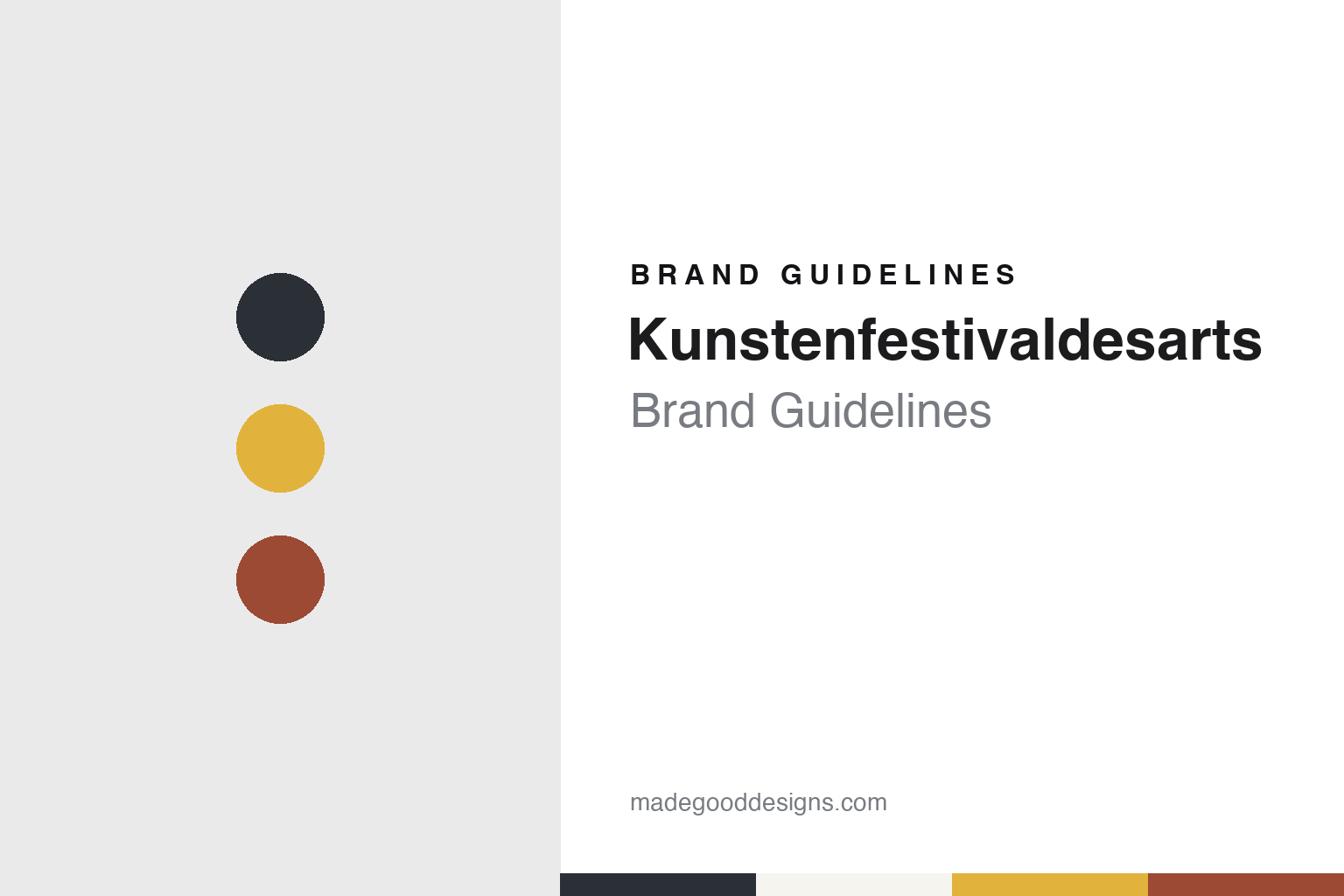
Kunstenfestivaldesarts Brand Guidelines
The bilingual Brussels festival of new theatre, dance and art, held each May since 1994.
Aa
Two constants: a slate, signal yellow and brick palette and a geometric grotesque register. Abstract homage — not a Kunstenfestivaldesarts mark; no logo, poster or campaign image is reproduced.
Brussels, 1994
A festival for two language communities.
Kunstenfestivaldesarts was founded in Brussels in 1994 by Frie Leysen, according to English Wikipedia; French and Dutch Wikipedia name a co-founder alongside her. A profile published on Focus on Belgium, the site of Belgium’s foreign ministry, describes her as co-founder of the bilingual festival in 1994 and says she directed it until 2006. Before that, the same profile says, she had spent eleven years building up deSingel, the arts centre in Antwerp. By the time she stepped down, the profile says, the festival was bringing theatre, dance, performance, film and visual arts to Brussels from Belgium and abroad.
The name carries the idea. It joins the Dutch kunstenfestival and the French des arts into a single word, and English Wikipedia says the festival was meant to serve both the Flemish and the French-speaking communities of Brussels, the one city in Belgium where both live side by side. Dutch Wikipedia describes it as a bilingual undertaking from the outset, in a country where culture has been a matter for the language communities since the state reform of 1980.
The organisation follows the same line. English Wikipedia says the festival is governed by a board drawn equally from the French- and Dutch-speaking communities, with a president from each. Programmes are published in French, Dutch and English, and shows in other languages are surtitled in French and Dutch, it adds; French and Dutch Wikipedia say the festival also programmes French-language work in Flemish theatres and the other way round, which brings in audiences from both communities and from international Brussels.
Leysen’s successor directed the festival from 2007 to 2018, English Wikipedia says, and since the 2019 edition it has been led by co-artistic directors who took over in October 2018. Dutch Wikipedia adds that from the start the festival acted as a producer or co-producer of work by Belgian and international artists, not only as a presenter of finished work.
Colour
Three weeks in May, with no house of its own.
The festival is held over about three weeks in May. French Wikipedia describes a programme of theatre, dance, performance, film and visual arts, made up of new and recent work from around the world, presented with some twenty Brussels theatres and arts centres and in several of the city’s public spaces. English Wikipedia counts around thirty venues in all, including theatres, cultural centres, museums and public spaces, and names the Kaaitheater as its main hub.
The festival has no hall of its own, Dutch Wikipedia says, and has also staged performances in disused buildings. Instead it moves its festival centre from year to year. French and Dutch Wikipedia list those centres: the Kaaitheater in 2007, the Beursschouwburg in several years from 2008, Les Brigittines in 2009 and 2016, and the Vanderborght building in 2012. In 2017 the festival moved into the Palais de la Dynastie on the Mont des Arts, Dutch Wikipedia says, and with the Wiels contemporary art centre staged an exhibition there called The Absent Museum. In 2018 the centres included the KANAL – Centre Pompidou building.
Alongside the performances it runs a “Free School” for sharing knowledge and artistic practice, and a series of community projects linking students, associations, professionals and the wider public, English Wikipedia says.
A typical run is set out in English Wikipedia’s note on the 2014 festival, which took place from 2 to 24 May. The calendar has moved once. In 2020 the festival ran from September to November, for the first time since it began, French Wikipedia says. In May 2022 it returned for its 27th edition, held over three weeks at more than thirty venues including the Kaaitheater, according to English Wikipedia.
The festival announced its 2025 edition at the Beursschouwburg on 1 April that year. In that announcement, carried by the Brussels Morning, it said the 30th edition would run from 9 to 31 May with 34 projects, 16 of them world premieres, by artists from 26 countries, across some thirty venues, with the Beursschouwburg as its hub, an open-air cinema and a free nightlife programme.
Typography
Festivals and their cities.
International arts and theatre festivals usually present themselves through a place and a season before anything else. Many take the simplest possible name, a city followed by the word “festival”; others add a season, a language or a coined word, and the open-access events that grow up beside them often borrow the word “fringe” or “Off”. The name tends to stay fixed for decades, while almost everything else about the festival changes from one edition to the next.
Behind most of these names sits a non-profit body rather than a company: an association, a foundation, a trust or a company limited by guarantee, often with a board on which a city, a region or a national arts body takes an institutional seat. A director or artistic director, appointed for a set term, shapes each programme, and the festival’s character can shift noticeably when that post changes hands.
The programmes themselves are usually spread across a city. Theatre, dance, music and visual art share the dates, and the venues range from established theatres and concert halls to courtyards, cloisters, chapels, quarries, warehouses and streets. Two models sit side by side. A curated festival invites every production it shows; an open-access fringe lets any company register and find its own venue, so the programme grows from the bottom up and the organiser mainly coordinates listings, ticketing and information.
Visually, this makes a festival identity unusually changeable. The fixed elements are often few: the name, the dates and sometimes a signature venue or ritual. Around them, a new programme, poster or campaign image is made for each edition, often commissioned from a visual artist or a design studio, so that the festival looks different every year while remaining recognisable by its place in the calendar and in the city.
Aa
A geometric grotesque for one long compound name. (Specimen set in Space Grotesk, a sans STAND-IN; NOT the Kunstenfestivaldesarts logo.)
Kunstenfestivaldesarts
One word, two languages.
Some artists return across decades. In May 2025 the Brussels city magazine BRUZZ reported that William Kentridge, a guest of the festival since its early years, was restaging Faustus in Africa!, the production he made with the Handspring Puppet Company and first presented at the festival nearly thirty years earlier, alongside a selection of his films. In May 2026 Euronews reported on that year’s three-week edition, which closed on 30 May, and on a work by Romeo Castellucci staged on the top deck of a Brussels car park.
Those two reports show the festival’s range of settings, from a theatre stage to a parking structure, within a single city. English Wikipedia also says the festival has introduced a number of new artists to Brussels audiences over the years.
For designers the name is the first piece of identity: one compound word that reads as Dutch at the start and French at the end, shortened to KFDA in English and Dutch Wikipedia. Any campaign has to work in three languages, French, Dutch and English, the languages in which the programme is published.
For a design guide, Kunstenfestivaldesarts shows how a bilingual city can be written into a single name, and how a festival without a building of its own can be held together by a moving festival centre and a fixed month. Compare the Holland Festival, held each June in Amsterdam across many venues, and the Festival d’Avignon. For this guide we use a slate grey, a signal yellow and a brick red with a sans, an unofficial interpretation; no product or logo is reproduced.
Explore & save
Keep Kunstenfestivaldesarts’s identity on hand — save it to a board in the Made Good inspiration library.
Kunstenfestivaldesarts identity set
Pin the Kunstenfestivaldesarts slate, signal yellow and brick palette and the geometric grotesque register to your own board.
Source & notes
Frequently Asked Questions
What font can I use to match the Kunstenfestivaldesarts look?
This guide describes Kunstenfestivaldesarts’ type as “A geometric grotesque for one long compound name”. Its type specimen is set in Space Grotesk from Google Fonts as a stand-in; Space Grotesk is not Kunstenfestivaldesarts’ own lettering.
What colours are in the Kunstenfestivaldesarts palette?
This guide’s Kunstenfestivaldesarts palette is Brussels slate #2B2F36, Ink #121316, Signal yellow #E2B33C, Brick #9C4A34 and Paper #F6F4EF. The tones are the guide’s own unofficial interpretation, not official Kunstenfestivaldesarts hex codes.
When was Kunstenfestivaldesarts founded?
Kunstenfestivaldesarts was founded in 1994, in Brussels, Belgium.
Who founded Kunstenfestivaldesarts?
Kunstenfestivaldesarts was founded by Frie Leysen in 1994.