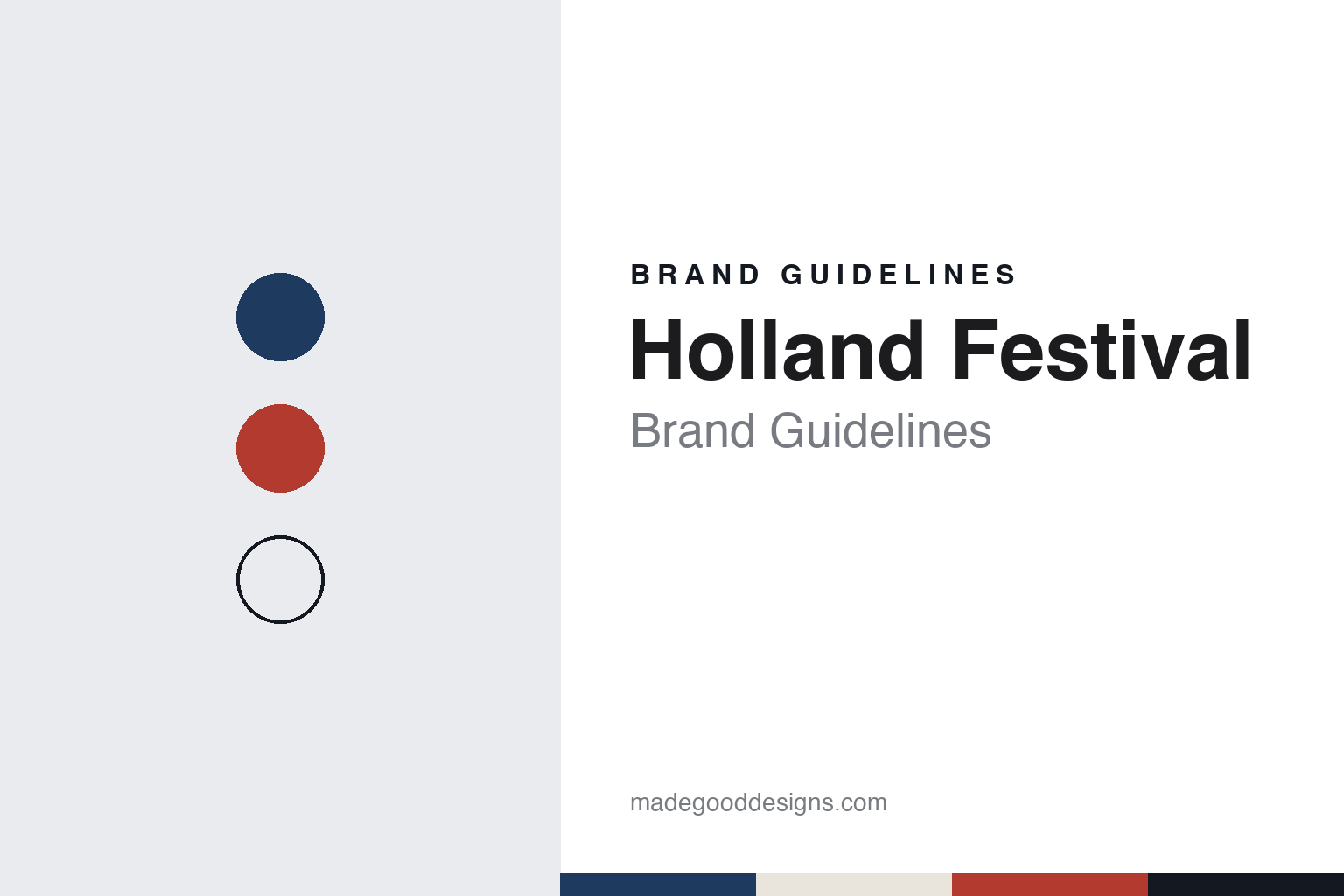
Holland Festival Brand Guidelines
Amsterdam’s June festival of theatre, music, opera and dance, founded in 1947.
Aa
Two constants: a canal blue, tulip red and warm stone palette and a grotesque sans register. Abstract homage — not a Holland Festival mark; no logo, poster or campaign image is reproduced.
Since 1947
An Amsterdam festival founded after the war.
The Holland Festival was founded in 1947, just after the Second World War, according to Dutch Wikipedia and a programme that Radio Netherlands made for the festival’s fiftieth anniversary, which says it first took place amid the optimism that followed the war years. Dutch Wikipedia places the founding beside other festivals started in the same years: the Festival d’Avignon and the Edinburgh International Festival in 1947, and the Aldeburgh Festival and the Wiener Festwochen in 1948. Amsterdam’s city information service, I amsterdam, dates the festival’s run of performances in the city to 1948.
The festival is held every June in Amsterdam. English Wikipedia, citing The New Grove Dictionary of Music and Musicians, describes a programme of theatre, music, opera and modern dance, with multimedia, visual arts, film and architecture added in later years, and says each edition is loosely themed. Dutch Wikipedia lists the disciplines as theatre, music, dance, music theatre and interdisciplinary forms, with deliberate links to visual art, digital art and film.
Its first director was Peter Diamand, who led the festival from 1948 to 1965, Dutch Wikipedia says; the Radio Netherlands anniversary programme includes an interview with him as the festival’s first director. Dutch Wikipedia lists eight directors between 1948 and 2018, among them the opera director Pierre Audi, who ran the festival from 2005 to 2014; English Wikipedia describes him as its artistic director and curator over those years.
The way the festival is led changed in 2018. From September that year it was run by a single director-bestuurder, a managing director responsible for both artistic and business matters, Dutch Wikipedia says, and since September 2019 that role has been held by Emily Ansenk.
Colour
A festival spread across a city.
The Holland Festival plays across Amsterdam at a large number of locations rather than in one hall. Dutch Wikipedia names the venues that form the core of its programme: the Internationaal Theater Amsterdam, the building of Dutch National Opera & Ballet known as the Stopera, the Muziekgebouw, the Concertgebouw, Carré, the Westergasfabriek, the Bimhuis, Frascati and Park Frankendael, along with the EYE film institute. English Wikipedia also names the city theatre and the Westergas factory site.
A single year shows how that works. I amsterdam’s guide to the 2025 programme gave the dates as 11 to 29 June, at venues including Dutch National Opera, the Muziekgebouw aan ’t IJ and the Internationaal Theater Amsterdam. That year Dutch National Opera’s staging of Boris Godunov, with the Royal Concertgebouw Orchestra, was also shown free at Opera in het Park on 22 June, the guide said, with picnic baskets welcome. The same guide listed a dance work by that year’s associate artist that turned the Likeminds venue into a meeting place for vogueing, early modern dance and butoh, and a music-theatre piece at the Muziekgebouw aan ’t IJ inspired by a seventeenth-century painting in the Rijksmuseum.
The programme mixes new work with older repertoire. English Wikipedia says the festival presents contemporary work alongside classical pieces given a modern edge, and that from 2005 it added side series called EarFuel, EyeFuel and MindFuel. I amsterdam describes a mix of theatre, music, opera, film and visual arts, with Western and non-Western performance in a variety of languages, and an emphasis on crossing between disciplines, on contemporary music and on new forms of music theatre.
Since the 2019 festival the Holland Festival has invited one or two associate artists each year to join it for a single edition, Dutch Wikipedia says. The festival shows new work by them, looks with them at artists they feel close to and at their sources of inspiration, and works with them and its own programming team to shape part of that year’s programme.
The international outlook goes back to the start. Dutch Wikipedia says that by showing national and international art side by side the festival drew attention to international cooperation and exchange, and that it now works with institutions and artists on every continent.
Typography
Festivals and their cities.
International arts and theatre festivals usually present themselves through a place and a season before anything else. Many take the simplest possible name, a city followed by the word “festival”; others add a season, a language or a coined word, and the open-access events that grow up beside them often borrow the word “fringe” or “Off”. The name tends to stay fixed for decades, while almost everything else about the festival changes from one edition to the next.
Behind most of these names sits a non-profit body rather than a company: an association, a foundation, a trust or a company limited by guarantee, often with a board on which a city, a region or a national arts body takes an institutional seat. A director or artistic director, appointed for a set term, shapes each programme, and the festival’s character can shift noticeably when that post changes hands.
The programmes themselves are usually spread across a city. Theatre, dance, music and visual art share the dates, and the venues range from established theatres and concert halls to courtyards, cloisters, chapels, quarries, warehouses and streets. Two models sit side by side. A curated festival invites every production it shows; an open-access fringe lets any company register and find its own venue, so the programme grows from the bottom up and the organiser mainly coordinates listings, ticketing and information.
Visually, this makes a festival identity unusually changeable. The fixed elements are often few: the name, the dates and sometimes a signature venue or ritual. Around them, a new programme, poster or campaign image is made for each edition, often commissioned from a visual artist or a design studio, so that the festival looks different every year while remaining recognisable by its place in the calendar and in the city.
Aa
A grotesque sans for a plain, two-word name. (Specimen set in Archivo, a sans STAND-IN; NOT the Holland Festival logo.)
Holland Festival
A country, a word and a month.
The name is plain: the English name of the country and the word “festival,” used unchanged in Dutch, and shortened to HF in Dutch Wikipedia. It gives a designer very little to decorate and a great deal to place, because the festival is tied less to a building than to a city and a month.
That month is the fixed point. Radio Netherlands’ anniversary programme describes Amsterdam venues hosting conductors, orchestras, opera singers, theatre ensembles and artists during the whole of June every year since the festival began, and I amsterdam still describes the festival as running throughout the month. The anniversary programme itself was made to mark the festival’s first half-century, and it includes the interview with Diamand.
The links with the other festivals of 1947 remain part of the story. I amsterdam’s event page, read in November 2026, says a new international collaboration has been launched with the Festival d’Avignon and the Edinburgh International Festival, both also founded in 1947 according to Dutch Wikipedia.
For a design guide, the Holland Festival shows how a festival without a house of its own can be held together by a name, a month and a city: concert halls, theatres, an opera house, a jazz club, a former gas-factory site and a park all carry the same two words for a few weeks each June. Compare the Festival d’Avignon and the Edinburgh International Festival, its contemporaries of 1947. For this guide we use a canal blue, a tulip red and a warm stone with a sans, an unofficial interpretation; no product or logo is reproduced.
Explore & save
Keep Holland Festival’s identity on hand — save it to a board in the Made Good inspiration library.
Holland Festival identity set
Pin the Holland Festival canal blue, tulip red and warm stone palette and the grotesque sans register to your own board.
Source & notes
Frequently Asked Questions
What font can I use to match the Holland Festival look?
This guide describes Holland Festival’s type as “A grotesque sans for a plain, two-word name”. Its type specimen is set in Archivo from Google Fonts as a stand-in; Archivo is not Holland Festival’s own lettering.
What colours are in the Holland Festival palette?
This guide’s Holland Festival palette is Canal blue #1F3A5F, Night ink #141821, Tulip red #B23A2E, Warm stone #E9E5DD and Paper #F8F6F1. The tones are the guide’s own unofficial interpretation, not official Holland Festival hex codes.
When was Holland Festival founded?
Holland Festival was founded in 1947, in Netherlands.