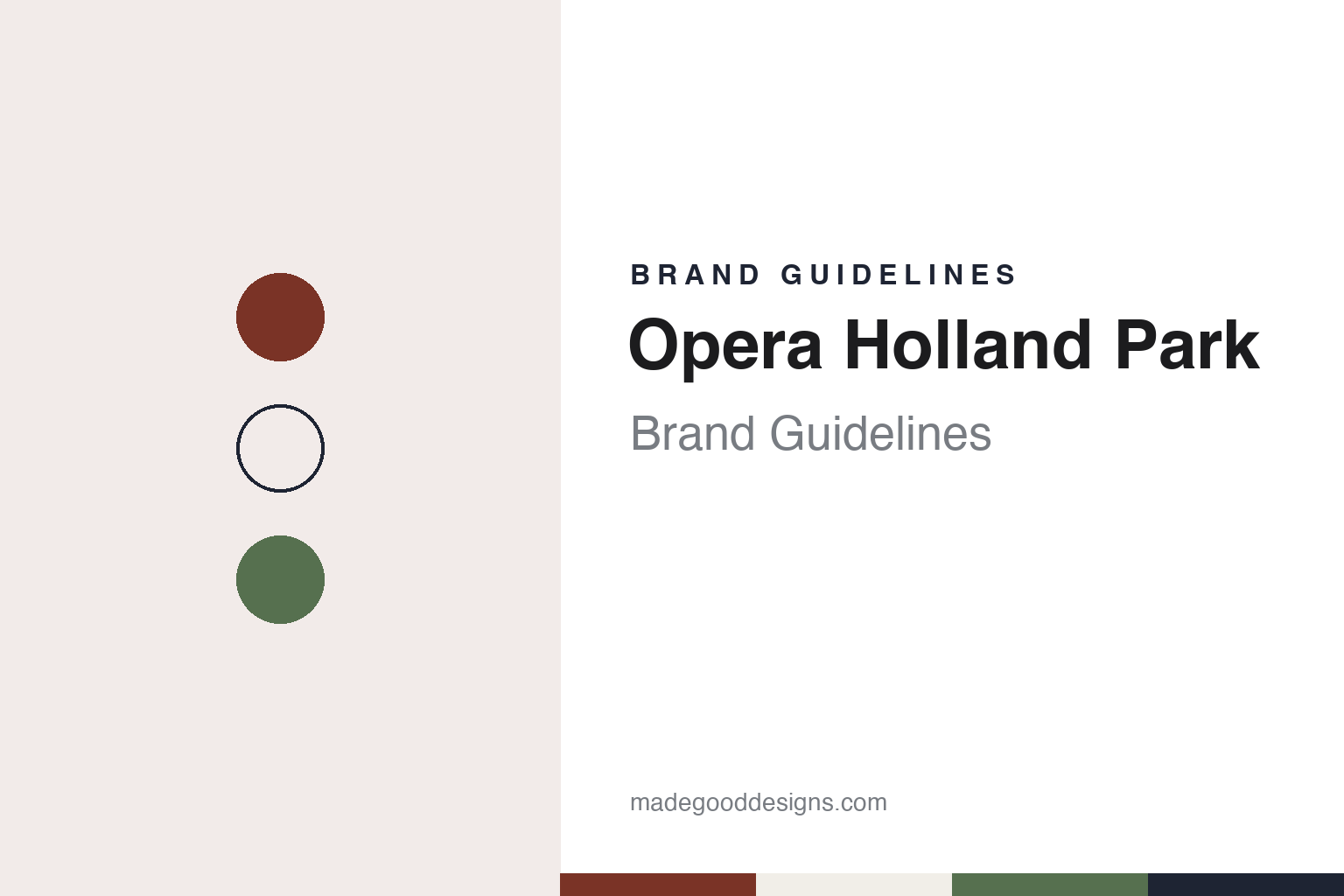
Opera Holland Park Brand Guidelines
A theatre built every summer under a canopy in a London park.
Aa
Two constants: an old brick, canopy white and park moss palette and a geometric sans register. Abstract homage — not an Opera Holland Park poster or mark; no logo, programme or production image is reproduced.
A council season
From a mixed programme to an opera company.
Opera Holland Park grew out of a summer arts season run by a London borough. Writing in International Arts Manager in November 2015, the company’s then general director Michael Volpe said the company emerged as a concept in 1996, as a way to produce opera within what was then the Holland Park Theatre season, which also included theatre, ballet and contemporary dance. By the 2000 season, he wrote, Opera Holland Park was producing the whole programme, and it had built a reputation for bringing rarely staged late-Italian operas to London audiences.
The first season set patterns the company still refers to. Its own announcement of the 2026 season says Verdi’s Un ballo in maschera was the finale of the inaugural season in 1996. James Clutton, the company’s director of opera, told WhatsOnStage in 2016 that Mascagni’s Iris, which opened that year’s season, had been one of the first shows the company ever produced.
For almost two decades the company was part of local government. English Wikipedia says that until October 2015 Opera Holland Park was part of the Royal Borough of Kensington and Chelsea, and that its permanent staff were technically council officers. Volpe described the old structure as a company inside a large council business group, with several layers of management above it.
The company’s setting is the park itself. Holland Park lies in the borough, and the company describes its auditorium as surrounded by formal gardens, wilder woodland and the park’s Kyoto Garden. The backdrop is the remains of Holland House, a house whose history the company traces back to 1605.
Colour
A canopy put up every summer.
The company does not have a permanent theatre. “Every summer we build a theatre,” it says. Performances take place under a temporary canopy in front of the remains of Holland House, English Wikipedia says, and the current canopy was designed in 2007 by the tensile-structure firm Architen Landrell with the architects Hall + Bednarczyk. It covers about 1,600 square metres, stands free of the old house, and is craned into position over three days, followed by about two weeks of fitting out.
Architen Landrell also made the fabric canopy used by Garsington Opera at Garsington Manor from 1995, according to English Wikipedia’s account of that festival. At Holland Park the canopy is part of the season’s routine: it goes up before the summer and the theatre is fitted out beneath it.
The musical forces are stable. English Wikipedia says the City of London Sinfonia has been the resident orchestra since 2003, and it played for the opening production of the 2026 season, Puccini’s La fanciulla del West, alongside the Opera Holland Park Chorus, according to Bachtrack. Its reviewer saw the production on 26 May 2026 at what the site calls the Holland Park Theatre, and wrote that it “epitomises the company’s commitment to thoughtful drama.”
The company describes its season as a summer festival of about three months and says it welcomes more than 30,000 people each summer. It has also commissioned new work: Alice’s Adventures in Wonderland, a family opera first commissioned in 2012, had reached its fourth year by 2016, Clutton told WhatsOnStage, and it returned on the main stage in 2026. In 2016 the company also co-produced Rossini’s La Cenerentola with the Danish National Opera, which toured the production in Denmark that autumn.
Typography
Opera festivals.
Opera festivals usually present themselves through a place or a person. Many take the name of their town with the word “festival” or “opera” attached, as Aix-en-Provence does; others carry the name of a composer, as the Rossini Opera Festival in Pesaro does, or the name of a house or estate. The name, the town and the stage often become the identity before any logo does.
Most run for a few weeks in summer. The Festival d’Aix-en-Provence takes place principally in July and the Rossini Opera Festival in August, each over a few weeks. Behind them stand non-profit bodies of different kinds: charities, associations and foundations, often with a city council or regional authority among their founders or members. The festival in Pesaro, for example, was set up by its city council in 1980 and became a foundation in 1994.
The settings vary as much as the names. Some festivals perform in castle or palace courtyards under the open sky, as Aix has done in the courtyard of its former archbishop’s palace since 1948; others use country-house theatres, historic Italian-style opera houses, purpose-built modern theatres or converted halls. Many festivals use more than one stage, and the list of venues is often part of how a festival describes itself.
Programmes commonly mix new productions with revivals, concerts and training. Academies and young-artist schemes, such as the Académie in Aix and the Accademia Rossiniana in Pesaro, put early-career singers, directors and musicians on the festival’s own stages. A poster, programme cover or season image is usually made anew for each edition, and Aix, for one, has worked with the same graphic designer since 2019. This guide describes those identities plainly, using our own unofficial colours and type.
Aa
A geometric sans for a theatre built in a park each year. (Specimen set in Jost, a sans STAND-IN; NOT the Opera Holland Park logo.)
Independence
A charity since October 2015.
Opera Holland Park became an independent charity on 1 October 2015, Volpe wrote in International Arts Manager that November. The idea of separating from the Royal Borough, its principal funder, had been discussed for several years; the council kept a close relationship with the company, which now had its own board. Volpe wrote that the company had written its principles of accessibility into its legal agreements with the council, and that its core activities would stay the same. English Wikipedia says the new board was chaired by a former chairman of Historic Royal Palaces.
The 2016 season was the first summer after independence. Clutton told WhatsOnStage that year that the change would make little difference to audiences, and that co-productions such as the Danish La Cenerentola were one result of it. He also described the company’s Young Artists scheme, in which young singers get three weeks in a rehearsal room with their own répétiteur and conductor, followed by a full performance with the orchestra, and its community programme, Inspire. The company’s team page now lists Clutton as chief executive and director of opera.
The 2026 season marked 30 years since the company was established, the company said in announcing it, and Seen and Heard International reported the programme in July 2025. It opened with a new La fanciulla del West, followed by a new Così fan tutte, also performed by the season’s Young Artists, and a new Die Fledermaus sung in English. A partnership with the Yachiyoza Theatre in Kumamoto, Japan, began with the UK premiere of The Bamboo Princess. A concert performance of Turandot completed the company’s presentation of all of Puccini’s operas, the company said, and the season closed with a revival of its 2019 Un ballo in maschera, the opera that ended the first season in 1996.
For a design guide, Opera Holland Park shows how a company can take its identity from a temporary building: a white canopy raised each year against old brick, in a public park in the middle of a borough. Compare Garsington Opera, which also played under an Architen Landrell canopy, and the Royal Opera House, in the same city. For this guide we use an old brick red, a canopy white, a park moss and a night navy with a sans, an unofficial interpretation; no product or logo is reproduced.
Explore & save
Keep Opera Holland Park’s identity on hand — save it to a board in the Made Good inspiration library.
Opera Holland Park identity set
Pin the Opera Holland Park old brick, canopy white and park moss palette and the geometric sans register to your own board.
Source & notes
Frequently Asked Questions
What font can I use to match the Opera Holland Park look?
This guide describes Opera Holland Park’s type as “A geometric sans for a theatre built in a park each year”. Its type specimen is set in Jost from Google Fonts as a stand-in; Jost is not Opera Holland Park’s own lettering.
What colours are in the Opera Holland Park palette?
This guide’s Opera Holland Park palette is Old brick #7A3326, Night navy #1E2433, Canopy white #F1EEE8, Park moss #56704F and Stone #C9C1B4. The tones are the guide’s own unofficial interpretation, not official Opera Holland Park hex codes.
When was Opera Holland Park founded?
Opera Holland Park was founded in 1996, in Holland Park, London.