Wine Paris Brand Guidelines
From a Bordeaux fair of 1981 to a February meeting in Paris.
Aa
Two constants: a claret, limestone and gilt palette and a Parisian serif register. Abstract homage — not a Wine Paris or Vinexposium mark; no logo, key visual or product is reproduced.
From Bordeaux to Paris
Three fairs that became one.
Wine Paris is the trade fair for wine and spirits that Vinexposium holds each February at Paris Expo Porte de Versailles in Paris. Its official site describes a trade audience of producers, importers, distributors, hotel and restaurant buyers and bartenders. Its roots lie in three earlier shows: Vinexpo in Bordeaux, Vinisud in Montpellier and Vinovision in Paris.
Vinexpo is the oldest of the three. English Wikipedia and French Wikipedia both date it to 1981, and French Wikipedia says it was created by the Chambre de Commerce et d’Industrie de Bordeaux, the city’s chamber of commerce, at the Parc des Expositions de Bordeaux-Lac. The 1981 show drew 524 exhibitors from 21 countries and 11,000 trade visitors from 50 countries, English Wikipedia says. Vinexposium’s own history page dates that opening edition to 22–26 June 1981. Over the following decades the Vinexpo name travelled: Vinexposium lists Vinexpo Asia-Pacific in Hong Kong from 1998 and Vinexpo America in New York from 2002, and English Wikipedia lists Vinexpo Nippon in Japan in 2014. The same timeline lists the World Bulk Wine Exhibition in Amsterdam from 2009, a fair for wine sold in bulk.
The Paris strand began in a different place. According to The Buyer, writing in February 2020, the exhibition company Comexposium entered the wine trade in February 2017 with Vinovision, a Paris show for cool-climate wines run with the generic bodies of the Loire, Alsace and Burgundy. In October 2017 Comexposium bought Adhesion Group, then the owner of Vinisud and the World Bulk Wine Exhibition, and in February 2018 Vinisud moved up from Montpellier to run beside Vinovision. In 2019 the two shows ran together as the opening Wine Paris, which The Buyer put at 2,000 exhibitors and 26,700 visitors.
Colour
Vinexpo comes to Paris.
The decisive step came in February 2020. Vinexpo brought its show to Paris and held it alongside Wine Paris under the joint name Wine Paris & Vinexpo Paris, from 10 to 12 February 2020 at Paris Expo Porte de Versailles. BKWine Magazine, in March 2020, described the decision to move Vinexpo from Bordeaux, where it had long been rooted, as a surprise to many, and reported 2,800 exhibiting producers and more than 29,000 trade visitors from 126 countries at that joint edition. The Buyer wrote in the same month that exhibitors and buyers had given the two shows their approval.
The organisers merged the same year. Vinexposium’s history page says that in 2020 Vinexpo and the wine division of Comexposium joined to form Vinexposium, and French Wikipedia describes the Paris show then as a subsidiary of Comexposium. The group also added Be Spirits in 2020, a section for spirits inside the Paris fair, according to its own timeline.
The double name was used until 2024. On 3 July 2024 Global Drinks Intel reported that Vinexposium had renamed Wine Paris & Vinexpo Paris simply Wine Paris, ahead of the edition of 10–12 February 2025, to help popularise the event internationally; the report quoted Vinexposium chief executive Rodolphe Lameyse. The Vinexpo name stays in use for the group’s fairs elsewhere: Vinexposium’s site lists Vinexpo Americas in Miami, Vinexpo Asia in Hong Kong, Vinexpo India and Vinexpo Explorer, alongside the World Bulk Wine Exhibition in Amsterdam.
The Paris fair has since been split into co-events. The official site presents Wine Paris, Be Spirits Paris and The Other Sip Paris, the latter for no- and low-alcohol drinks and formerly called Be No, each in its own space at Porte de Versailles. For its last edition the organiser gives 6,537 exhibitors, 63,541 trade visitors and 169 represented countries.
Typography
How food and wine fairs present themselves.
Food and wine trade fairs tend to present themselves through a short name. Some are acronyms built from a longer title, such as SIAL, from the French Salon International de l’Alimentation, or Anuga, from the German words for a general food and luxury-goods exhibition. Others pair a word with a country or a city, as FOODEX JAPAN does, and many editions are announced simply as the name followed by the year.
Most of these fairs are business events rather than public shows. Their halls are aimed at producers, importers, wholesalers, retail buyers and caterers, and admission usually depends on trade registration. German Wikipedia says Anuga dropped its last public day in 1975, and FOODEX JAPAN’s organiser says entry is limited to people from the trade.
Behind each fair stands an organiser of a particular kind: an exhibition company, a trade association, a group of producer or hospitality bodies, or a fair company owned by a city or region. Halls are often arranged in two ways at once, by product area and by country, with national pavilions placed beside sector halls for drinks, dairy, frozen food or fine food. Some fairs have grown into networks of sister events abroad under the same name.
The visual side usually follows the same pattern. A wordmark is kept from one edition to the next, while the key visual, the poster image and the colour of the year can change with each edition. For a design guide, that combination of a steady name and a changing seasonal look offers a clear pattern to study, and the colours and type in these guides are our own interpretation rather than official assets.
Aa
A high-contrast Parisian serif for a fair named after its city. (Specimen set in Cormorant Garamond, a serif STAND-IN; NOT the Wine Paris logo.)
Wine Paris
A city name as the whole identity.
The current name is the plainest the event has carried. Where the 2020 to 2024 shows needed an ampersand to hold two brands together, the single name Wine Paris pairs a product with a city. The official site styles it “Wine Paris by Vinexposium” in running text, which keeps the group name in a supporting role, and presents the spirits and no-alcohol shows as separately named co-events rather than as halls of one fair.
The calendar has moved as well as the name. Vinexpo was a June fair in Bordeaux in 1981, according to Vinexposium’s timeline; Wine Paris is a February fair in Paris. The venue, Paris Expo Porte de Versailles, appears on every official listing, and the site gives day-by-day opening hours for each of its three days.
Three strands remain visible in what the fair is today. The Vinexpo history gives it a lineage back to Bordeaux in 1981 and a family of sister events abroad. Vinovision and Vinisud, the two shows that formed the 2019 Wine Paris, brought cool-climate French wine and Mediterranean wine into the same halls, as The Buyer and BKWine Magazine described in 2020. And the exhibition-company side, through Comexposium and then Vinexposium, gives it the format of a large professional trade show: registration for trade visitors, booked meetings, a talks programme and a catalogue of exhibitors.
For a design guide, Wine Paris shows how a merged event can settle on one short name and let its sub-brands carry the detail. Compare Comexposium, the exhibition company behind Vinovision and the 2019 Wine Paris, and ProWein, the wine and spirits fair in Düsseldorf. For this guide we use claret, limestone and an old gilt with a serif, an unofficial interpretation; no product or logo is reproduced.
Explore & save
Keep Wine Paris’s identity on hand — save it to a board in the Made Good inspiration library.
Wine Paris identity set
Pin the Wine Paris claret, limestone and gilt palette and the Parisian serif register to your own board.
Source & notes
Frequently Asked Questions
What font can I use to match the Wine Paris look?
This guide describes Wine Paris’ type as “A high-contrast Parisian serif for a fair named after its city”. Its type specimen is set in Cormorant Garamond from Google Fonts as a stand-in; Cormorant Garamond is not Wine Paris’ own lettering.
What colours are in the Wine Paris palette?
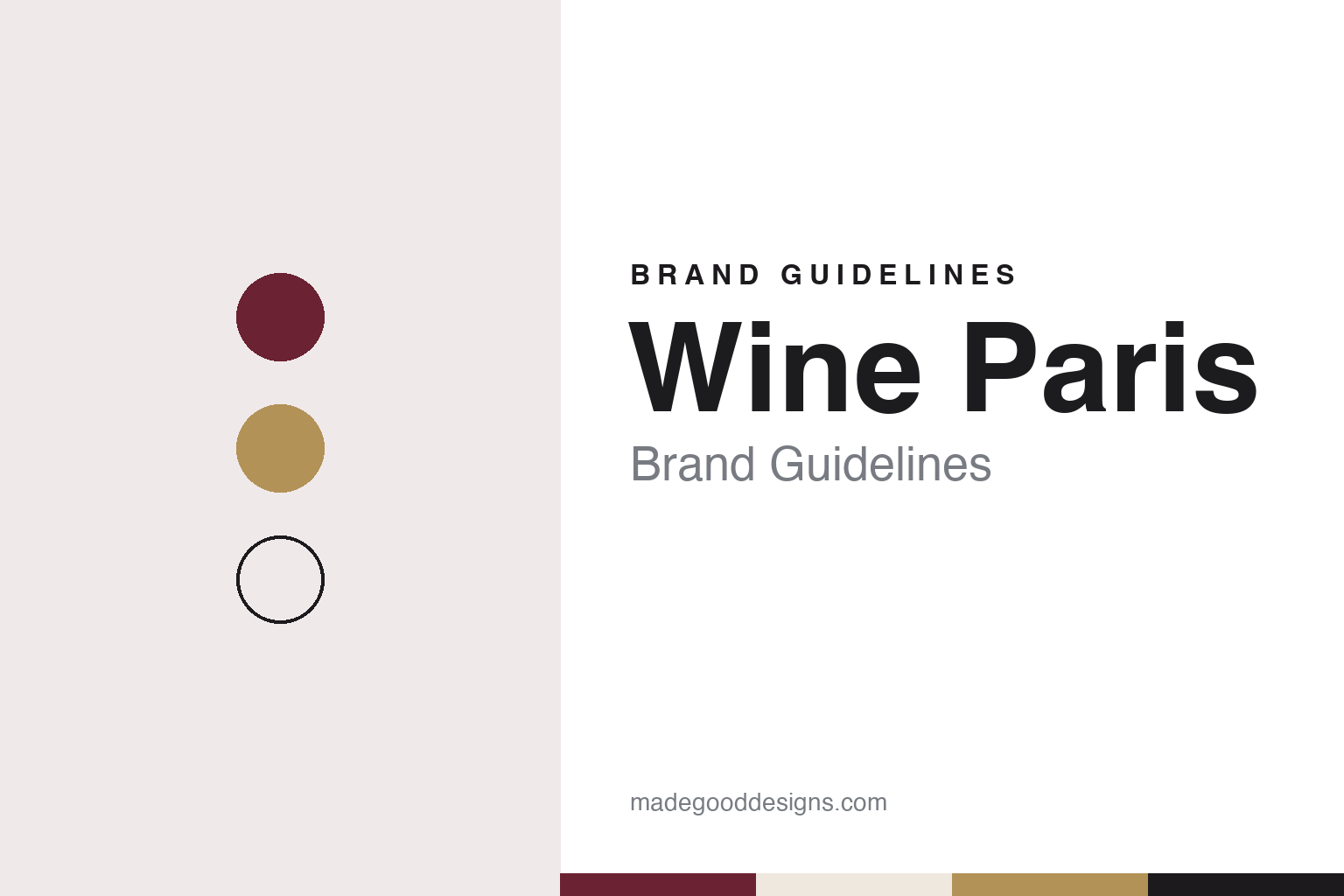
This guide’s Wine Paris palette is Claret #6B2232, Cellar ink #1D1A1E, Limestone #EFE8DF, Old gilt #B39257 and Paper #F8F5F0. The tones are the guide’s own unofficial interpretation, not official Wine Paris hex codes.
When was Wine Paris founded?
Wine Paris was founded in 1981 (as Vinexpo), in Bordeaux, France.