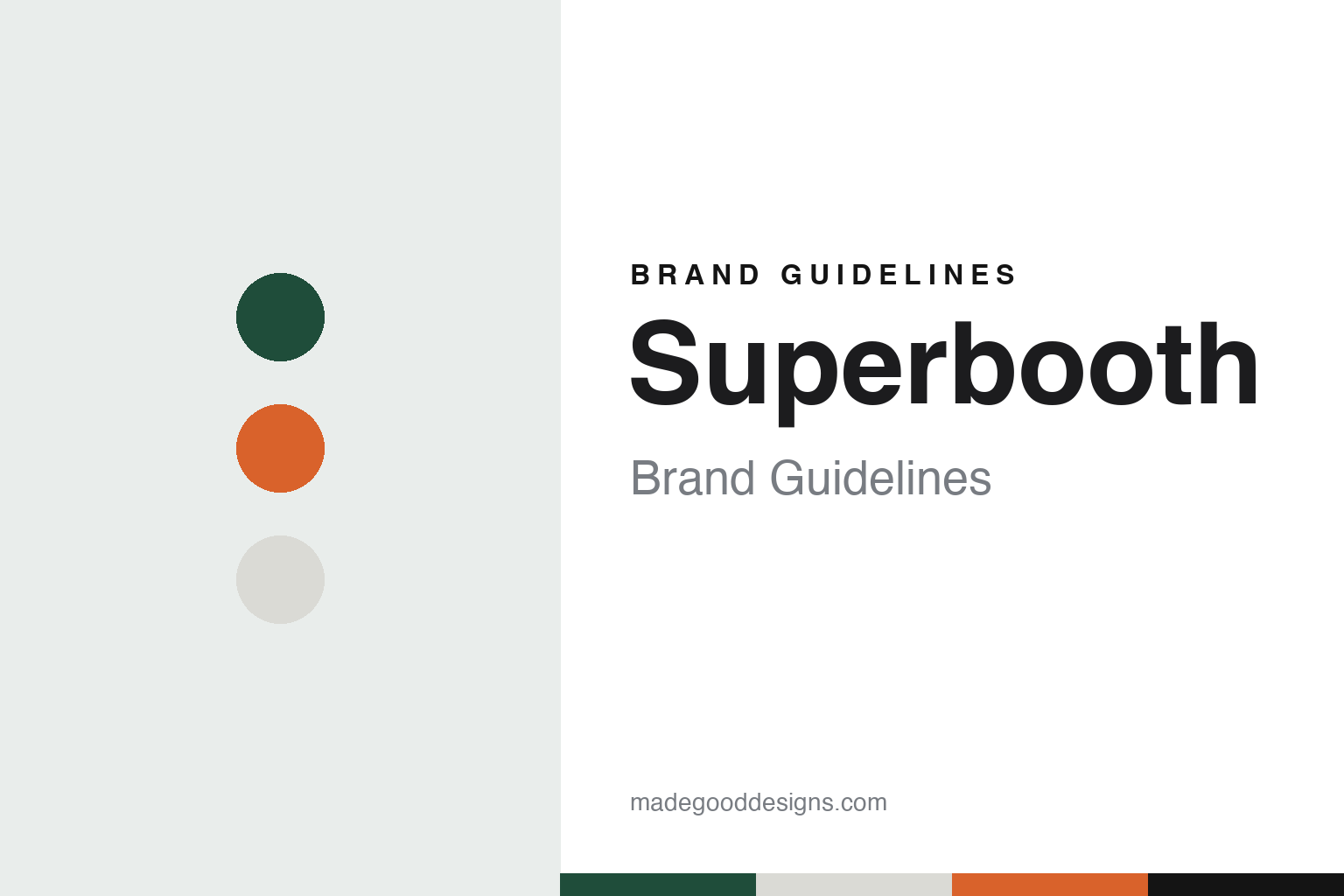
Superbooth Brand Guidelines
A shared stand at Musikmesse that became a Berlin fair.
Aa
Two constants: a green, orange and panel black palette and a grotesque sans register. Abstract homage — not a Superbooth mark; no instrument, module, logo or poster is reproduced.
A stand in Frankfurt
From a shared booth at Musikmesse to Berlin.
Superbooth is a trade fair and festival for electronic musical instruments, held each spring in Berlin. Its organiser, SUPERBOOTH Berlin GmbH, writes the name in capitals as SUPERBOOTH and numbers each edition by year, as in SUPERBOOTH16 or SB25. The fair was started by Andreas Schneider, who runs the Berlin synthesizer shop SchneidersLaden; Sound On Sound described him in July 2016 as a specialist retailer and distributor of analogue synthesizers and related equipment through his Schneidersbuero and Schneidersladen businesses.
The idea is older than the Berlin fair. The organiser’s history page says it began as a shared space within Musikmesse in Frankfurt, where a group of friends gathered small makers of electronic instruments on one stand. The aim, the page says, was to let small and emerging brands afford a place at a large fair, and to show what their instruments could do when connected to one another rather than presenting each brand on its own. Sound On Sound reported that the Superbooth stand was a fixture at the Frankfurt fair for 12 years.
The history page lists a theme for most of those years, among them Superpatch in 2003, Analogue village in 2004, The black cabins in 2006 and Trans Europa Exzess in 2011. Between the Frankfurt fairs, it says, Schneider’s mobile modular system also travelled to London and Poland and played in Berlin clubs. In 2015 Schneider decided to take Superbooth out of Frankfurt and turn it into a specialist trade fair of his own in Berlin, the page says.
Colour
Funkhaus, then the FEZ.
The first standalone edition, SUPERBOOTH16, was held at the Funkhaus Berlin, the former headquarters of East German broadcasting, at the end of March and the start of April 2016. Sound On Sound reported that Schneider had secured the building after several years of planning and negotiation, and that the show brought boutique synthesizer makers together with larger manufacturers including Roland and Korg; it estimated that at least 90 percent of the products on display were Eurorack modules, the compact modular format that dominated the floor. MusicTech, reporting from the show on 1 April 2016, called it a brand new show for modular synthesizer fans that also drew software companies. In a closing press release dated 10 April 2016, the organiser said nearly 3,000 trade and private visitors and nearly 100 exhibitors had attended over three days; its history page gives 96 exhibitors.
From 2017 the fair moved to the FEZ-Berlin, a leisure and recreation centre in the Wuhlheide park in south-east Berlin, where it has been held since. The history page says the number of exhibitors reached 230 in 2019. In April 2020 the organiser held an online edition, the SUPERBOOTH 20 HOME EDITION, and in September 2021 an edition with much of the fair set outdoors in the FEZ woodland; in 2022 the fair returned to its usual May dates.
The format mixes trade fair and festival. Visitors can try the instruments on show and meet their makers, and the programme adds workshops, talks and concerts on the FEZ stages, according to the organiser and a 2025 listing by the Berlin events site Digital in Berlin. MusicRadar, previewing the 2026 show on 30 April 2026, described it as part industry trade show and part jam session, with large music-technology brands alongside many smaller and newer firms, and with modular and Eurorack equipment prominent among the exhibits.
Typography
Toy, music and sporting-goods trade fairs.
Trade fairs for toys, musical instruments and sporting goods tend to name themselves plainly. Most pair the product field with a city or with a single word such as fair, show or expo, so that the name alone tells a buyer what is on offer and where to go. Some keep a word in the language of their home city even when most visitors come from abroad; others have shortened longer official titles to the form people already used.
Many of these events are built for the trade rather than the public. Trade days are usually reserved for retailers, buyers, distributors, manufacturers and press, and some fairs check credentials or set a minimum age at the door. Others are open to the public, either throughout or on particular days, and present themselves more like festivals for players, musicians or riders.
Behind the fairs stand different kinds of organiser: trade associations representing an industry, cooperatives owned by the exhibitors themselves, and exhibition companies that run the halls and sell the space. Dates matter as much as names. A fair tied to the buying calendar may move between seasons when the industry’s order cycle changes, and the month becomes part of how the event is known.
Inside, the halls are usually arranged by product group, so that a visitor can walk from one category to the next. Demonstration areas, play areas, sound booths and test tracks let products be tried rather than only seen. The visual identity often follows a simple pattern: a wordmark or emblem kept from year to year, set beside a key visual, edition number and dates that change with each edition. This guide describes those identities from dated sources and uses colours and type of our own choosing.
Aa
A grotesque sans with the feel of a front panel. (Specimen set in Space Grotesk, a sans STAND-IN; NOT the Superbooth logo.)
SUPERBOOTH
Ten editions as a separate fair.
The fair has grown since moving to the FEZ. In a press release dated 6 August 2025, SUPERBOOTH Berlin GmbH said SUPERBOOTH25, held in May 2025, had more than 8,800 guests and 301 exhibitors from 31 countries across eight exhibition areas. It said software and pro-audio equipment had joined the established Eurorack and synthesizer areas, with 38 pro-audio exhibitors from nine countries, and that the exhibiting small makers were present in person to show new products and prototypes. The organiser also says the event has been independent from the start, without branding or sponsorship by outside companies.
The same release described the 2025 programme around the stands: three days of concerts, including special concerts by the studio for electroacoustic music of Berlin’s Akademie der Künste and by a Modular Synthesizer Ensemble taking part for the eighth time, as well as talks, pro-audio presentations and workshops ranging from sessions for beginners and do-it-yourself builders to field recording and tape loops.
SUPERBOOTH26, the tenth edition as a separate event, took place at the FEZ-Berlin from 7 to 9 May 2026. The online magazine GreatSynthesizers, reporting in June 2026, said more than 300 exhibitors showed their products in the main building and across the grounds of the leisure centre, and noted that music software and outboard studio equipment were taking up more space alongside synthesizer and effects modules. MusicRadar described Superbooth in April 2026 as an event at which music-technology brands announce and show new equipment, setting it alongside The NAMM Show, held in California each January.
For a design guide, Superbooth shows how a fair can keep the manner of a shared stand as it grows: makers present in person, instruments patched together for visitors to play, and concerts in a wooded park. Compare Musikmesse, where the original stand stood, and The NAMM Show in California. For this guide we use a forest green, a patch-cable orange and a panel black with a sans, an unofficial interpretation; no product or logo is reproduced.
Explore & save
Keep Superbooth’s identity on hand — save it to a board in the Made Good inspiration library.
Superbooth identity set
Pin the Superbooth green, orange and panel black palette and the grotesque sans register to your own board.
Source & notes
Frequently Asked Questions
What font can I use to match the Superbooth look?
This guide describes Superbooth’s type as “A grotesque sans with the feel of a front panel”. Its type specimen is set in Space Grotesk from Google Fonts as a stand-in; Space Grotesk is not Superbooth’s own lettering.
What colours are in the Superbooth palette?
This guide’s Superbooth palette is Wuhlheide green #1F4D3A, Panel black #141414, Patch-cable orange #D9622B, Aluminium #DADAD5 and Paper #F6F5F0. The tones are the guide’s own unofficial interpretation, not official Superbooth hex codes.
When was Superbooth founded?
Superbooth was founded in 2016 (as a separate fair), in Berlin, Germany.
Who founded Superbooth?
Superbooth was founded by Andreas Schneider (SchneidersLaden) in 2016 (as a separate fair).