Musikmesse Brand Guidelines
The Frankfurt fair for instruments and sheet music, 1980 to 2019.
Aa
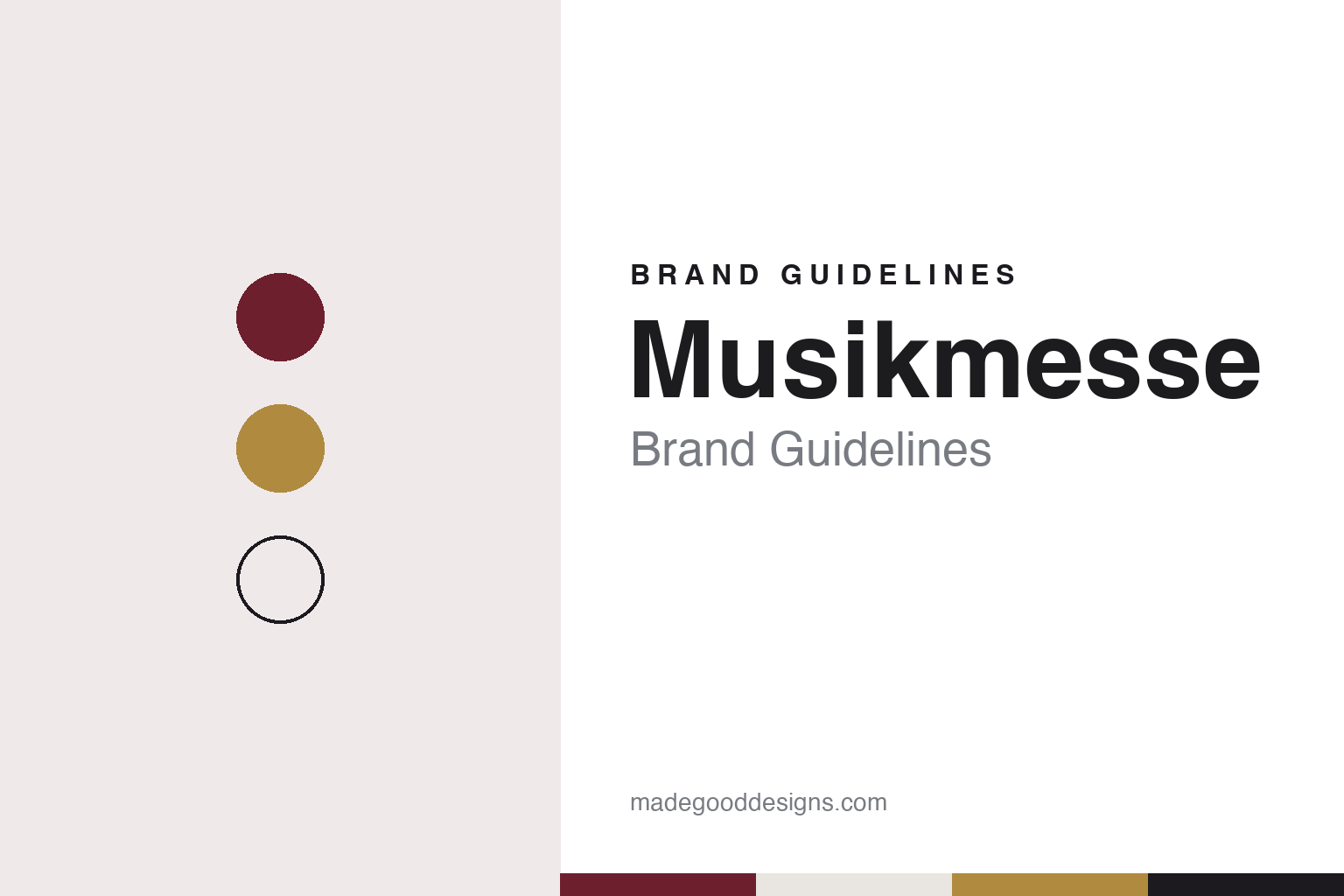
Two constants: a burgundy, brass and hall grey palette and an exhibition sans register. Abstract homage — not a Musikmesse or Messe Frankfurt mark; no instrument, logo or poster is reproduced.
Frankfurt, 1980
A product show for instruments and sheet music.
Musikmesse was a trade fair for musical instruments, sheet music and music technology held at the Frankfurt Fair and Exhibition Centre. Its organiser, Messe Frankfurt, dates its launch to 1980: the company’s history page lists Musikmesse among the specialist fairs that grew out of Frankfurt’s older general trade fairs, and a Messe Frankfurt press release of July 2020 said it had begun “as a classic product show focusing on instruments and sheet music.” The Frankfurt city news site frankfurt-tipp.de wrote in March 2022 that the fair had been based in the city for around 40 years.
The English-language music press often wrote the name as two words. In its March 1984 issue the British magazine Electronics & Music Maker reported on that year’s “Frankfurt Musik Messe,” describing a show staged across three of the showground’s halls: Halle 8 for guitars, acoustic and electric instruments and drums, and Halle 9.1, the “upstairs hall,” for sound equipment, loudspeakers and recording gear. The same report said the fair had had a difficult run in the late 1970s and early 1980s, and that the 1984 edition showed more real innovation than the years before it.
Musikmesse was a spring fair. In its later years it ran over several days in late March or April, with dealers, distributors and other trade visitors at its core. Messe Frankfurt’s own reports from that period describe a fair that had been steadily opened up to new themes, from instruments and sheet music to electronic equipment, hardware and software, and finally to concerts and public days across the city.
Colour
Prolight + Sound, the Festival and the Plaza.
For two decades the fair also housed the event-technology trade. According to the German Music Information Centre (miz), whose entry was last updated in February 2024, Prolight + Sound was run as an exhibition section within Musikmesse up to and including 1999, and has been a separate trade fair since 2000. It covers professional lighting, stage, audio and media technology and is open to trade visitors only, miz says. The two fairs kept sharing the Frankfurt grounds and the same spring week, and Messe Frankfurt reported their visitor numbers together.
From 2016 the organiser reshaped Musikmesse. A Messe Frankfurt press release of April 2017 referred to a restructuring begun in 2016 and quoted the Society of Music Merchants, a German industry association, welcoming it. The Musikmesse Festival, a programme of concerts at the exhibition centre and at clubs and venues across Frankfurt, had its premiere in 2016; the organiser said more than 20,000 music fans attended its events in 2017, and that the two fairs together drew around 100,000 visitors and 1,922 exhibitors from 55 countries that year. Their product range ran from media, lighting, sound and stage technology to musical instruments, electronic equipment, hardware and software, the release said.
In 2019 Messe Frankfurt added the Musikmesse Plaza, a pop-up market with direct sales and events for music fans after the trade days. The organiser’s closing report for that edition, dated 9 April 2019, gave more than 85,000 visitors across Musikmesse and Prolight + Sound and around 25,000 at Festival events in some 50 clubs and hotels in Frankfurt, and said 76 percent of visitors at the exhibition centre were trade visitors. The week ended with a concert in Frankfurt’s Festhalle. That April 2019 edition was the last Musikmesse to be held.
Typography
Toy, music and sporting-goods trade fairs.
Trade fairs for toys, musical instruments and sporting goods tend to name themselves plainly. Most pair the product field with a city or with a single word such as fair, show or expo, so that the name alone tells a buyer what is on offer and where to go. Some keep a word in the language of their home city even when most visitors come from abroad; others have shortened longer official titles to the form people already used.
Many of these events are built for the trade rather than the public. Trade days are usually reserved for retailers, buyers, distributors, manufacturers and press, and some fairs check credentials or set a minimum age at the door. Others are open to the public, either throughout or on particular days, and present themselves more like festivals for players, musicians or riders.
Behind the fairs stand different kinds of organiser: trade associations representing an industry, cooperatives owned by the exhibitors themselves, and exhibition companies that run the halls and sell the space. Dates matter as much as names. A fair tied to the buying calendar may move between seasons when the industry’s order cycle changes, and the month becomes part of how the event is known.
Inside, the halls are usually arranged by product group, so that a visitor can walk from one category to the next. Demonstration areas, play areas, sound booths and test tracks let products be tried rather than only seen. The visual identity often follows a simple pattern: a wordmark or emblem kept from year to year, set beside a key visual, edition number and dates that change with each edition. This guide describes those identities from dated sources and uses colours and type of our own choosing.
Aa
An exhibition sans for hall signs and programmes. (Specimen set in Archivo, a sans STAND-IN; NOT the Musikmesse logo.)
Musikmesse
A fair that ended in 2022.
Musikmesse did not return after 2019. On 17 March 2020 Messe Frankfurt announced that the international trade show would not take place that year, together with the Plaza and the Festival concerts planned for the turn of March and April. On 3 July 2020 it announced a new date of 22 to 24 October 2021, opening alongside the Frankfurter Buchmesse in cooperation with the book fair’s creative-industry programme THE ARTS+; that edition was not held either. The Australian music magazine Mixdown noted on 3 March 2022 that the fair had not run for two years.
On 2 March 2022 Messe Frankfurt said it would no longer continue the business-to-business part of Musikmesse, and that Musikmesse, the Plaza and the Festival would not take place in April 2022, the Schweizer Musikzeitung reported that day. Stephan Kurzawski, a member of Messe Frankfurt’s board of management, explained the decision by the concentration of the instrument trade: “a small number of online retailers account for over 70 per cent of the market in Germany and neighbouring countries alone,” he said, as quoted by Mixdown, adding that it was not commercially viable to organise a B2B trade fair. Prolight + Sound was not affected and was scheduled for 26 to 29 April 2022, Mixdown reported.
The fair left a trace elsewhere. Superbooth, the Berlin trade fair and festival for electronic instruments, began as a shared stand in the Frankfurt halls: Sound On Sound reported in July 2016 that Andreas Schneider’s Superbooth stand had been a fixture at the fair for 12 years before it became a separate event in Berlin that spring.
For a design guide, Musikmesse shows how a trade fair for instruments and sheet music widened into concerts and public days across a city before its organiser ended it. Compare Messe Frankfurt, the company that ran it, and Superbooth, the Berlin fair that grew out of a stand in its halls. For this guide we use a deep burgundy, a warm brass and a pale hall grey with a sans, an unofficial interpretation; no product or logo is reproduced.
Explore & save
Keep Musikmesse’s identity on hand — save it to a board in the Made Good inspiration library.
Musikmesse identity set
Pin the Musikmesse burgundy, brass and hall grey palette and the exhibition sans register to your own board.
Source & notes
Frequently Asked Questions
What font can I use to match the Musikmesse look?
This guide describes Musikmesse’s type as “An exhibition sans for hall signs and programmes”. Its type specimen is set in Archivo from Google Fonts as a stand-in; Archivo is not Musikmesse’s own lettering.
What colours are in the Musikmesse palette?
This guide’s Musikmesse palette is Concert-hall burgundy #6E1F2E, Ink #1C1A1F, Brass #B08A3E, Hall grey #E9E6E1 and Paper #FAF8F4. The tones are the guide’s own unofficial interpretation, not official Musikmesse hex codes.
When was Musikmesse founded?
Musikmesse was founded in 1980, in Frankfurt am Main, Germany.