IABR Brand Guidelines
Rotterdam’s research biennale of architecture, held since 2003.
Aa
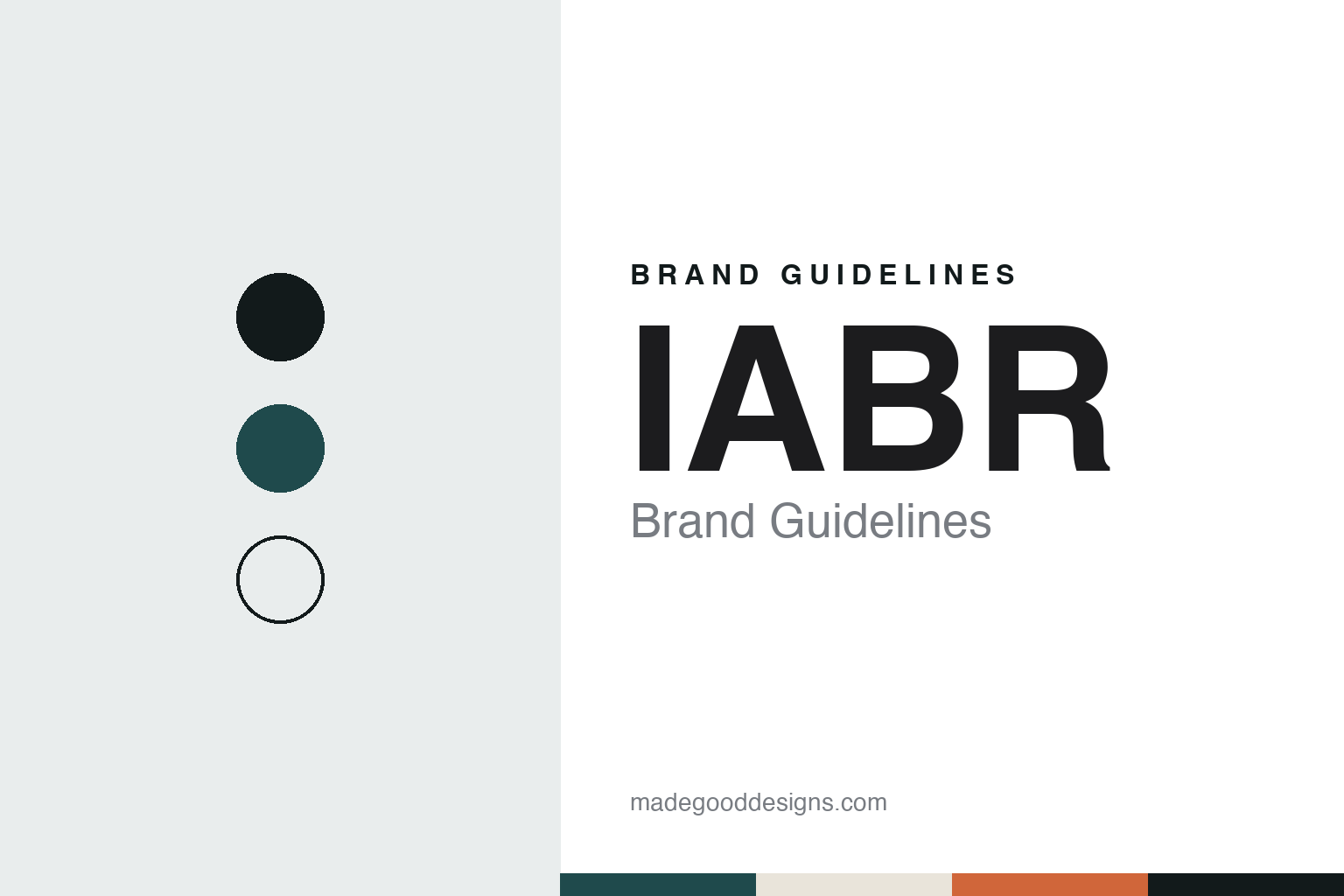
Two constants: a harbour teal, sand and signal orange palette and a Grotesque sans register. Abstract homage — not an IABR mark; no logo, poster or key visual is reproduced.
A biennale in Rotterdam
Started in 2003, every two years since.
IABR is the short name of the International Architecture Biennale Rotterdam — in Dutch, the Internationale Architectuur Biënnale Rotterdam. Its own history page says the opening edition took place in 2003. The initiative came from Kristin Feireiss, at the time director of the Netherlands Architecture Institute (NAi), who set up the event as a recurring two-yearly architecture manifestation and asked the architect Francine Houben to put together the opening edition, on the theme of Mobility. English Wikipedia gives its full title as “Mobility: A Room with a View.”
The second edition followed in 2005 under the title The Flood (De Zondvloed in Dutch), about how cities deal with water, curated by a landscape architect. A director-manager appointed in those early years held the post until 2021, the organiser says. From the start, its history page says, the Rotterdam biennale presented itself as a research biennale, treating architecture in a broad sense, with urban planning and landscape architecture given an important place.
The organisation behind it is a foundation — a stichting in Dutch law. Its organisation page says the foundation works under a supervisory-board model, in which the board oversees policy and advises the management, and a single director-manager runs the organisation and carries final responsibility. The same page says the IABR holds ANBI status, the Dutch designation for an institution serving the public good, and publishes its ANBI documents and annual reports there. Since 2021 the director-manager has been Saskia van Stein, who is listed today as general and artistic director.
The IABR describes itself as a cultural knowledge institution based in Rotterdam. It says it organises a biennale every two years, with exhibitions, debates, lectures, workshops and guided tours, and that it continues research and partnerships between editions. Its website currently lists projects such as a collaboration with the province of Gelderland and a research project on energy infrastructure in North Africa.
Colour
Twelve editions, twelve themes.
Each edition has its own title and its own curator or curatorial team. The organiser’s list of biennales, matched by English Wikipedia, runs: Mobility (2003), The Flood (2005), Power: Producing the Contemporary City (2007), curated by the Berlage Institute, Open City: Designing Coexistence (2009), Making City (2012), curated by a team, Urban by Nature (2014), The Next Economy (2016), The Missing Link (2018), also by a team, and Down to Earth (2020–2021). The organiser counts It’s About Time (2022) as its 10th edition, curated by a team of four.
The fourth edition took place in 2009 and the fifth in 2012; from 2012 the editions again came two years apart. English Wikipedia says that from the fourth edition in 2009 the IABR increasingly combined its research projects with concrete urban planning assignments, in cities including Rotterdam, Istanbul and São Paulo. The organiser’s history page describes the same shift in its own terms: research concentrated in “Ateliers” with public partners and designers, often on location. It also says that from The Flood in 2005 an awareness of the climate question set the agenda of successive editions.
The 11th edition, Nature of Hope, ran from 29 June to 13 October 2024. The design magazine STIR reported on 11 October 2024 that it had three main parts: an exhibition of the same name at the Nieuwe Instituut, a green route visiting a series of “Botanical Monuments” with events around them, and a public programme of research presentations, guided tours, workshops, talks and book launches. STIR said the exhibition brought together about 70 approaches and examples from around the world, and that the curatorial team was led by Saskia van Stein. The opening symposium, it reported, took place on 30 June 2024.
The 12th edition, Systems of Support, runs from 18 September to 29 November 2026 at De Piekfabriek on the former Hunter Douglas site in Rotterdam, the organiser says. Its edition page describes an exhibition of more than 50 projects on housing, energy, water and materials, a public programme of symposia, talks and tours, and partner collaborations. It names a team of four curators, led by a chief curator and including van Stein.
Typography
Design and documentation.
Architecture biennials, triennials, festivals and open-house events usually take their names from the city that holds them. Most combine the place with words such as architecture, urbanism, biennale, triennial, festival or open house, and many are shortened to an acronym or a few initials, so that the name works as a date in the calendar as much as a title.
The bodies behind them vary. Some are hosted by city governments or public agencies acting in an institutional role; others are run by architecture centres, professional institutes, foundations, non-profit organisations or media and events companies. Several share an organiser with a permanent architecture centre or exhibition hall in the same city, and some work in partnership with a neighbouring city or a network of sister events abroad.
What they share is a programme spread across a city rather than gathered in one hall. Exhibition halls, reused industrial buildings, stations, plazas and parks hold curated exhibitions and installations, while talks, tours, workshops and, in open-house events, buildings opened to the public for a weekend or a week, often with volunteer guides, carry the programme into the streets. Biennials and triennials tend to work with a director or curatorial team and a yearly theme; festivals and open-house events often depend on many independent hosts.
Visual identity follows the same pattern. A steady name or wordmark carries from edition to edition, while each director or curator brings a new title, key visual and set of venues. This guide describes each event from its own first edition, using dated sources for organisers, venues, dates and themes, and sets an unofficial palette and type stand-in beside it; no logo or key visual is reproduced.
Aa
A grotesque sans — IABR in capitals. (Specimen set in Space Grotesk, a sans STAND-IN; NOT the IABR logo.)
IABR
An acronym, and a new title each time.
The name works at two lengths. In full it is a plain description — international, architecture, biennale, Rotterdam — and in short it becomes the four capitals IABR, which the organisation uses as its name across its website, social accounts and email addresses. Edition titles sit alongside the acronym: the organiser’s website sets them in capitals, as in “IABR 2026 SYSTEMS OF SUPPORT,” so that the steady acronym carries a title that changes every two years.
The venue changes too. The 2024 exhibition took place at the Nieuwe Instituut, as STIR reported; the 2026 edition is based at De Piekfabriek, which the organiser describes as a former factory site in Rotterdam, with a separate office address in the city. The IABR’s own pages present each edition through photographs of openings and exhibition halls, credited to named photographers, rather than through a single fixed poster style.
The format, as the organiser describes it, is wider than an exhibition. Its organisation page says that for each biennale the IABR works with one or more curators who translate a current social theme into a programme of research, exhibitions and public events, working with the organisation and a network of designers, researchers and partners. Between editions it runs research and design projects, publishes outcomes in a knowledge bank of images, texts, podcasts and exhibitions, and sells publications through its webshop. It also says it subscribes to the Dutch Governance Code for Culture and the Fair Practice Code.
Two languages run through the identity. The website appears in Dutch and English; the Dutch name uses the diaeresis in Biënnale, while English sources write Biennale. The edition titles have mostly been in English since the opening Mobility edition, with Dutch forms such as De Zondvloed given alongside.
For a design guide, IABR shows how a biennale can keep one acronym fixed while each curator brings a new title and a new site. Compare Dutch Design Week, another Dutch design event with a short-form name, and Oslo Architecture Triennale, a European architecture event that also changes curator with each edition. For this guide we use a harbour teal, a sand and a signal orange with a sans, an unofficial interpretation; no product or logo is reproduced.
Explore & save
Keep IABR’s identity on hand — save it to a board in the Made Good inspiration library.
IABR identity set
Pin the IABR harbour teal, sand and signal orange palette and the Grotesque sans register to your own board.
Source & notes
Frequently Asked Questions
What font can I use to match the IABR look?
This guide describes IABR’s type as “A grotesque sans — IABR in capitals”. Its type specimen is set in Space Grotesk from Google Fonts as a stand-in; Space Grotesk is not IABR’s own lettering.
What colours are in the IABR palette?
This guide’s IABR palette is Harbour teal #1F4A4C, Ink #121A1B, Quay sand #E9E4DA, Signal orange #D0663A and Paper #F7F5F0. The tones are the guide’s own unofficial interpretation, not official IABR hex codes.