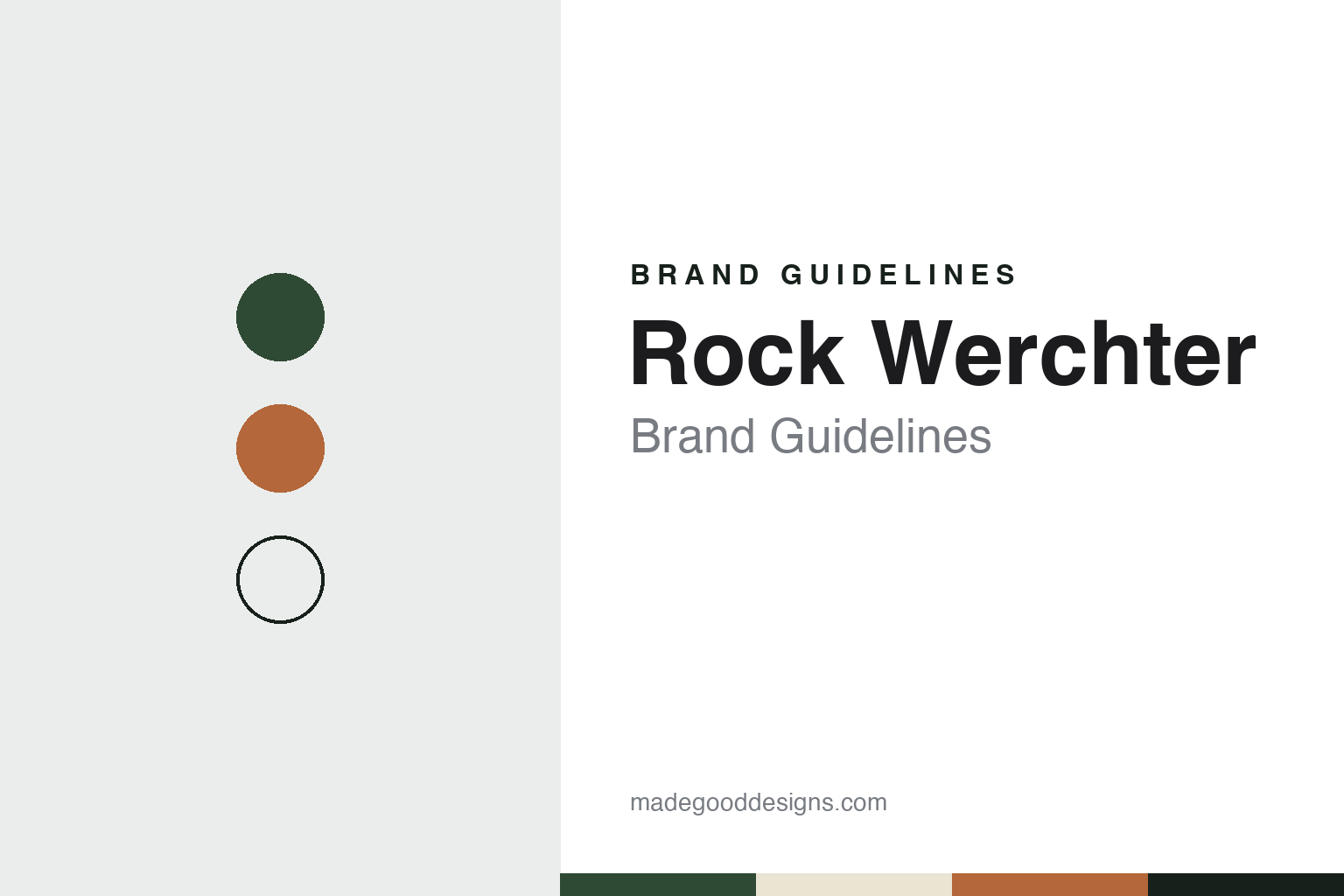
Rock Werchter Brand Guidelines
A tent in a village meadow that grew into a four-day festival park.
Aa
Two constants: a meadow green, clay and straw palette and a condensed festival sans register. Abstract homage — not a Rock Werchter asset; no logo, poster or wristband is reproduced.
Werchter, 1975
A youth-movement tent, then a meadow of its own.
Rock Werchter takes its name from Werchter, a village that is part of the municipality of Rotselaar in Flemish Brabant, a short distance from Leuven. Its story begins in the summer of 1975. The Canon van Vlaanderen, the Flemish history canon published in 2023, records that two bands played in rural Werchter that year for a few hundred people, on the initiative of the local Chiro group, the Catholic youth movement. VRT NWS, looking back in June 2025, gives the first name as the Rock & Blues Festival Werchter, held the day after a Chiro party in the same tent, for a little under 1,000 visitors; Pollstar noted in 2025 that the first edition was advertised as a “T-Dansant,” the old Belgian name for a Sunday-afternoon dance.
The tent had poles in the middle that blocked the view of the stage. According to the organiser Herman Schueremans, speaking to VRT NWS in 2025, that lesson led to an open-air stage of their own on another field along the Haachtsesteenweg — the seed of the stage-building company Stageco, later run by Hedwig De Meyer. Schueremans told Pollstar that the two of them started Stageco so that touring productions could play the festival in full.
In 1977 the festival joined forces with organisers in Torhout, in West Flanders. The Canon van Vlaanderen describes the result as the double festival Torhout/Werchter: the same artists played first in Torhout and then in Werchter, which allowed the organisation to book larger names. VRT NWS dates that arrangement from 1977 to 1998, with two day-festivals sharing one bill each summer, and the initials TW stayed in use long after.
Schueremans decided in 1999 to continue only in Werchter, over three days, VRT NWS reported; from 2003 the festival ran for four days. The name Rock Werchter has been used on its own since then, and the festival is held on the first weekend of the Belgian summer holidays — the last weekend of June or the first of July. The 50th-anniversary edition took place on 3–6 July 2025 at Werchter’s Festivalpark, Pollstar reported. The 2020 and 2021 editions did not take place.
Colour
Four stages, one festival park, a family of events.
The festival grounds are a large meadow with a main stage and covered halls, owned by the organisation, Dutch Wikipedia says. Pollstar’s 2025 interview lists four stages: a main stage for 63,000 people, The Barn for 20,000, KluB C for 10,000 and a stage for new acts, which VRT NWS names as The Slope, added in 2018. The two halls are fully darkened, with no pillars and with seating arranged in a U, Schueremans told Pollstar. English Wikipedia notes that The Barn opened in 2012 and that its Dutch name, De Schuur, plays on the organiser’s nickname, while KluB C replaced an earlier tent, the Pyramid Marquee, in 2013.
The ground itself has been rebuilt. VRT NWS reported in 2025 that the relaying of the Festivalpark was completed in 2018, with new levelling, gutters along the permanent paved areas and rainwater tunnels under the road, so that water drains away throughout the year. In 2006 a spatial plan for the site, known as the RUP Rock Werchter, was approved by the authorities, Dutch Wikipedia records.
Around the main festival, the same field hosts other events. TW Classic, held since 2002, is a one-day, one-stage concert named after the old Torhout-Werchter initials, English Wikipedia says, and Dutch Wikipedia adds the family-oriented Werchter Boutique, first held in 2008, and Werchter Parklife. Most of the campsites are run by local associations rather than by the organiser, according to Dutch Wikipedia, with exceptions such as The Hive and The Hive Resort.
The festival’s practical identity is visible on its website: each ticket includes a return train journey within Belgium to Leuven or Aarschot and a shuttle bus to Werchter, and food and drink on the Festival Park are paid for with “Coins,” the festival’s own digital currency, topped up through a code on the wristband. Since 2014 a stacked-container artwork, North West Walls, has stood on the meadow, Dutch Wikipedia says, with new murals added over the years.
Typography
How continental European festivals present themselves.
Music festivals in continental Europe usually take their names from a place or a coined word. Some carry the name of a village, a town, a racetrack or a stretch of seafront; others borrow the name of a youth club or invent a short word of their own, often in the local language. Rock Werchter is named after the Flemish village where it began in 1975; Pukkelpop kept the name of the Leopoldsburg youth house, De Pukkel, where its organisers met. Long names are soon cut down to initials on posters, wristbands and websites — TW for the old Torhout-Werchter, PKP with the year for Pukkelpop.
Behind the names stand different kinds of organiser. Some festivals were started by youth movements or non-profit associations and are still run by their founders; others are produced by promoters and festival companies, a number of which sit inside larger international live-entertainment groups. Municipalities appear in their institutional role, as landowners, planners or partners for transport. The organiser is rarely the face of the festival; its name sits in the small print.
The setting is part of the identity. A typical festival fills a festival park, a meadow, a racetrack, an airfield, a seafront or a farm for one long weekend, with several stages — often a large open-air main stage beside covered halls or tents — and campsites around the grounds. When a festival changes site, the new place name tends to join the dates in the line that sits beside the festival name.
Each year brings a new line-up poster, with headliners in large type above rows of smaller names, and an edition key visual that changes from year to year. Around these, a steady wordmark, the place and the dates hold the identity together, and some festival names have carried a title sponsor’s name for part of their history. This guide looks at how each festival handles that balance, using only what dated sources and the festivals’ own pages show.
Aa
A condensed sans for a village name set large. (Specimen set in Barlow Condensed, a sans STAND-IN; NOT the Rock Werchter logo.)
Live Nation Belgium
A local promoter inside an international group.
The festival has had corporate owners for most of its recent history. Asked by Pollstar in July 2025 how much Clear Channel’s arrival in 2001 and Live Nation’s in 2005 had changed things, Schueremans said both had let the team run the festival as it saw fit. In November 2025 Pollstar described him as chief executive and managing director of Live Nation Belgium, promoting the event since its first edition in 1975, and credited him with roles in founding the production companies Stageco and EML. VRT NWS, reporting in September 2026, named Rock Werchter among the Belgian festivals organised by Live Nation, alongside Graspop Metal Meeting.
The look of the festival has a documented author. From 1999 to 2019 the festival’s visual identity was designed each year by the Antwerp graphic designer and illustrator Tom Hautekiet, Dutch Wikipedia says, and English Wikipedia credits him with the festival’s posters and other graphics. That twenty-year run coincides with the period in which the festival dropped Torhout, grew to four days and rebuilt its grounds.
The festival has also been written up as history. A 2014 book, Rock Werchter sinds 1975, covered its first 40 years, and a companion book on Torhout, published in 2021, described the West Flemish half of the twin festival as a festival that no longer exists. The Canon van Vlaanderen uses Rock Werchter as its entry on Flemish festival culture, alongside Jazz Bilzen, first held in 1965, and later events such as Tomorrowland.
For a designer, the identity rests on a place name and a pair of initials. The village name carries the formal brand; TW survives as a shorthand in TW Classic; the stages have short, plain English names — The Barn, KluB C, The Slope — and the year sits beside the name on every edition. The yearly poster changed with each edition under Hautekiet, while the name and the July timing stayed fixed.
For a design guide, Rock Werchter shows how a festival can keep a village name and an old pair of initials while its ownership, its grounds and its length change around them. Compare Pukkelpop, the Limburg festival whose founders learned from the Torhout-Werchter organisers, and Tomorrowland, another Flemish summer festival. For this guide we use a meadow green, clay and straw with a sans, an unofficial interpretation; no product or logo is reproduced.
Explore & save
Keep Rock Werchter’s identity on hand — save it to a board in the Made Good inspiration library.
Rock Werchter identity set
Pin the Rock Werchter meadow green, clay and straw palette and the condensed festival sans register to your own board.
Source & notes
Frequently Asked Questions
What font can I use to match the Rock Werchter look?
This guide describes Rock Werchter’s type as “A condensed sans for a village name set large”. Its type specimen is set in Barlow Condensed from Google Fonts as a stand-in; Barlow Condensed is not Rock Werchter’s own lettering.
What colours are in the Rock Werchter palette?
This guide’s Rock Werchter palette is Meadow green #2F4A34, Riverbank clay #B4673A, Straw #EAE4D3, Field night #17201A and Paper #F7F5EF. The tones are the guide’s own unofficial interpretation, not official Rock Werchter hex codes.