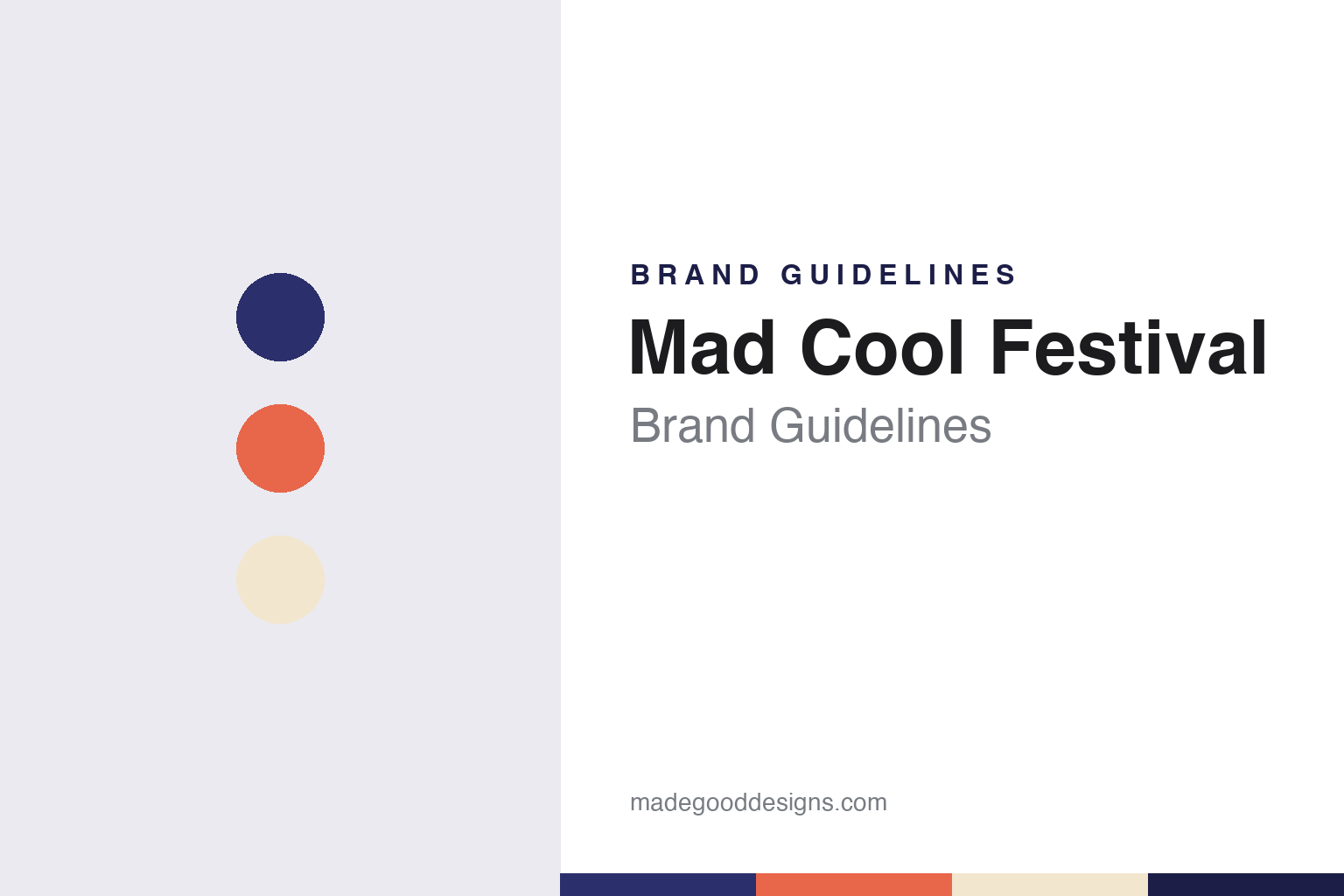
Mad Cool Festival Brand Guidelines
Madrid’s July music festival, from the Caja Mágica to Villaverde.
Aa
Two constants: an indigo, coral and dry-grass palette and a wide grotesque sans register. Abstract homage — not a Mad Cool Festival poster, wordmark or key visual; no logo is reproduced.
Caja Mágica, 2016
A new festival on the edge of Madrid.
Mad Cool Festival is a multi-day music festival held in Madrid. Its first edition took place on 16–18 June 2016 at the Caja Mágica in Madrid. The Spanish design and culture magazine Neo2, reviewing that first weekend on 22 June 2016, counted six stages: two main stages outdoors, three inside the Caja Mágica building and a sixth, smaller stage beside a design market, the Mercado del Diseño. It described a programme that ran from The Who to electronic acts, a Ferris wheel lit up over the site, and a giant multicoloured figure that came out to greet the crowd each day. Neo2 put attendance at 102,647 across the three days.
The second edition stayed at the Caja Mágica. Spanish Wikipedia dates it to 6–8 July 2017 and says it kept five stages, this time all of them outdoors. From 2017 on the festival settled into July, two weekends after the Madrid Pride celebrations, Spanish Wikipedia notes.
In 2018 the festival moved to a larger open-air site on an extension of the IFEMA trade-fair grounds, which Spanish Wikipedia calls Espacio Mad Cool. The news agency EFE, interviewing the festival’s two directors in December 2018, referred to the new site as opened that year and reported that the 2019 edition, held on 11–13 July 2019, would cap capacity at 75,000 people, down from 80,000 the year before. The 2020 edition did not take place. When the festival returned on 6–10 July 2022, it was again on the site by Valdebebas, according to an NME photo caption of 6 July 2022.
A third site followed in 2023. NME reported on 12 June 2023 that the festival was moving to a new site in Madrid’s Villaverde district, in partnership with Madrid City Council, for an edition on 6–8 July 2023. In March 2023 the newspaper El Independiente, citing the agency Servimedia, had reported that the promoter had bought around 190,000 square metres of land in Villaverde for a permanent multi-use site, described as a “Ciudad de la Música,” a city of music.
Colour
A promoter, a director and a long July weekend.
The company behind the festival is Mad Cool Events, which El Independiente described in March 2023 as the festival’s promoting company. Its director is Javier Arnáiz, who led the festival in its early years alongside a co-director, according to the EFE interview of December 2018. In that interview Arnáiz said the team had come to Madrid with experience of almost fifty festivals, and that one of the things the city had lacked was a physical space for an event of this kind. The two directors described the programming as “open, but with limits,” wide enough for electronic, folk and hard-rock acts on one bill.
The EFE interview also gives a sense of how the site was dressed. The directors said they had laid around 120,000 square metres of artificial grass at the Caja Mágica, and had raised a wall of recycled wood there so that the M-40 ring road could not be seen from the festival. The aim, the directors said, was a large-format festival with the quality of a small-format one.
The Villaverde site carries the name of its sponsor, Iberdrola Music. Pollstar reported on 4 December 2025 that the festival would return there, “its chosen home since 2023,” for its tenth-anniversary edition on 8–11 July 2026, with a line-up led by Foo Fighters. Spanish Wikipedia dates the seventh and eighth editions to 10–13 July 2024 and 10–13 July 2025, both on the same site. The festival’s own news pages name its stages after places and partners, among them an Orange Stage and a Region of Madrid Stage, and the festival says more than 200,000 people attended the four days of the 2026 edition.
In the same Pollstar interview, Arnáiz described the festival as a place to see major acts and rising names while exploring Madrid, and said “the real magic is the full experience: the atmosphere, the comfort, the energy of Madrid.” Mad Cool’s deputy director told Pollstar in May 2026 that the festival is “eclectic by nature,” bringing different generations, genres and cultures into one space, and that Spain sits between Europe and Latin America as a source of artists and audiences.
Typography
Festivals and their places.
Music festivals in continental Europe usually take their names from a place or a coined word. Some carry the name of a village, a town, a racetrack or a stretch of seafront; others borrow the name of a youth club or invent a short word of their own, often in the local language. Rock Werchter is named after the Flemish village where it began in 1975; Pukkelpop kept the name of the Leopoldsburg youth house, De Pukkel, where its organisers met. Long names are soon cut down to initials on posters, wristbands and websites — TW for the old Torhout-Werchter, PKP with the year for Pukkelpop.
Behind the names stand different kinds of organiser. Some festivals were started by youth movements or non-profit associations and are still run by their founders; others are produced by promoters and festival companies, a number of which sit inside larger international live-entertainment groups. Municipalities appear in their institutional role, as landowners, planners or partners for transport. The organiser is rarely the face of the festival; its name sits in the small print.
The setting is part of the identity. A typical festival fills a festival park, a meadow, a racetrack, an airfield, a seafront or a farm for one long weekend, with several stages — often a large open-air main stage beside covered halls or tents — and campsites around the grounds. When a festival changes site, the new place name tends to join the dates in the line that sits beside the festival name.
Each year brings a new line-up poster, with headliners in large type above rows of smaller names, and an edition key visual that changes from year to year. Around these, a steady wordmark, the place and the dates hold the identity together, and some festival names have carried a title sponsor’s name for part of their history. This guide looks at how each festival handles that balance, using only what dated sources and the festivals’ own pages show.
Aa
A wide grotesque sans for a festival name set in English. (Specimen set in Archivo, a sans STAND-IN; NOT the Mad Cool Festival logo.)
Mad Cool Festival
An English name for a Madrid weekend.
The festival’s name is in English, and the full form, Mad Cool Festival, is the one the organiser uses on its website and in its news pages; in Spanish press coverage it is often shortened to Mad Cool. Each edition is identified by its year, as in Mad Cool 2026, and the anniversary edition of 2026 was presented as the tenth.
What the sources describe of the festival’s look is mostly the site itself rather than a printed identity. Neo2’s 2016 review dwelt on the lit Ferris wheel and the giant multicoloured figure that appeared each day, and on a stage set beside a design market. The directors, speaking to EFE in 2018, pointed to the artificial grass and the recycled-wood screen at the Caja Mágica. Each move since has brought a new layout: Spanish Wikipedia counts seven stages at the 2018 site, four outdoors and three in tents, and the Villaverde site has carried the Iberdrola Music name since 2023.
For a design guide, Mad Cool Festival shows how a young city festival builds recognition through its name, its July dates and the way its site is dressed, while the ground underneath it changes. Compare Primavera Sound, another Spanish city festival, and Festival Internacional de Benicàssim, held on Spain’s Mediterranean coast in July. For this guide we use a night indigo, a sunset coral and a dry-grass cream with a sans, an unofficial interpretation; no product or logo is reproduced.
Explore & save
Keep Mad Cool Festival’s identity on hand — save it to a board in the Made Good inspiration library.
Mad Cool Festival identity set
Pin the Mad Cool Festival indigo, coral and dry-grass palette and the wide grotesque sans register to your own board.
Source & notes
Frequently Asked Questions
What font can I use to match the Mad Cool Festival look?
This guide describes Mad Cool Festival’s type as “A wide grotesque sans for a festival name set in English”. Its type specimen is set in Archivo from Google Fonts as a stand-in; Archivo is not Mad Cool Festival’s own lettering.
What colours are in the Mad Cool Festival palette?
This guide’s Mad Cool Festival palette is Night indigo #2B2F6B, Deep indigo #1C1E47, Sunset coral #E8664A, Dry grass #F2E6CF and Paper #FAF7F1. The tones are the guide’s own unofficial interpretation, not official Mad Cool Festival hex codes.