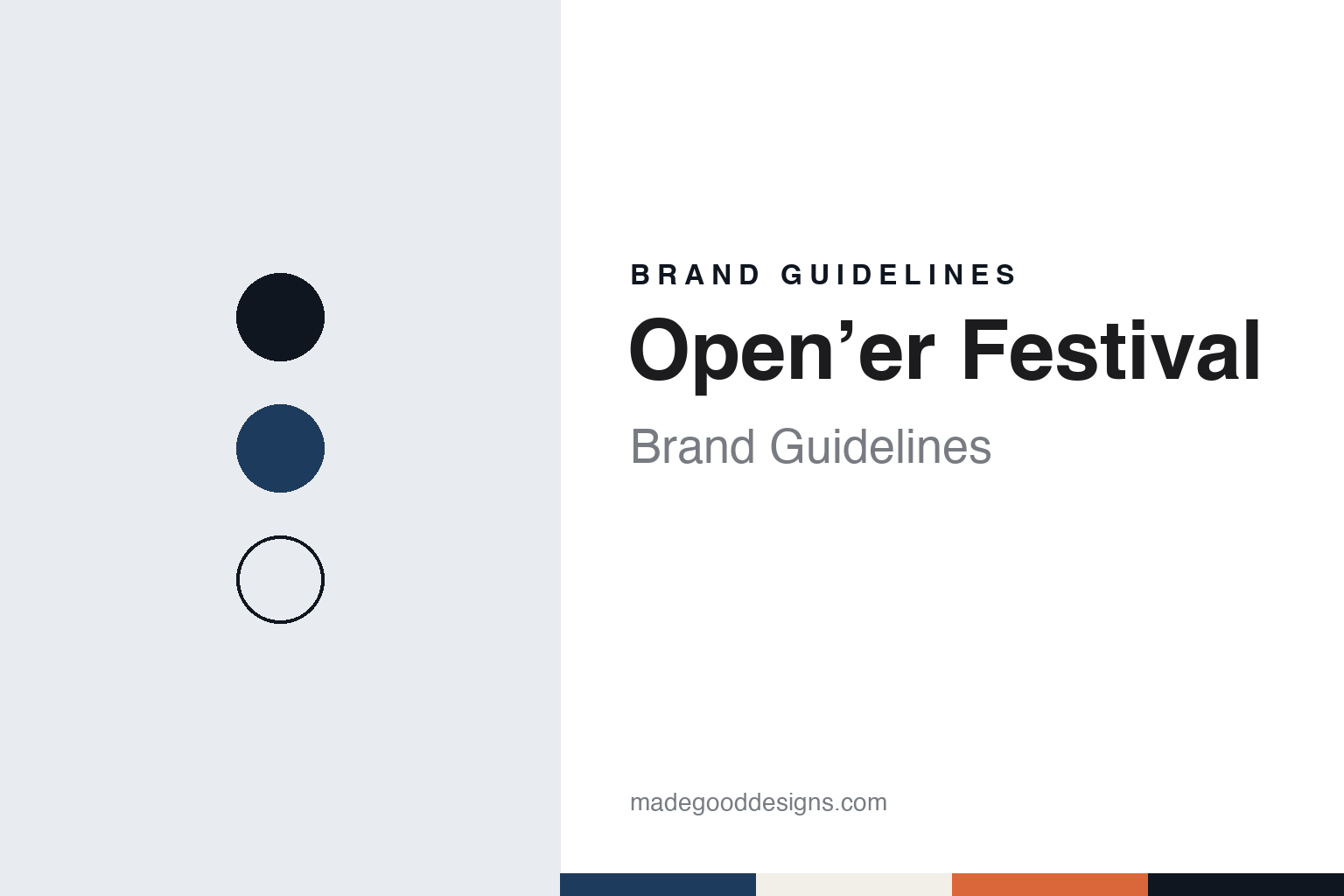
Open’er Festival Brand Guidelines
From a Warsaw skating track to the Gdynia airfield.
Aa
Two constants: a Baltic blue, runway grey and sunset orange palette and an airfield grotesk register. Abstract homage — not an Open’er Festival poster or mark; no logo, poster or artwork is reproduced.
Warsaw, 2002
One day at a skating track, then the coast.
Open’er Festival began as a one-day concert in Warsaw in 2002. Polish Wikipedia says the first edition was held at the Stegny ice-skating track in the city under the name Open Air Festival, and the festival’s own history page says that day brought The Chemical Brothers to Poland for the first time. Pollstar, writing in July 2010, put the 2002 crowd at a sold-out 10,000 at Tor Stegny.
The festival moved to the Baltic coast the following year. From 2003 to 2005 it was held on Kościuszko Square (Skwer Kościuszki) in the port city of Gdynia, Polish Wikipedia and the festival’s history page both say. The 2004 edition ran for two days, and the festival says 25,000 people came in 2005.
In 2006 the square had become too small for the crowd, the festival’s history says, and Open’er moved to the airfield at Babie Doły–Kosakowo, beside Gdynia, which is now called the Gdynia-Kosakowo Airfield. The festival grew to three days that year and, according to Polish Wikipedia, to four days by 2009, when it had three stages running at the same time: a Main Stage, a World Stage and a Tent Stage. The airfield has been its home ever since.
The tenth edition, in 2011, was marked with an anniversary album titled Open’er Dekada, Polish Wikipedia says. The 2020 and 2021 festivals did not take place. In 2021 the organiser instead ran a separate summer event, Open’er Park, in Kolibki Park in Gdynia, with 23 concert days spread over six weeks, the festival’s history page says, and the airfield edition returned in 2022. The festival counted its 2023 edition as the twentieth and its 2025 edition as the twenty-second.
Colour
A Warsaw promoter and a week by the sea.
The festival is organised by Alter Art, a concert and festival promoter based in Warsaw; Polish Wikipedia names the organising company as Alter Art Festival Sp. z o.o. Pollstar reported in July 2010 that Alter Art, under Mikołaj Ziółkowski, had run the event since it began, and in August 2023 it described Ziółkowski as the founder and director of Alter Art, whose festivals also include Kraków Live.
The 2010 Pollstar report gives a picture of the festival at the end of its first decade: some 60,000 people a day at the Babie Doły airfield from 1 to 4 July, and, by Ziółkowski’s account, around a fifth of the crowd from outside Poland, most of them British, with others from the Baltic states. He told Pollstar that the organisers had set out to build a festival in the mould of Rock Werchter in Belgium or Roskilde in Denmark, and that what such festivals share is a main stage area where everyone on the site can see the headline acts.
The festival runs for four days at the turn of June and July. Its website, read in November 2026, says the 2025 edition welcomed 140,000 people over its four days; the festival says the 2024 edition drew more than 130,000 individual visitors. Polish Wikipedia gives a figure of 140,000 over four days for 2018. In 2023 Ziółkowski described the work to Pollstar as building “an entire city of culture inside a field, where there is usually nothing.”
Open’er has also widened beyond concerts. Polish Wikipedia says the festival adopted the formula “Music & Arts” in 2012, and that the Museum of Modern Art in Warsaw has brought commissioned exhibitions to a hangar on the site since then. Theatre arrived the same year, mainly in cooperation with Warsaw’s Nowy Teatr, whose production of Angels in America played to large audiences at the airfield, and a permanent gallery of large artworks began with a multicoloured totem sculpture in 2012. The festival’s history page also names a fashion space, the Fashion Stage, a cinema strand called Alterkino and a discussion tent called Let’s Talk.
Typography
Music festivals in continental Europe.
Music festivals in continental Europe usually take their names from a place or a coined word. Some carry the name of a village, a town, a racetrack or a stretch of seafront; others borrow the name of a youth club or invent a short word of their own, often in the local language. Rock Werchter is named after the Flemish village where it began in 1975; Pukkelpop kept the name of the Leopoldsburg youth house, De Pukkel, where its organisers met. Long names are soon cut down to initials on posters, wristbands and websites — TW for the old Torhout-Werchter, PKP with the year for Pukkelpop.
Behind the names stand different kinds of organiser. Some festivals were started by youth movements or non-profit associations and are still run by their founders; others are produced by promoters and festival companies, a number of which sit inside larger international live-entertainment groups. Municipalities appear in their institutional role, as landowners, planners or partners for transport. The organiser is rarely the face of the festival; its name sits in the small print.
The setting is part of the identity. A typical festival fills a festival park, a meadow, a racetrack, an airfield, a seafront or a farm for one long weekend, with several stages — often a large open-air main stage beside covered halls or tents — and campsites around the grounds. When a festival changes site, the new place name tends to join the dates in the line that sits beside the festival name.
Each year brings a new line-up poster, with headliners in large type above rows of smaller names, and an edition key visual that changes from year to year. Around these, a steady wordmark, the place and the dates hold the identity together, and some festival names have carried a title sponsor’s name for part of their history. This guide looks at how each festival handles that balance, using only what dated sources and the festivals’ own pages show.
Aa
A crisp grotesk for a name written with an apostrophe. (Specimen set in Space Grotesk, a sans STAND-IN; NOT the Open’er Festival logo.)
Open’er
An apostrophe, a hashtag and a row of stages.
The name is short and written with an apostrophe: Open’er. On the festival’s website in November 2026 editions are tagged with a hashtag that joins the year directly to the name, and the same pages run a history section with an archive of the posters from past editions alongside a year-by-year account of each festival. Until 2013 the full name also carried a title sponsor’s brand, Polish Wikipedia says.
Stage names form a second layer of the identity. Polish Wikipedia’s listing for 2015 names four stages, the Main Stage, the Tent Stage, the Alter Stage and the Beat Stage, each with its own running order across the four days; for 2014 it lists a stage named after the festival itself, the Open’er Stage. The Tent Stage, under cover, has been part of the plan since the early airfield years, and Polish Wikipedia describes a chill-out zone set up in one of the airfield hangars in 2006.
Wristbands have been part of the experience from the start of the airfield years. Polish Wikipedia says that in 2006 each ticket was exchanged at the gate for a wristband, which also served as a ticket for a free bus from the centre of Gdynia to the main gate, and that the same system was used in 2009 for buses to and from the site. The festival’s own history page presents each year through its line-up, mixing international headliners with Polish artists, and says the festival gives Polish performers a chance to play to audiences of tens of thousands, often for the first time.
For a design guide, Open’er Festival shows how a festival can keep one compact, punctuated name while moving from a skating track to a city square to an airfield, and widen from music into theatre and art. Compare Rock Werchter and the Roskilde Festival, the two festivals its organiser named as models in 2010. For this guide we use a Baltic blue, a runway grey and a sunset orange with a sans, an unofficial interpretation; no product or logo is reproduced.
Explore & save
Keep Open’er Festival’s identity on hand — save it to a board in the Made Good inspiration library.
Open’er Festival identity set
Pin the Open’er Festival Baltic blue, runway grey and sunset orange palette and the airfield grotesk register to your own board.
Source & notes
Frequently Asked Questions
What font can I use to match the Open’er Festival look?
This guide describes Open’er Festival’s type as “A crisp grotesk for a name written with an apostrophe”. Its type specimen is set in Space Grotesk from Google Fonts as a stand-in; Space Grotesk is not Open’er Festival’s own lettering.
What colours are in the Open’er Festival palette?
This guide’s Open’er Festival palette is Baltic blue #1D3B5C, Runway grey #9AA3A8, Dune white #F2EFE8, Sunset orange #D9673A and Ink #10161F. The tones are the guide’s own unofficial interpretation, not official Open’er Festival hex codes.
When was Open’er Festival founded?
Open’er Festival was founded in 2002, in Warsaw, Poland.