NOS Alive Brand Guidelines
A July festival on the riverside at Algés, near Lisbon.
Aa
Two constants: a teal, late-sun and river-sand palette and a condensed sans register. Abstract homage — not a NOS Alive poster, wordmark or key visual; no logo is reproduced.
Alive!07
A new promoter and a riverside field.
NOS Alive began with a new promoter. Pollstar reported on 19 May 2007 that Álvaro Covões, after seventeen years at the Portuguese promoter Música no Coração, had set up Everything Is New at the start of that year, bringing in former colleagues, with the aim of working more with international touring acts. Within months the new company had announced a three-day festival, Alive!07, for 8–10 June 2007.
The site was in Algés, in the municipality of Oeiras, just west of Lisbon. Pollstar described it as a site with room for 40,000 people on the banks of the River Tagus, a wide expanse of grassland next to the old docklands. The first bill included Pearl Jam, The White Stripes and Linkin Park. Portuguese Wikipedia gives the first edition’s name as Oeiras Alive!, after the municipality.
The festival has kept that riverside site. Portuguese Wikipedia places every edition on the Passeio Marítimo de Algés, the seafront promenade, and the Portuguese news agency Lusa, in a report carried by SAPO on 13 July 2024, wrote that the festival was first held in 2007 and takes place every year in July, always on the Passeio Marítimo de Algés. Lusa added that the management of the area is shared between the Oeiras municipality and the Port of Lisbon Administration.
The dates moved to July from the second year. Portuguese Wikipedia dates the 2008 edition to 10–12 July 2008, by then under the name Optimus Alive!, and the following editions to early or mid-July. The 2011 edition was the first to run for four days, on 6–9 July; the tenth edition, in 2016, was held on 7–9 July. The 2020 and 2021 editions did not take place, and the festival returned on 6–9 July 2022.
Colour
A title sponsor in the name.
The festival’s name has followed its title sponsor. For its second edition it became Optimus Alive!, after the Portuguese telecoms company Optimus. In 2013 Optimus merged with the communications company ZON Multimédia, and the merged company, first called ZON OPTIMUS, took the name NOS, according to Portuguese Wikipedia. The festival followed: it has been called NOS Alive since 2014, named after its title sponsor, the telecoms company NOS. Portuguese Wikipedia lists that year’s edition, the eighth, as Optimus/NOS Alive, held on the Passeio Marítimo de Algés on 10–12 July 2014.
The change was fresh when the 2014 edition opened. The newspaper Diário de Notícias, reporting from the gates on 10 July 2014, wrote that the first band on stage greeted the crowd with “Welcome to Optimus Alive 2014!” and noted that most people inside were still confused by the names of “the now NOS Alive, which until recently was called Optimus Alive.” That opening band had been chosen through the sponsor’s Live Act contest, which, the paper said, drew almost 600 applications from bands and DJs that year. Portuguese Wikipedia records a similar thread in 2009, when a third stage was given over to bands from a sponsor initiative that released EPs by Portuguese artists online, free and legally.
Everything Is New remains the organiser. The 2024 edition, the sixteenth, sold out at 55,000 people a day, the promoter told Lusa, with 124 artists giving 129 performances; Pearl Jam, who had played the first edition in 2007, headlined the main stage on the closing night. Covões, speaking for Everything Is New at the press conference that closed that edition, announced the 2025 edition for 10–12 July 2025 on the same promenade.
The festival’s own website, in its 2026 version, keeps a list of previous editions running back to 2007 under the NOS Alive name, and its footer names Everything Is New as the rights holder and the creative agency Temper as the designer of the site. It explains that a festival pass is exchanged on the first day for a NOS Alive wristband, worn for all three days.
Typography
Festivals and their places.
Music festivals in continental Europe usually take their names from a place or a coined word. Some carry the name of a village, a town, a racetrack or a stretch of seafront; others borrow the name of a youth club or invent a short word of their own, often in the local language. Rock Werchter is named after the Flemish village where it began in 1975; Pukkelpop kept the name of the Leopoldsburg youth house, De Pukkel, where its organisers met. Long names are soon cut down to initials on posters, wristbands and websites — TW for the old Torhout-Werchter, PKP with the year for Pukkelpop.
Behind the names stand different kinds of organiser. Some festivals were started by youth movements or non-profit associations and are still run by their founders; others are produced by promoters and festival companies, a number of which sit inside larger international live-entertainment groups. Municipalities appear in their institutional role, as landowners, planners or partners for transport. The organiser is rarely the face of the festival; its name sits in the small print.
The setting is part of the identity. A typical festival fills a festival park, a meadow, a racetrack, an airfield, a seafront or a farm for one long weekend, with several stages — often a large open-air main stage beside covered halls or tents — and campsites around the grounds. When a festival changes site, the new place name tends to join the dates in the line that sits beside the festival name.
Each year brings a new line-up poster, with headliners in large type above rows of smaller names, and an edition key visual that changes from year to year. Around these, a steady wordmark, the place and the dates hold the identity together, and some festival names have carried a title sponsor’s name for part of their history. This guide looks at how each festival handles that balance, using only what dated sources and the festivals’ own pages show.
Aa
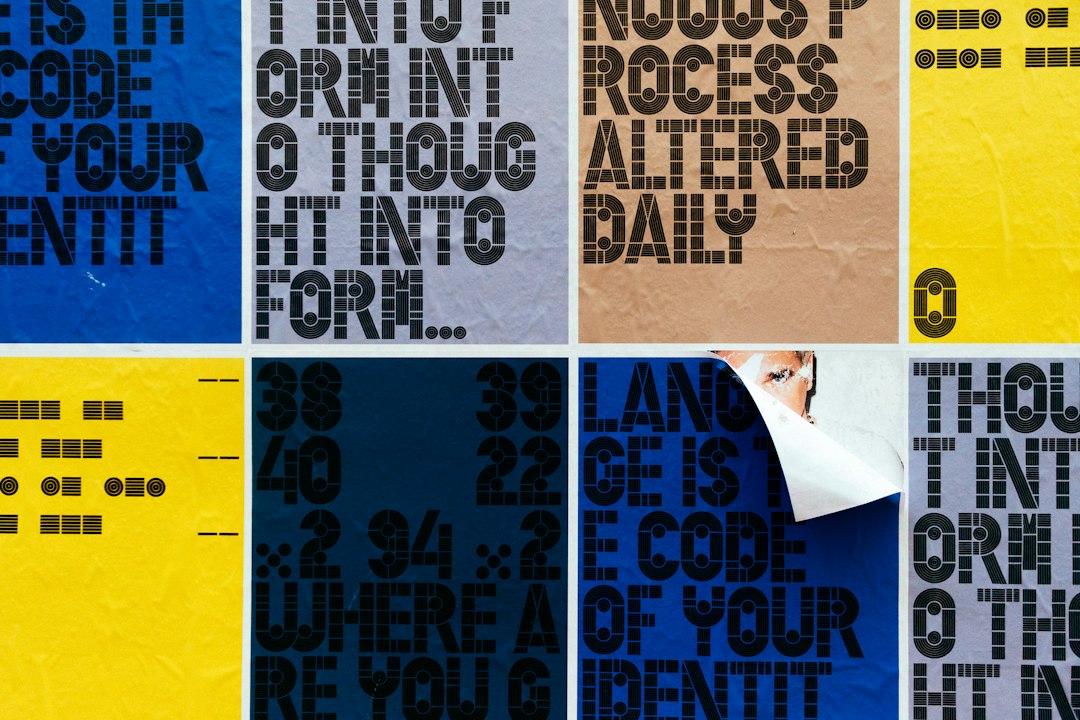
A condensed sans for a short, two-word name. (Specimen set in Barlow Condensed, a sans STAND-IN; NOT the NOS Alive logo.)
NOS Alive
One word that stays, one that changes.
The festival’s name has two parts. The word Alive has stayed since 2007; the word in front of it has changed with the title sponsor, from the municipality’s name in Portuguese Wikipedia’s account of the first year, to Optimus from 2008, to NOS from 2014. The year is usually attached as a short suffix: the first edition was announced as Alive!07, later editions appear as Optimus Alive!08 or Optimus Alive ’11, and the festival’s 2026 website writes NOS Alive’26 and NOS Alive’27. In news copy the core word can also stand alone: Lusa’s report of July 2024 opens by calling the event simply “the Alive festival,” returning to Algés the following July.
The setting does much of the rest. Pollstar’s 2007 description of grassland beside the old docklands on the Tagus still fits the Passeio Marítimo de Algés, which Lusa in 2024 placed at the centre of the festival’s identity: every edition held there, every edition in July. The wristband, the year suffix and the riverside promenade are the constants that carry from one edition to the next.
For a design guide, NOS Alive shows how a festival can keep a steady core word while the name around it changes with its sponsor, and how a single site and a fixed month do the work of a mark. Compare Rock in Rio, which has also held editions in Lisbon, and Mad Cool Festival, another July festival on the Iberian peninsula. For this guide we use a Tagus teal, a late-sun ochre and a river-sand cream with a sans, an unofficial interpretation; no product or logo is reproduced.
Explore & save
Keep NOS Alive’s identity on hand — save it to a board in the Made Good inspiration library.
NOS Alive identity set
Pin the NOS Alive teal, late-sun and river-sand palette and the condensed sans register to your own board.
Source & notes
Frequently Asked Questions
What font can I use to match the NOS Alive look?
This guide describes NOS Alive’s type as “A condensed sans for a short, two-word name”. Its type specimen is set in Barlow Condensed from Google Fonts as a stand-in; Barlow Condensed is not NOS Alive’s own lettering.
What colours are in the NOS Alive palette?
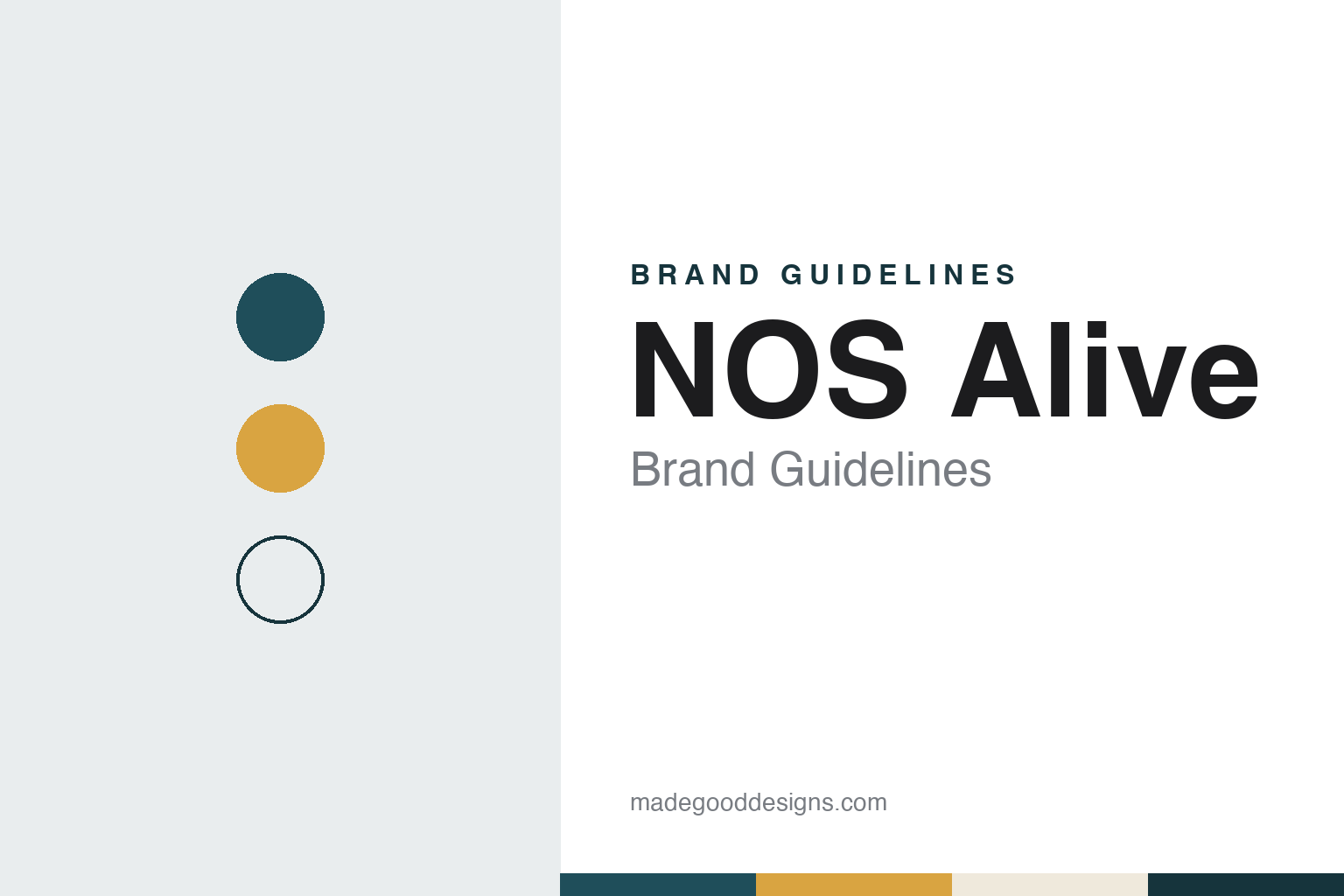
This guide’s NOS Alive palette is Tagus teal #1F4E5A, Deep estuary #16343C, Late sun #D9A441, River sand #EFE9DC and Paper #FAF8F3. The tones are the guide’s own unofficial interpretation, not official NOS Alive hex codes.