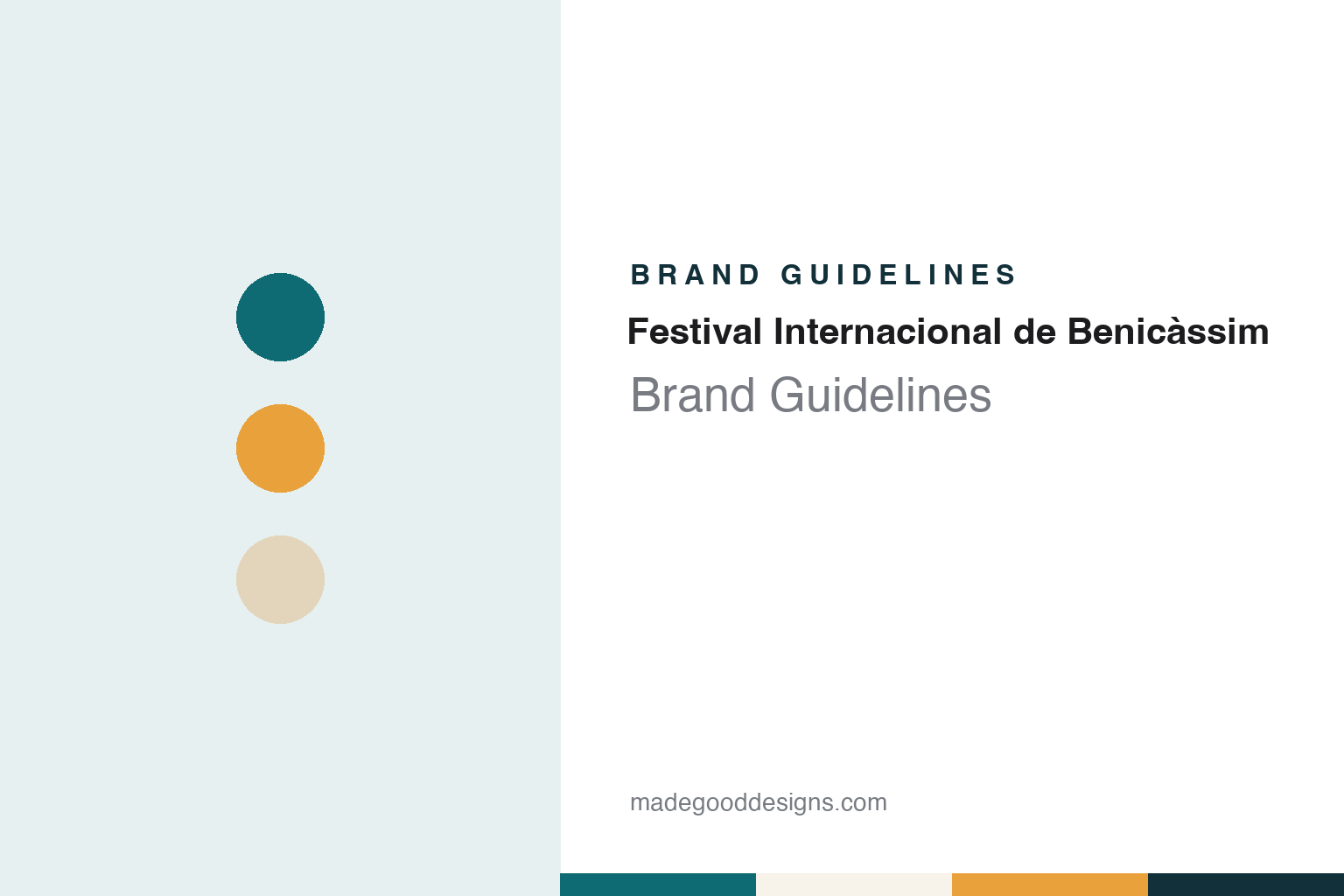
Festival Internacional de Benicàssim Brand Guidelines
An indie weekend at a seaside velodrome that grew into a July festival beside the coast road.
Aa
Two constants: an Azahar teal, July orange and beach sand palette and a Geometric grotesque register. Abstract homage — not a FIB asset or mark; no logo, poster, artwork or wordmark is reproduced.
An independent festival
Thirty bands at a velodrome on the Costa del Azahar.
The Festival Internacional de Benicàssim — known for short as FIB — is held each summer in Benicàssim, a seaside town in the province of Castellón, on the Valencian coast. Spanish Wikipedia describes it as a festival of pop, rock, indie and electronic music, with theatre, fashion and film alongside, held every year since 1995.
Its first name was different. Spanish Wikipedia says the festival began as the Festival Independiente de Benicàssim, keeping the same initials when “Independiente” later became “Internacional.” It was created in 1995 by two brothers from León who lived in Madrid, Miguel and José Morán, together with the founder of the record label Elefant Records and the founder of the magazine Spiral. The Valencian newspaper Valencia Plaza reported in July 2019 that the Morán brothers launched the festival in 1995 with the organising company Maraworld.
The idea was to bring about thirty independent bands, Spanish and international, to one town. Spanish Wikipedia says the concerts of that first edition were held at the Velódromo de Benicàssim, the town’s cycling track. The festival returned to the velodrome in 1996 and 1997, adding electronic music in 1996 and, in 1997, a film-and-music programme and extra opening and closing parties. Two of the four founders left the festival’s direction in 1997, the same article says.
In 1998 the festival moved to a larger site on the edge of the town, beside the N-340 coast road, where it has stayed. Spanish Wikipedia says the space allowed tents and stages to be added as the festival grew; in 1998 a chill-out tent joined the bill.
Colour
August, then July, and a run of new owners.
For its first decade FIB was an August festival. English Wikipedia gives the 2005 edition as 5–7 August and the 2006 edition as 20–23 July; Spanish Wikipedia says the festival was held around the first weekend of August until 2005 and has been held in mid-July since then. It has run through the night, with music from late afternoon until morning on its main stages, according to English Wikipedia. Its main stage is called Las Palmas, a name the festival itself used in a statement quoted by Valencia Plaza in May 2020.
Ownership has changed several times. Spanish Wikipedia says the British festival promoter Vince Power joined the shareholding of the organising company in 2006, and that after the 2009 edition the Morán brothers left the company entirely, leaving it wholly in Power’s hands; Valencia Plaza dates his acquisition of the brand rights to 2009. Four years later, the same newspaper reported, the festival passed to a new owner, an English businessman who was still its director at the 2019 edition.
The next change came in July 2019. The day after the 25th edition ended on 22 July, Valencia Plaza and its sister paper Alicante Plaza reported, the Valencia promoter The Music Republic — already behind the Arenal Sound festival in nearby Burriana and the Festival de les Arts in Valencia — announced an agreement with the owners to take control and management of FIB for at least fifteen years. Alicante Plaza also reported in December 2019 that Benicàssim town council had bought the festival land, which until then had been split between some twenty owners.
The 2020 edition did not take place, Valencia Plaza reported on 18 May 2020. In January 2023 Pollstar, citing the Spanish newspaper El Confidencial, reported that the investment firm Providence Equity, through the festival group Superstruct, had acquired all of The Music Republic, whose events include FIB, Arenal Sound and Viña Rock. In June 2024 Valencia Plaza reported that the American investment firm KKR had announced the purchase of Superstruct, the group that includes The Music Republic’s festivals, and that the promoter’s founders had kept day-to-day management until then.
Typography
Design and documentation.
Music festivals in continental Europe usually take their names from a place or a coined word. Some carry the name of a village, a town, a racetrack or a stretch of seafront; others borrow the name of a youth club or invent a short word of their own, often in the local language. Rock Werchter is named after the Flemish village where it began in 1975; Pukkelpop kept the name of the Leopoldsburg youth house, De Pukkel, where its organisers met. Long names are soon cut down to initials on posters, wristbands and websites — TW for the old Torhout-Werchter, PKP with the year for Pukkelpop.
Behind the names stand different kinds of organiser. Some festivals were started by youth movements or non-profit associations and are still run by their founders; others are produced by promoters and festival companies, a number of which sit inside larger international live-entertainment groups. Municipalities appear in their institutional role, as landowners, planners or partners for transport. The organiser is rarely the face of the festival; its name sits in the small print.
The setting is part of the identity. A typical festival fills a festival park, a meadow, a racetrack, an airfield, a seafront or a farm for one long weekend, with several stages — often a large open-air main stage beside covered halls or tents — and campsites around the grounds. When a festival changes site, the new place name tends to join the dates in the line that sits beside the festival name.
Each year brings a new line-up poster, with headliners in large type above rows of smaller names, and an edition key visual that changes from year to year. Around these, a steady wordmark, the place and the dates hold the identity together, and some festival names have carried a title sponsor’s name for part of their history. This guide looks at how each festival handles that balance, using only what dated sources and the festivals’ own pages show.
Aa
A geometric grotesque — three capital letters that do most of the work. (Specimen set in Space Grotesk, a sans STAND-IN; NOT the FIB logo or wordmark.)
FIB
Three letters, kept through a change of name.
The festival’s steadiest element is its abbreviation. Because “Independiente” and “Internacional” begin with the same letter, the switch between the two names left the initials untouched, and FIB has carried the festival from its first edition to its current one. The festival’s own website is titled “FIB Benicàssim” and sets the full name, Festival Internacional de Benicàssim, in capital letters above the dates.
The other constant is the place. Benicàssim lies on the stretch of coast known as the Costa del Azahar, and the festival’s own language leans on it: in its May 2020 statement, quoted by Valencia Plaza, it spoke of the sand of the Costa del Azahar, the Mediterranean breeze and the photograph visitors take in front of the large FIB sign at the entrance before heading to the Las Palmas stage.
Campers are part of the picture. English Wikipedia says holders of multi-day passes can camp from the Monday before the festival until the Tuesday after, which turns a long weekend into most of a week by the coast road.
The festival’s owners have changed several times since 2006, but the name, the initials and the July date have stayed in place. Its website today keeps the full name in capitals rather than the initials alone.
For a design guide, the Festival Internacional de Benicàssim shows how a set of initials can outlast a change of name and several changes of owner, and how a seaside setting can supply a whole visual vocabulary. Compare Primavera Sound, another Spanish festival on the Mediterranean, and Sónar, the Barcelona festival that Pollstar reported in 2023 had also taken investment from Providence. For this guide we use an Azahar teal, a July orange and a beach sand with a geometric sans, an unofficial interpretation; no product or logo is reproduced.
Explore & save
Keep Festival Internacional de Benicàssim’s identity on hand — save it to a board in the Made Good inspiration library.
FIB identity set
Pin the FIB Azahar teal, July orange and beach sand palette and the Geometric grotesque register to your own board.
Source & notes
Frequently Asked Questions
What font can I use to match the Festival Internacional de Benicàssim look?
This guide describes Festival Internacional de Benicàssim’s type as “A geometric grotesque — three capital letters that do most of the work”. Its type specimen is set in Space Grotesk from Google Fonts as a stand-in; Space Grotesk is not Festival Internacional de Benicàssim’s own lettering.
What colours are in the Festival Internacional de Benicàssim palette?
This guide’s Festival Internacional de Benicàssim palette is Azahar Teal #0E6B73, Night Coast #12303A, July Orange #E9A23B, Beach Sand #E3D5BC and Paper #FBF9F5. The tones are the guide’s own unofficial interpretation, not official Festival Internacional de Benicàssim hex codes.
Who founded Festival Internacional de Benicàssim?
Festival Internacional de Benicàssim was founded by Miguel and José Morán, with partners.
Who owns Festival Internacional de Benicàssim?
Festival Internacional de Benicàssim is owned by The Music Republic (since 2019).