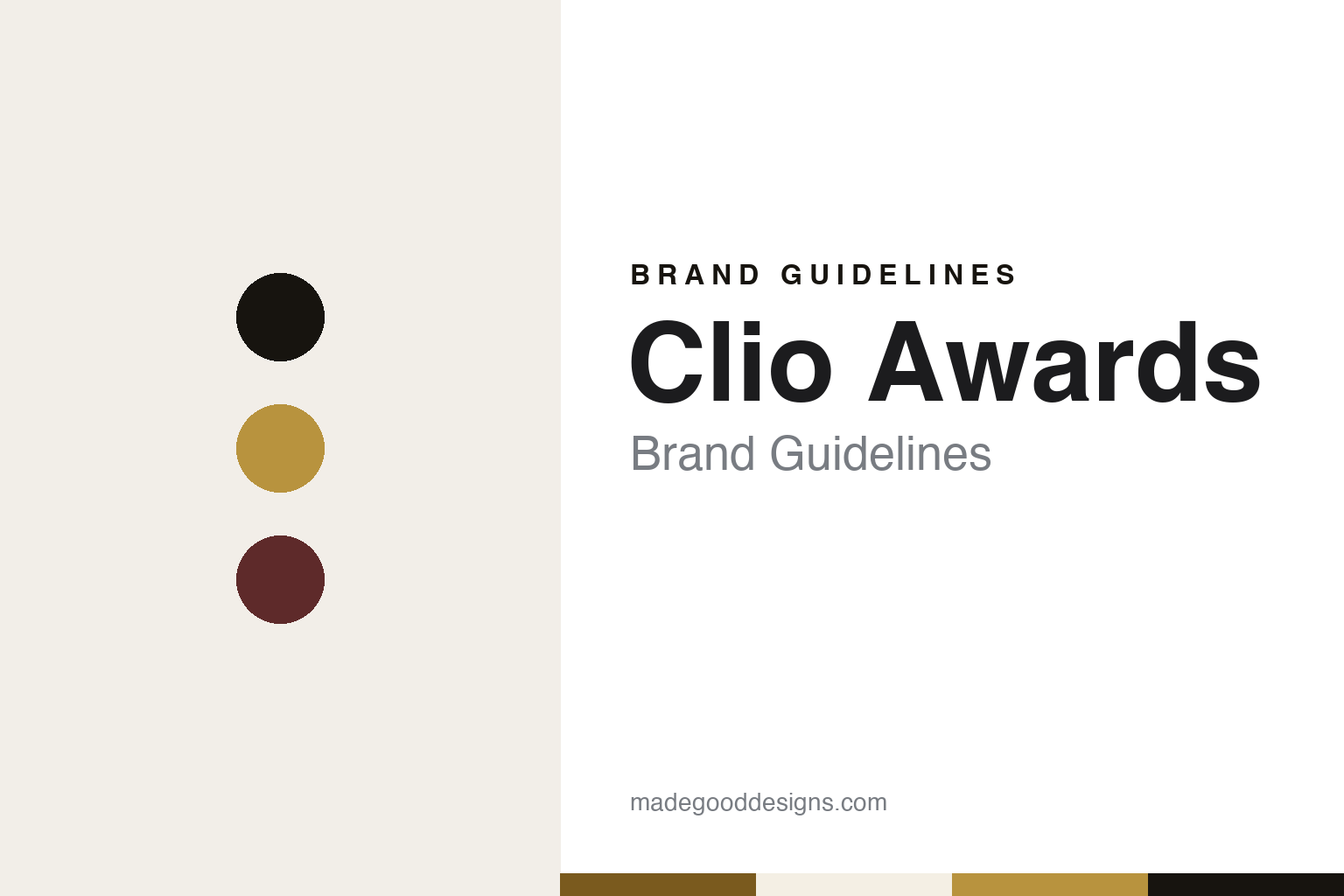
Clio Awards Brand Guidelines
A muse’s name, a gold figure and a May night of statues.
Aa
Two constants: a statue bronze, muse gold and velvet oxblood palette and a High-contrast display serif register. Abstract homage — not a Clio Awards asset, statuette or mark; no trophy or logo is reproduced.
A festival for commercials
Wallace A. Ross, a muse and the first statuettes of 1960.
The Clio Awards were founded in 1959 by Wallace A. Ross, a New York advertising executive, and the organiser still gives 1959 as its founding year on its own “About Clio” page. English Wikipedia says Ross set up the awards together with the American Television Commercials Festival, which he also directed and which served as the parent of the prize in its first years. The name comes from Clio, the Muse of history in Greek mythology, described in The Guide to United States Popular Culture as the proclaimer and celebrator of great deeds.
The first Clios were presented in 1960, for United States television advertising; an Indiana University news release of December 2017 also dates the first awards to 1960. English Wikipedia, citing the same guide, says the competition opened to international television and cinema work in 1966 and to American radio advertising in 1967, and that each winner received a gold statuette designed by Georg Olden, the American graphic designer.
The programme changed hands in the early 1970s. English Wikipedia dates the sale to a new owner to 1971, and the Los Angeles Times, writing in September 1992, said the purchase had taken place about twenty years earlier. Under that owner the competition grew across media: English Wikipedia lists American print advertising from 1971, international print from 1972, international radio from 1974, packaging design from 1976 and American cable work from 1983. The Los Angeles Times reported in 1992 that the programme had earlier offered some 250 categories, and that its ceremonies had once been held at Lincoln Center in New York.
Colour
A 1992 relaunch, new owners and six programmes.
The awards changed hands again in 1992. According to the Los Angeles Times, a Chicago trade-paper publisher acquired the Clio name and staged the New Clio Awards at the Waldorf-Astoria in New York on 15 September 1992, with the number of categories cut to 169. In February 1993 the Chicago Tribune reported that another Chicago businessman had taken sole ownership of the awards.
Later owners were publishing groups. English Wikipedia says the Clios were sold in 1997 to the Dutch-owned group VNU, owner of Adweek, which renamed itself the Nielsen Company in 2007. Bizcommunity reported in December 2009 that Nielsen Business Media had agreed to sell eight properties, among them Adweek, The Hollywood Reporter, Billboard and the Clio Awards, to a new company, e5 Global Media. In September 2017 Adweek reported that the Clio Awards had been acquired by the investment company Evolution Media, and quoted the Clio president, Nicole Purcell, as saying the awards would join Evolution Media’s portfolio; the report said the annual show would continue without significant leadership or structural changes.
The flagship has since been joined by sister programmes, which the organiser calls verticals. Its entry pages list six: the Clio Awards, Clio Health (founded in 2009), Clio Music and Clio Sports (both founded in 2014), Clio Entertainment and Clio Creators (founded in 2026). English Wikipedia says Clio Entertainment grew out of The Hollywood Reporter’s Key Art Awards, which Clio took over in 2014 and renamed in 2017.
The films entered in the early decades now sit in a university archive. The Indiana University news release of 14 December 2017 said its Libraries Moving Image Archive had acquired the former Clio archive, about 11,000 reels of 16 mm and 35 mm film holding American commercials dated from 1959 to 1991, which had been stored in a New York warehouse since 1992, when London International Advertising Awards bought it from the Clio organisation.
Typography
How advertising and creative awards present themselves.
Advertising and creative awards tend to present themselves through very few elements. The name is usually short: a set of initials, a club’s name, or the city where the festival takes place. Next to it sits a trophy with a name and a shape of its own, such as a lion, a pencil, a statuette, a cube or an eye, and that object often does the work of a logo, lending its name to the levels of award and to the everyday talk around them.
The organisations behind these programmes vary. Some are associations or clubs formed by working designers, art directors and copywriters; some are registered charities or non-profits; others are run by publishers or events companies, and a few have changed owners as those companies were bought and sold. Where a programme has a parent company, the festival name usually stays in front and the owner appears in the small print.
Most follow a yearly cycle. Entries open months ahead, juries of practitioners meet in rounds, a shortlist is published, and the awards are given at a ceremony or during a festival week, often with talks, workshops and student competitions alongside. Award levels are typically graded, from a shortlist through bronze, silver and gold or their equivalents, with a top prize that juries may decide not to give.
The visual identity has two speeds. A steady wordmark and trophy carry over from year to year, while a key visual is refreshed for each edition, and the selected work is kept in an annual book or an online archive. This guide describes those elements as the organisers and dated sources set them out, and the colours and type shown here are an unofficial interpretation.
Aa
A high-contrast display serif — after the engraved lettering of trophy plaques and gala programmes. (Specimen set in Playfair Display, a serif STAND-IN; NOT the Clio Awards logo or wordmark.)
The Clios
Juries, statues and a deadline calendar.
The organiser describes its judging in plain steps. Each year it appoints juries of creative and marketing professionals for each group of media; jurors first score entries individually in preliminary rounds, then meet in a final round to decide which work earns a Gold, Silver or Bronze statue or a place on the Shortlist. All jurors have an equal say and the majority decides, the Clio judging page says, and there is no minimum or maximum number of statues in any medium or category, so work is measured on its own merit rather than against a quota. Jurors abstain from voting on work their own company has entered. Above the medals sits the Grand Clio, which the organiser calls its highest honour and reserves for work it considers far ahead of the rest of a medium in a given year.
The cycle runs across autumn, winter and spring. Entry deadlines fall in the autumn and winter, with judging to follow, according to the organiser. The ceremonies on its events calendar fall in May: 1 May 2024, 13 May 2025 and 12 May 2026, with a creative summit in October. The organiser presents itself as “The Clios” as well as the Clio Awards, and each sister programme carries the Clio name followed by its field.
For a design guide, the Clio Awards show how a classical name can carry a commercial prize: a Muse borrowed from Greek myth, a gold statuette that English Wikipedia credits to a graphic designer, and a family of programmes that keep the one word at the front. Compare The One Show and The Webby Awards, two other New York award programmes. For this guide we use statue bronze, muse gold, velvet oxblood and ink with a high-contrast serif, an unofficial interpretation; no product or logo is reproduced.
Explore & save
Keep Clio Awards’s identity on hand — save it to a board in the Made Good inspiration library.
Clio Awards identity set
Pin the Clio Awards bronze, gold and oxblood palette and the High-contrast display serif register to your own board.
Source & notes
Frequently Asked Questions
What font can I use to match the Clio Awards look?
This guide describes Clio Awards’ type as “A high-contrast display serif — after the engraved lettering of trophy plaques and gala programmes”. Its type specimen is set in Playfair Display from Google Fonts as a stand-in; Playfair Display is not Clio Awards’ own lettering.
What colours are in the Clio Awards palette?
This guide’s Clio Awards palette is Statue bronze #7A5A1E, Ink #17140F, Muse gold #B8933E, Velvet oxblood #5E2A2A and Paper #F8F5EE. The tones are the guide’s own unofficial interpretation, not official Clio Awards hex codes.
When was Clio Awards founded?
Clio Awards was founded in 1959, in New York, USA.
Who founded Clio Awards?
Clio Awards was founded by Wallace A. Ross in 1959.
Who owns Clio Awards?
Clio Awards is owned by Evolution Media (2017). This guide dates Clio Awards to 1959, in New York, USA.