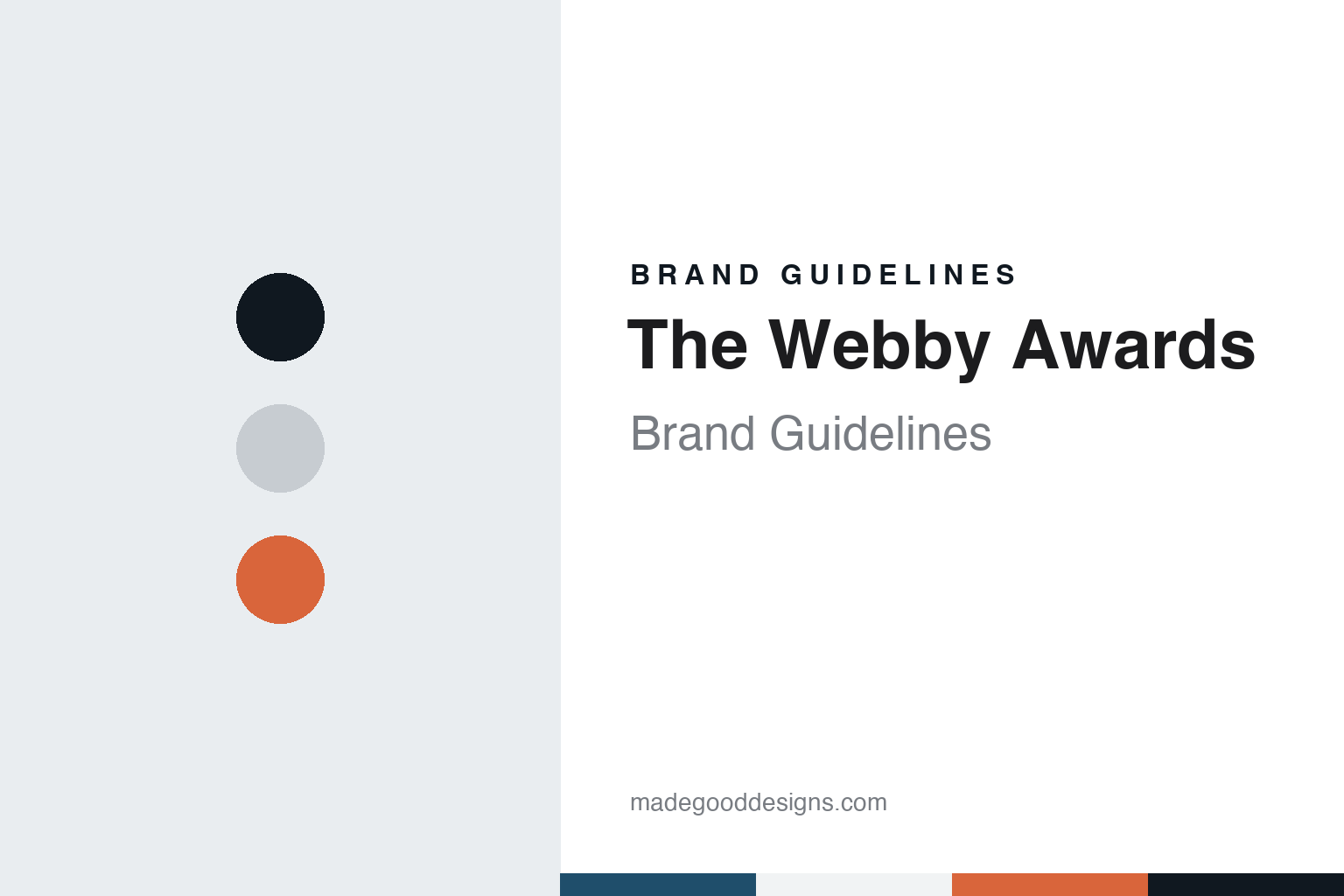
The Webby Awards Brand Guidelines
A spiral of code, five words and a public vote.
Aa
Two constants: a server blue, chrome grey and signal orange palette and a Geometric screen sans register. Abstract homage — not a Webby Awards asset, statuette or mark; no trophy or logo is reproduced.
A magazine’s awards
The Web, IDG and a San Francisco start.
The Webby Awards began as a project of a magazine. The organiser’s history page says the awards were born as part of The Web, a magazine from the technology publisher IDG, and that the first Webby Awards were produced in 1996 with 15 categories; its own pages give 1996 as the year the programme was established. English Wikipedia, citing Forbes, says the awards were first held in San Francisco in 1997, so the two dates refer to the first awards year and the first ceremony.
The founder named in the press of the time is Tiffany Shlain, a filmmaker. The Los Angeles Times wrote in July 2000 that she had founded the Webbys four years earlier, that she wrote, directed and produced the show, and that she worked from an office in the South Park area of San Francisco’s South of Market district. English Wikipedia adds that she was hired by The Web to establish the awards.
The magazine did not last, but the awards did. According to the organiser, IDG closed The Web in 1998 and allowed the Webby team to carry on independently. The group of internet specialists who had chosen the first winners became the basis for the International Academy of Digital Arts and Sciences, or IADAS, which English Wikipedia says was established in 1998. In December 1998 the Los Angeles Times reported that the academy, with Shlain as its president, had retained the accounting firm PricewaterhouseCoopers to audit the public voting for the 1999 awards, for which more than 200,000 online voters were expected.
Colour
An academy, a public vote and five words.
The awards rest on two kinds of vote. The organiser says IADAS now has more than 3,000 members, split between Executive Members, drawn from internet business, media and the arts, and Associate Members, who include former winners, nominees and other internet professionals. In each of more than 100 categories the academy typically chooses five Nominees, and its members then pick the Webby Award winner. A second prize in every category, the Webby People’s Voice Award, is decided by an open public vote. Below the nominees, the organiser names Official Honorees, which it says account for less than 20 percent of entries, and it calculates company “of the year” titles with a points system set by the academy.
The most widely reported ritual is the speech. The Los Angeles Times noted in 2000 that Webby acceptance speeches were limited to five words, and the organiser’s announcement of 25 March 2026 still described five-word speeches as one of the programme’s traditions.
The ceremony moved east. English Wikipedia, citing an organiser press release of April 2005, says the Webbys were presented in New York City from 2005 to 2019. TheWrap reported on 25 March 2026 that the 30th Annual Webby Awards would be held on 11 May 2026 at Cipriani Wall Street in New York, and quoted Jesse Feister as executive director of Webby Media Group, the company behind the show; the organiser’s team page lists David-Michel Davies as chief executive. The same team co-founded Internet Week New York with the City of New York in 2008, the organiser says, before Crain Communications acquired a majority stake in that festival in 2012.
The categories have followed the web. The organiser lists nine media types today: Websites and Mobile Sites; Video and Film; Advertising, Media and PR; Apps, Software and Immersive; Social; Podcasts; Games; Creators; and AI. It says creator categories were added in 2024 and AI categories in 2025, and that more than 13,000 entries arrived from over 70 countries in the most recent year. Sister programmes named on its site are the Lovie Awards, a European programme launched in 2010, and the Anthem Awards, launched in 2021.
Typography
How advertising and creative awards present themselves.
Advertising and creative awards tend to present themselves through very few elements. The name is usually short: a set of initials, a club’s name, or the city where the festival takes place. Next to it sits a trophy with a name and a shape of its own, such as a lion, a pencil, a statuette, a cube or an eye, and that object often does the work of a logo, lending its name to the levels of award and to the everyday talk around them.
The organisations behind these programmes vary. Some are associations or clubs formed by working designers, art directors and copywriters; some are registered charities or non-profits; others are run by publishers or events companies, and a few have changed owners as those companies were bought and sold. Where a programme has a parent company, the festival name usually stays in front and the owner appears in the small print.
Most follow a yearly cycle. Entries open months ahead, juries of practitioners meet in rounds, a shortlist is published, and the awards are given at a ceremony or during a festival week, often with talks, workshops and student competitions alongside. Award levels are typically graded, from a shortlist through bronze, silver and gold or their equivalents, with a top prize that juries may decide not to give.
The visual identity has two speeds. A steady wordmark and trophy carry over from year to year, while a key visual is refreshed for each edition, and the selected work is kept in an annual book or an online archive. This guide describes those elements as the organisers and dated sources set them out, and the colours and type shown here are an unofficial interpretation.
Aa
A geometric screen sans — after the rounded, even letterforms of early web interfaces. (Specimen set in Sora, a sans STAND-IN; NOT The Webby Awards logo or wordmark.)
The Webbys
A spiral, a statuette and a theme each year.
The Webby mark is a coil. In a letter published on the organiser’s site on 1 April 2016, as the 20th awards approached, Davies described the symbol as “a spiral, not a spring” and tied it to the idea of the internet as code connected across time; the same letter presented a redrawn logo for that anniversary. The trophy takes the same form. The Victoria and Albert Museum describes a 2007 Webby award in its collection as a cast, silver-coloured metal award shaped like a cylindrical spring, printed with repeating lines of computer code made of zeros and ones and set on a metal base, about 21 centimetres high. The organiser says Webby Award and People’s Voice winners receive a hand-cast Webby statuette.
Around that fixed mark, each edition gets its own look. In a feature dated 26 May 2026 the organiser said that every year the show leads with an anthemic theme phrase, and that for the 30th edition the design studio Red Antler chose the line “We Made It” and built a visual world around a three-dimensional chrome logo that referred to mylar textures and inflated balloon lettering, with a vibrant palette and a bold display typeface carried across social toolkits, motion guidelines and nominee and winner assets.
The yearly cycle follows the same rhythm. Entries open in the autumn, the academy announces nominees in the spring, winners are revealed in April, and the ceremony follows in May. For the 2026 edition the organiser announced nominees on 31 March, ahead of the 11 May ceremony in New York.
For a design guide, The Webby Awards show how a digital prize can keep one simple coil as its constant while each year’s theme, colour and type change around it. Compare Clio Awards and The One Show, two other awards held in New York. For this guide we use server blue, chrome grey, signal orange and night ink with a geometric sans, an unofficial interpretation; no product or logo is reproduced.
Explore & save
Keep The Webby Awards’s identity on hand — save it to a board in the Made Good inspiration library.
The Webby Awards identity set
Pin The Webby Awards blue, chrome and orange palette and the Geometric screen sans register to your own board.
Source & notes
Frequently Asked Questions
What font can I use to match the The Webby Awards look?
This guide describes The Webby Awards’ type as “A geometric screen sans — after the rounded, even letterforms of early web interfaces”. Its type specimen is set in Sora from Google Fonts as a stand-in; Sora is not The Webby Awards’ own lettering.
What colours are in the The Webby Awards palette?
This guide’s The Webby Awards palette is Server blue #1F4E6B, Night ink #101820, Chrome grey #C7CCD1, Signal orange #D9653B and Paper #F6F7F8. The tones are the guide’s own unofficial interpretation, not official The Webby Awards hex codes.
When was The Webby Awards founded?
The Webby Awards was founded in 1996, in San Francisco, USA.