iF Design Award Brand Guidelines
From a 1953 Hannover fair show to nine disciplines.
Aa
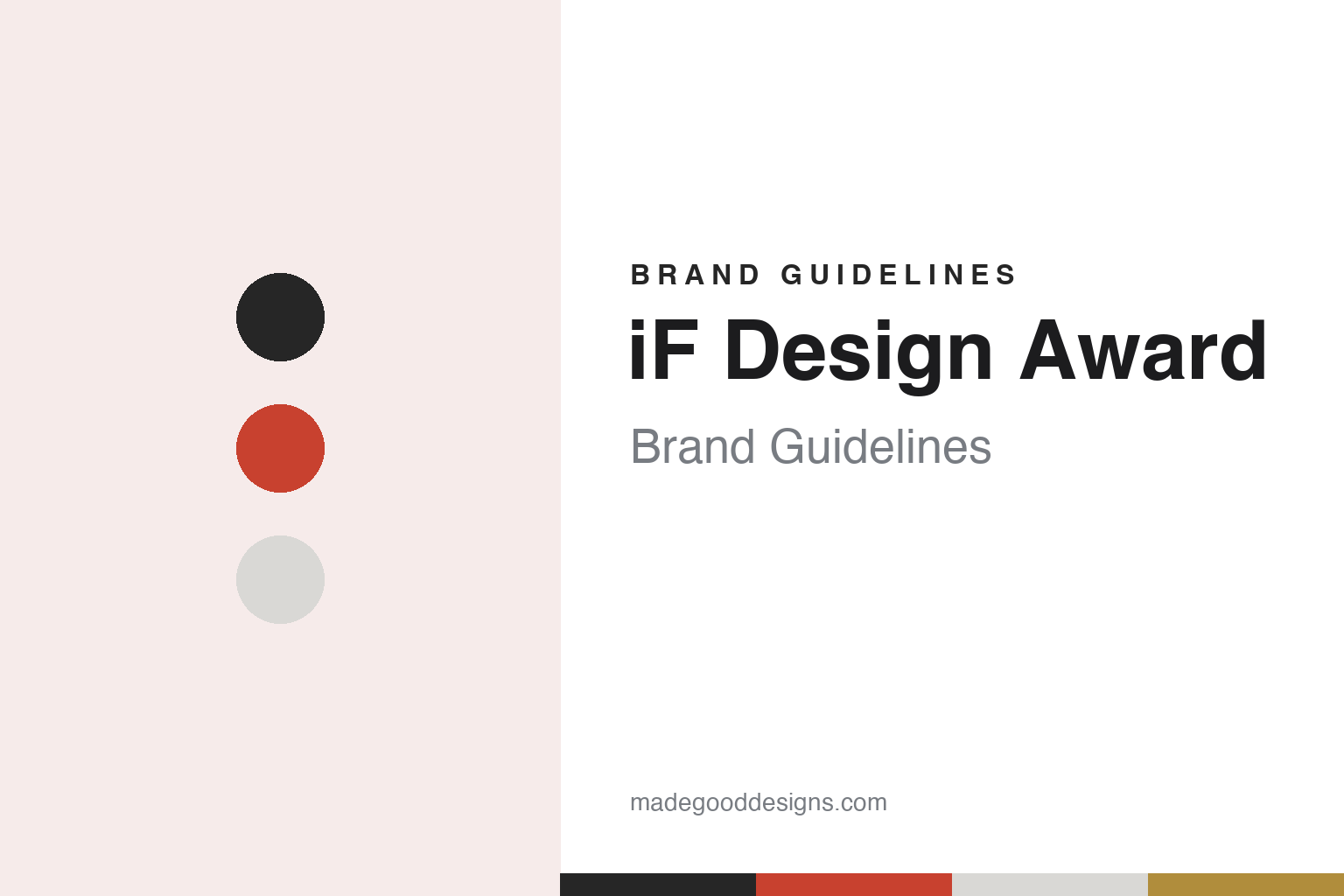
Two constants: a graphite, vermilion and soft grey palette and a geometric sans register. Abstract homage — not an iF label, sculpture or mark; no logo is reproduced.
Hannover 1953
A special show at the Hannover fair.
The iF Design Award — written iF DESIGN AWARD by its organiser — is an annual design award run from Hannover, Germany, by iF International Forum Design GmbH. Its origins lie at the city’s trade fair. German Wikipedia says that in 1952 an association called the Zentralstelle zur Förderung deutscher Wertarbeit was set up in Hannover to host yearly special shows at the Hannover Messe, and that the earliest of them, the “Sonderschau formgerechter Industrieerzeugnisse” — a special show of well-designed industrial products — took place in 1953.
The award followed a year later. German Wikipedia dates the annual award to 1954, and says that in its early years it was reserved for product design by exhibitors at the fair. In a 2013 interview published by Icsid, the international council of industrial-design societies now called the World Design Organization, iF said the work was run at first by the fair’s own organisation, with only fair exhibitors invited to apply, and that the 1954 award went to 221 products in categories such as household goods, industry, office equipment and consumer electronics. In the same interview iF dated its earliest international winners — from Switzerland, the Netherlands, Austria and Britain — to 1957.
The names changed over the following decades. In 1959 the exhibition was renamed “Die gute Industrieform” (“good industrial form”), and in 1965 an association of the same name was founded, according to German Wikipedia. From the early 1980s iF saw itself as a forum, and in 1990 a new name and visual appearance followed: iF stood for “Industrie Forum Design Hannover,” a move away from the narrower idea of “good industrial form.” A separate iF corporate design award, for companies’ visual identities, was introduced in 1983.
The present structure dates from the turn of the century. An operating company, iF International Forum Design GmbH, was formed out of the association to run the competitions — in 2001, according to German Wikipedia, or 2002, according to the 2013 Icsid profile — and the letters iF now stand for “International Forum.” Its sole shareholder is the non-profit iF Design Foundation in Hannover, founded in 2018, which replaced the iF Industrie Forum Design association that had existed since 1965, German Wikipedia says. iF told Icsid in 2013 that its staff worked in Hannover, Hamburg and Munich, and that it had opened a branch office in Taiwan in 2007.
Colour
Nine disciplines and a final jury.
For years iF ran several awards side by side. Until 2014 the competition was split into separate brands — the iF product design award, the iF packaging design award and the iF communication design award — and from the entry phase for 2015 they were brought together as one award, German Wikipedia says.
Today entries are assigned to one of nine disciplines: product, packaging, communication, service design, architecture, interior architecture, user experience (UX), user interface (UI) and professional concept, according to German Wikipedia. English Wikipedia lists sub-categories within them; in product alone these run from automotive, sports and bicycles to audio, lighting, home furniture, kitchen, bathroom and building technology.
Judging has a documented history of its own. iF told Icsid in 2013 that its criteria were defined in 1975 by Professor Herbert Lindinger, and named among the most important the quality of the design, the degree of innovation, environmental impact, functionality and ergonomics; it said the criteria are reviewed after each competition using the jurors’ comments. For the 2025 award, DesignWanted reported in March 2025, relaying iF’s account, the jury worked with five criteria — idea, form, function, differentiation and sustainability. An online preselection in December was followed by the Final Jury, to which the higher-rated half of the nearly 11,000 entries went forward; it met over three days at Schuppen 52 in Hamburg, and each product or project was examined by a panel of three experts.
There are two main levels: the iF Design Award itself and the iF Design Award Gold, given to a small group of entries. German Wikipedia says 75 designs received gold in 2014, out of around 4,600 entries, and 75 again in 2023, iF’s 70th year, when almost 11,000 entries arrived from 56 nations. Winners may carry the award label, and iF told Icsid in 2013 that it had moved its ceremony to the start of the year partly so that winners could use the label for as long as possible.
The ceremony has moved with the programme. In 2013 iF described a single gala for all disciplines in Munich, with about 2,000 guests expected on 22 February that year. For 2025 the iF DESIGN AWARD NIGHT was set for 28 April at the Friedrichstadt-Palast in Berlin, where the Gold winners were to receive gold sculptures from chief executive Uwe Cremering, with the iF Design Trend Conference the next day, DesignWanted reported in March 2025.
Sister programmes sit beside the main award. An iF concept design award for design students and graduates began in 2008 and now runs as the iF Design Student Award, judged by an international jury; an iF Public Value Award, given from 2016, was renamed the iF Social Impact Prize in 2017, German Wikipedia says. English Wikipedia notes that iF has published annual yearbooks of the winners.
Typography
How design awards present themselves.
Design awards and competitions usually present themselves through a short name and a single sign. Some reduce the name to an acronym or a pair of letters; others rely on a colour or a simple shape. That sign is often carried by a label that winners may print on products, packaging and their own marketing, and sometimes by a named trophy or sculpture handed over at a ceremony.
The organisations behind them vary. Some programmes are run by design councils or design centres, some by foundations or the companies they own, and some grew out of trade fairs, where a special exhibition of well-made goods turned into a yearly selection. Others are run by professional societies of designers or by design publications, and a single organiser may keep several sister programmes for students, concepts or particular disciplines next to its main award.
Most follow a yearly cycle. Entries open for a set period, juries of designers, teachers and specialist writers meet to judge them, often in several rounds and at more than one level of award, and the results are presented at a ceremony or festival. The awarded work then lives on in exhibitions, yearbooks, museums or online archives, which become a record of what each year’s juries selected.
Their disciplines range from product and industrial design to packaging, communication design, interiors, architecture, digital interfaces and unbuilt concepts. This guide describes each programme on its own terms — who founded it, who runs it, how the cycle works and how its name and mark are shown — without ranking the programmes or naming the work they have recognised.
Aa
A geometric sans for a two-letter name. (Specimen set in Work Sans, a sans STAND-IN; NOT the iF logo or label.)
iF
Two letters, a label and a gold level.
The identity rests on two letters. German Wikipedia says the 1990 renaming came with a new visual appearance, when iF came to stand for “Industrie Forum Design Hannover”; since the operating company was formed, the same letters have stood for “International Forum.” The organiser writes the award’s name in capitals, iF DESIGN AWARD, and its award night in the same way.
Beyond the letters, the programme is marked by its levels and its places. The Gold level comes with a physical object — the gold sculpture presented at the award night — while the wider group of winners carries the label. Its geography is part of the record too: it began at the Hannover fair, is managed from Hannover by a foundation-owned company, and in 2025 was judged in Hamburg and celebrated in Berlin, according to DesignWanted.
For a design guide, the iF Design Award shows how a trade-fair exhibition of 1953 can become a two-letter name spanning nine disciplines, a foundation and a yearly award night. Compare the Red Dot Design Award, which grew from a 1950s exhibition in Essen, and the Hannover Messe, where the 1953 special show was held. For this guide we use graphite, a vermilion red and soft grey with a sans, an unofficial interpretation; no product or logo is reproduced.
Explore & save
Keep iF Design Award’s identity on hand — save it to a board in the Made Good inspiration library.
iF Design Award identity set
Pin the graphite, vermilion and soft grey palette and the geometric sans register to your own board.
Source & notes
Frequently Asked Questions
What font can I use to match the iF Design Award look?
This guide describes iF Design Award’s type as “A geometric sans for a two-letter name”. Its type specimen is set in Work Sans from Google Fonts as a stand-in; Work Sans is not iF Design Award’s own lettering.
What colours are in the iF Design Award palette?
This guide’s iF Design Award palette is Graphite #262626, Vermilion #C8412F, Soft grey #D9D8D5, Gold leaf #B08D3C and Paper #F8F7F4. The tones are the guide’s own unofficial interpretation, not official iF Design Award hex codes.
When was iF Design Award founded?
iF Design Award was founded in 1953 (special show at the Hannover Messe), in Hannover, Germany.