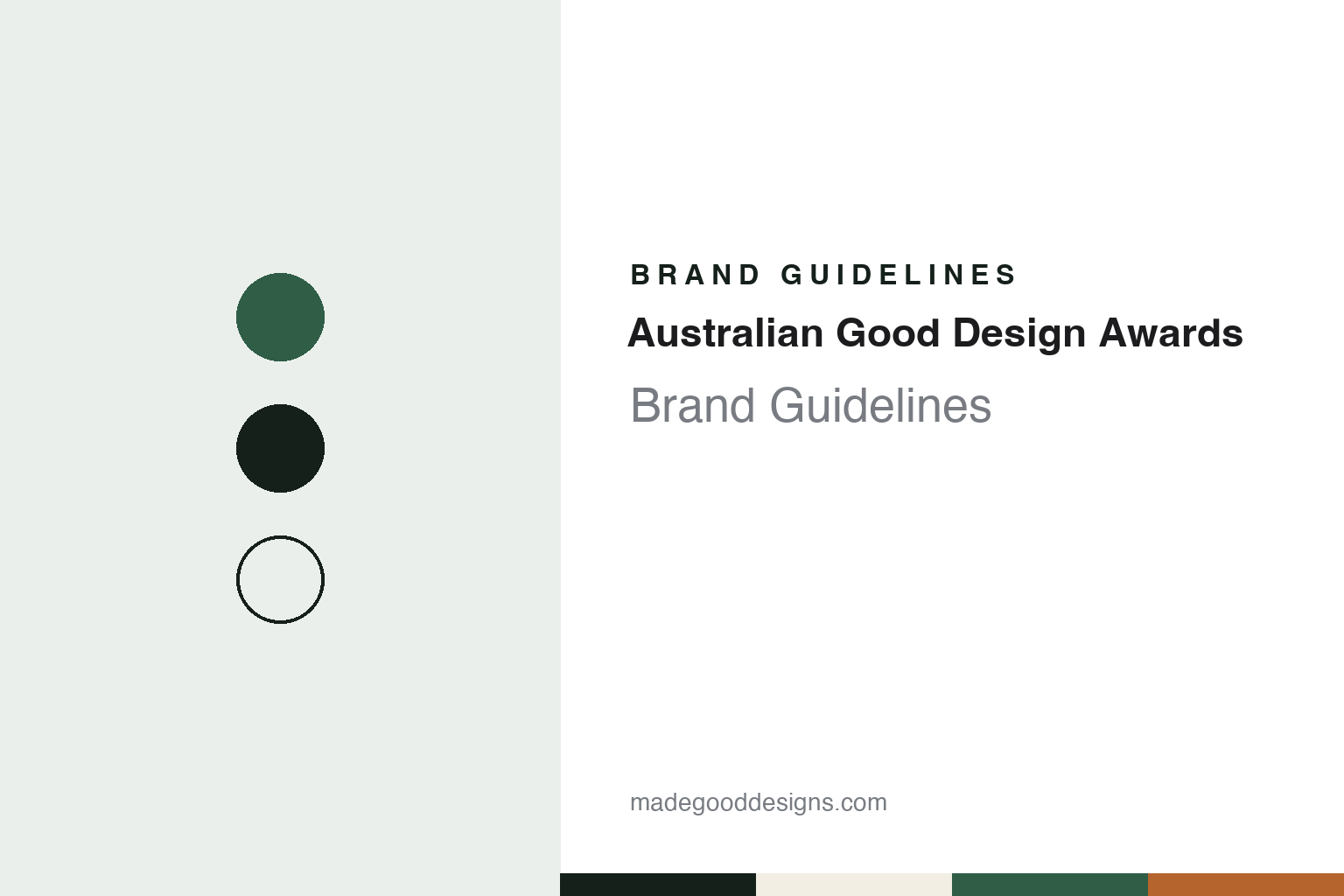
Australian Good Design Awards Brand Guidelines
The Good Design Tick, from the 1958 design council to Good Design Australia.
Aa
Two constants: a eucalypt green, sandstone and ochre palette and a grotesque sans register. Abstract homage — not the Good Design Tick or any Good Design Australia asset; no label, logo or trophy is reproduced.
The Industrial Design Council
A national design council and its labels.
The Australian Good Design Awards trace their roots to 1958, when the Industrial Design Council of Australia (IDCA) was formally established. The organiser’s history page says the council was set up by a group of design and industry professionals, funded by the Commonwealth Government and modelled on Britain’s Design Council, with the aim of raising standards of design in manufactured goods. Its first chair, from 1959, was the industrialist Essington Lewis, then chairman of BHP, and its first meetings were held at the Australian National University, whose design unit helped set it up. The Guardian, in a 2018 picture feature, likewise dated the awards to 1958.
The council’s first tools were labels and an index. From 1964, the organiser says, Good Design Labels began to appear on products in shops, and the Australian Design Index for Good Design became a register of well-designed Australian goods. The first Australian Design Centre opened in Melbourne the same year, with an exhibition of selected products, and further centres followed in other state capitals. In 1967 the Prince Philip Prize for Australian Design was introduced for engineering design; it was first awarded in 1968, after more than 90 entries.
The council’s footing changed several times. The organiser says the IDCA closed temporarily in 1976 and reopened later that year with new Commonwealth funds, and that the Australian Design Awards were set up at that time; the first yearbook of winners followed in 1979, and ABC television carried the presentation. In 1987 the government relaunched the council as the Australian Design Council, with a new role in design information and training, and in 1991 control of the council and the awards passed to Standards Australia. A three-tier scheme, the Australian DesignMark, the Australian Design Award and the Australian Design Award of the Year, was introduced in 1993 and first awarded in 1994.
Colour
From Standards Australia to Good Design Australia.
The 1990s brought new partners and new formats. In 1992 Sydney’s Powerhouse Museum added a museum design award and selection to the programme, with winning products shown at the museum for a year, the organiser says. In 1997 the awards took entries online for the first time and held a black-tie presentation night at the Metro Theatre in Sydney, and the programme became Australia’s design promotion member of the International Council of Societies of Industrial Design. The 1999 programme was put on hold and then reopened under a new budget model.
In 2008, the fiftieth year, products designed abroad but sold in Australia were admitted for the first time, and the programme was relaunched as the Australian International Design Awards, with a new award for sustainability. In late 2010 Standards Australia transferred custodianship of the programme to Good Design Australia, a new design promotion organisation set up by Brandon Gien to run the awards, the organiser says. From 2013 the awards were aligned with the Vivid Sydney festival, and in 2015 they were restructured and renamed the Australian Good Design Awards, with seven disciplines from product and service design to social innovation and business model design. The organiser’s own pages use both that name and the shorter Good Design Awards.
Later years added disciplines and accolades. Engineering design and fashion design arrived in 2018, the sixtieth year, along with a Good Design Team of the Year Award, an Indigenous design award and the Australian Design Prize for a designer’s whole career; the ceremony that year was held at the Sydney Opera House. A Women in Design Award followed in 2019, judging moved online in 2020, policy design became a stand-alone discipline in 2024 and concept design in 2025. In 2024 Rachel Wye was appointed managing director of Good Design Australia and Brandon Gien became chair, the organiser says.
Typography
How design awards present themselves.
Design awards and competitions usually present themselves through a short name and a single sign. Some reduce the name to an acronym or a pair of letters; others rely on a colour or a simple shape. That sign is often carried by a label that winners may print on products, packaging and their own marketing, and sometimes by a named trophy or sculpture handed over at a ceremony.
The organisations behind them vary. Some programmes are run by design councils or design centres, some by foundations or the companies they own, and some grew out of trade fairs, where a special exhibition of well-made goods turned into a yearly selection. Others are run by professional societies of designers or by design publications, and a single organiser may keep several sister programmes for students, concepts or particular disciplines next to its main award.
Most follow a yearly cycle. Entries open for a set period, juries of designers, teachers and specialist writers meet to judge them, often in several rounds and at more than one level of award, and the results are presented at a ceremony or festival. The awarded work then lives on in exhibitions, yearbooks, museums or online archives, which become a record of what each year’s juries selected.
Their disciplines range from product and industrial design to packaging, communication design, interiors, architecture, digital interfaces and unbuilt concepts. This guide describes each programme on its own terms — who founded it, who runs it, how the cycle works and how its name and mark are shown — without ranking the programmes or naming the work they have recognised.
Aa
A plain grotesque sans for a tick-and-word label. (Specimen set in Archivo, a sans STAND-IN; NOT the Good Design Tick or the Good Design Australia logo.)
The Good Design Tick
A tick as trophy, label and trademark.
Today the organiser describes the programme as 13 design disciplines covering more than 30 categories: built environment, communication, concept, design research, design strategy, digital, engineering, fashion and textiles, Next Gen for designers under 30, policy, product, service and social impact. Every entry is assessed by an independent jury against three criteria, Good Design, Design Innovation and Design Impact, each written for its discipline, and judging runs in three rounds: online independent scoring, group evaluation and a multidisciplinary final assessment.
The levels climb from the basic award. The organiser lists the Australian Good Design Award Winner for design excellence; Gold for about the top five projects in each category; a class-level award for the top project or projects in each sub-category; a discipline-level award for the top project in each discipline; a single Award for Sustainability; and a single Australian Good Design Award of the Year chosen from all disciplines. The accolade is known, the organiser says, as the Good Design Tick. Winners receive an engraved trophy, certificates, a place in the yearbook and the right to use the registered award trademark. In 2022 the organiser redesigned its tick-shaped trophy so that each one holds a kilogram of compressed Australian post-consumer plastic.
The cycle runs through the year. The Guardian reported that entries for the 2018 awards closed on 19 March, with winners announced on 12 April. The organiser listed its 2026 ceremony for 9 October 2026 at ICC Sydney, a black-tie evening at which the year’s top accolades are announced.
For a design guide, the Australian Good Design Awards show how a mark first printed on shop goods in the 1960s can become a trophy, a trademark and the name of the programme itself. Compare Japan’s Good Design Award, which grew from a 1957 government selection scheme and also gives a mark to winners, and the iF Design Award. For this guide we use a eucalypt green with sandstone, a dark bush tone and an ochre with a sans, an unofficial interpretation; no product or logo is reproduced.
Explore & save
Keep Australian Good Design Awards’s identity on hand — save it to a board in the Made Good inspiration library.
Australian Good Design Awards identity set
Pin the eucalypt green, sandstone and ochre palette and the grotesque sans register to your own board.
Source & notes
Frequently Asked Questions
What font can I use to match the Australian Good Design Awards look?
This guide describes Australian Good Design Awards’ type as “A plain grotesque sans for a tick-and-word label”. Its type specimen is set in Archivo from Google Fonts as a stand-in; Archivo is not Australian Good Design Awards’ own lettering.
What colours are in the Australian Good Design Awards palette?
This guide’s Australian Good Design Awards palette is Eucalypt green #2F5D46, Night bush #16201B, Sandstone #F2EEE4, Ochre #B5642E and Salt white #FAF8F2. The tones are the guide’s own unofficial interpretation, not official Australian Good Design Awards hex codes.
When was Australian Good Design Awards founded?
Australian Good Design Awards was founded in 1958 (as the IDCA), in Australia.