German Design Award Brand Guidelines
A Frankfurt design prize with roots in a 1953 parliamentary vote.
Aa
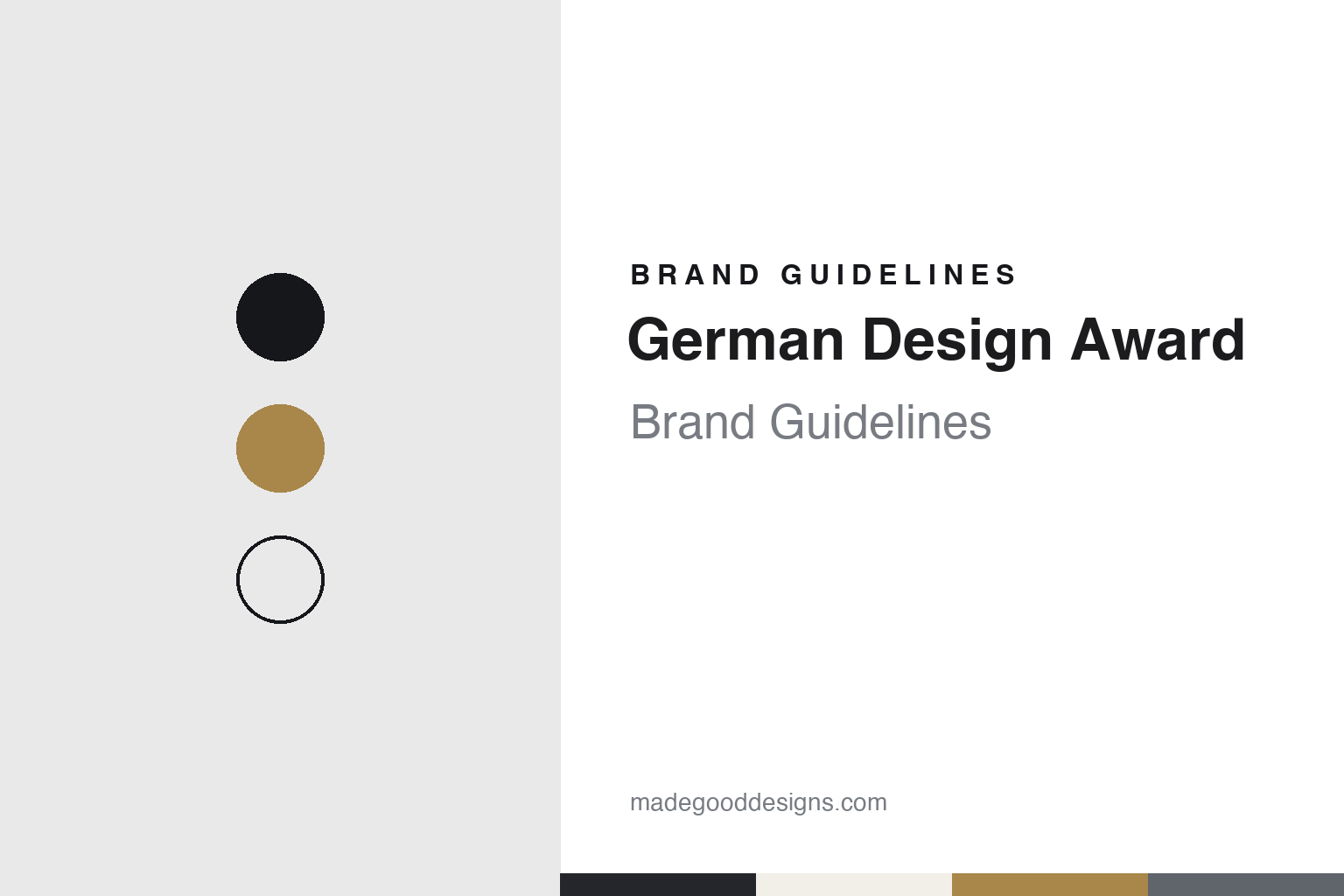
Two constants: a black, warm white and muted gold palette and a Council serif register. Abstract homage — not a German Design Award label, trophy or mark; no logo is reproduced.
A council and its prize
A 1953 foundation, a 2012 award.
The German Design Award is the design prize of the German Design Council, the foundation long known by its German name, Rat für Formgebung. The council says its founding was approved by the German Bundestag in its opening term and that it was established in 1953; German Wikipedia gives the background as criticism of how post-war German products were presented at an export fair in New York in 1949, after which the Bundestag resolved to have an independent design council set up as a foundation. German Wikipedia says the council had its seat in Darmstadt from 1953 to 1987. Today it is based in Frankfurt am Main, in the Messeturm, the trade-fair tower, and says it has more than 300 member companies and experts from business and design.
Before it had a prize of its own, the council ran state design awards. German Wikipedia lists the Gute Form award from 1969 to 2001 and the Designpreis der Bundesrepublik Deutschland from 2002 to 2012, both on behalf of the federal economics ministry. The organiser describes the German Design Award as having its roots in that federal award for good design.
The council has presented its own award since 2012, according to both the organiser and German Wikipedia. German Wikipedia says the prize was briefly called Designpreis Deutschland and was then renamed German Design Award, because the name could be confused with the federal design prize. The same article lists other programmes the council has started since then, including the German Brand Award from 2016 and the German Innovation Award from 2018.
In January 2026 the council said it was moving from the German name “Rat für Formgebung” to “German Design Council” for its public brand, as part of a new corporate design.
Colour
Three disciplines, two levels, one show.
The award is organised around three disciplines, each with its own list of categories: Excellent Architecture, Excellent Communications Design and Excellent Product Design. German Wikipedia names the three main fields as architecture, communications design and product design. The organiser’s current list runs from apps, packaging and typography in communications design to furniture, household goods and transport in product design, and from public buildings to lighting and wayfinding in architecture. A project is entered in one category only. In 2026, the organiser says, Service Design was added as a category of its own, beside an existing Circular Design category.
Entry has changed over time. German Wikipedia describes a contest open only to projects that had been nominated. The organiser now describes two routes: the council may nominate a project it has noticed in the market, or a company or designer may register a project directly, which is then checked by a panel before it is admitted. Projects must have been launched within the previous five years, with exceptions for design classics and re-editions and for start-ups; concepts are also accepted.
An international jury appointed by the council judges the entries. The organiser lists its criteria as design quality, overall concept, function, context and sustainability. Successful projects receive the title Winner or the higher Gold; winners may use the award label in their communication and receive certificates, and Gold winners are given a sculpture on stage. Two further titles sit beside the project awards: Personality of the Year, which the organiser says it has given since 2012, and Newcomer of the Year, chosen from five finalists nominated by universities in the German Design Graduates programme.
Stylepark reported in February 2016 that about 3,400 entries had been submitted that year and that the objects filled a complete hall when laid out for the jury. The organiser now says the award receives around 4,000 entries a year from more than 60 countries.
Typography
Design and documentation.
Design awards and competitions usually present themselves through a short name and a single sign. Some reduce the name to an acronym or a pair of letters; others rely on a colour or a simple shape. That sign is often carried by a label that winners may print on products, packaging and their own marketing, and sometimes by a named trophy or sculpture handed over at a ceremony.
The organisations behind them vary. Some programmes are run by design councils or design centres, some by foundations or the companies they own, and some grew out of trade fairs, where a special exhibition of well-made goods turned into a yearly selection. Others are run by professional societies of designers or by design publications, and a single organiser may keep several sister programmes for students, concepts or particular disciplines next to its main award.
Most follow a yearly cycle. Entries open for a set period, juries of designers, teachers and specialist writers meet to judge them, often in several rounds and at more than one level of award, and the results are presented at a ceremony or festival. The awarded work then lives on in exhibitions, yearbooks, museums or online archives, which become a record of what each year’s juries selected.
Their disciplines range from product and industrial design to packaging, communication design, interiors, architecture, digital interfaces and unbuilt concepts. This guide describes each programme on its own terms — who founded it, who runs it, how the cycle works and how its name and mark are shown — without ranking the programmes or naming the work they have recognised.
Aa
A council serif — the council’s 2026 identity pairs Meta Serif with ABC Social. (Specimen set in Source Serif 4, a serif STAND-IN; NOT the German Design Award logo.)
German Design Award
A show beside a trade fair.
The award year ends with an award show in Frankfurt. The organiser says the show is held by the council in parallel with Ambiente, the consumer-goods fair at Messe Frankfurt, and its venue for the current edition is the Forum at Messe Frankfurt; guests receive a ticket for the fair as well. The organiser says around 1,300 guests attended the 2026 show in early February, with designers, agencies, companies and architecture practices from 57 countries. The programme includes the presentation of the Gold awards in the three disciplines, a talk on stage, an exhibition of the winning projects and the Newcomer of the Year presentation. An online gallery of the winning projects goes live before the ceremony.
The people around the award are named in their roles. Lutz Dietzold is chief executive of the German Design Council and opens the show; the designer and professor Mike Richter has been its president since 2021, German Wikipedia says. In 2016 Stylepark quoted Peter Pfeifer, then the council’s president, on the size of the international jury.
The council’s visual identity has a long history of its own. German Wikipedia credits its logo to the graphic designer Anton Stankowski. In a press release of January 2026 the council said its new corporate design was built on a refined version of the Stankowski logo, set with the typefaces Meta Serif and ABC Social, and that the design system was developed with the agency Edenspiekermann. deutschland.de, writing in February 2017, noted that the award covers campaigns as well as craft-made objects.
For a design guide, the German Design Award shows how a national design council can carry a long institutional history into an international prize, with three plain discipline names and two clear levels. Compare the Red Dot Design Award in Essen and the iF Design Award in Hannover. For this guide we use black, a warm white and a muted gold with a serif, an unofficial interpretation; no product or logo is reproduced.
Explore & save
Keep German Design Award’s identity on hand — save it to a board in the Made Good inspiration library.
German Design Award identity set
Pin the German Design Award black, warm white and muted gold palette and the Council serif register to your own board.
Source & notes
Frequently Asked Questions
What font can I use to match the German Design Award look?
This guide describes German Design Award’s type as “A council serif — the council’s 2026 identity pairs Meta Serif with ABC Social”. Its type specimen is set in Source Serif 4 from Google Fonts as a stand-in; Source Serif 4 is not German Design Award’s own lettering.
What colours are in the German Design Award palette?
This guide’s German Design Award palette is Council black #24262B, Tower grey #60646B, Gallery white #F2EFE8, Gold stage #A9874A and Paper #FAF8F4. The tones are the guide’s own unofficial interpretation, not official German Design Award hex codes.