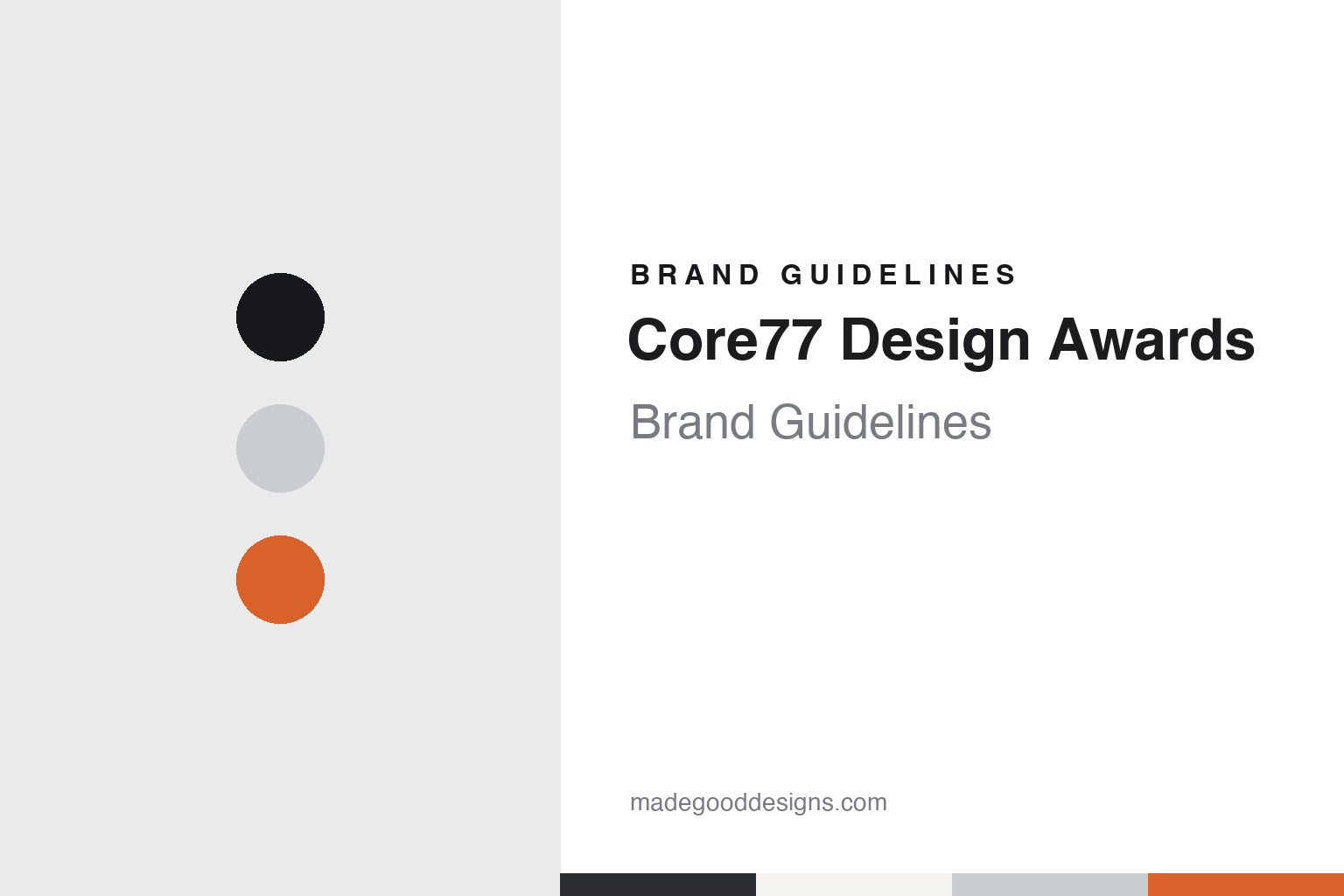
Core77 Design Awards Brand Guidelines
An online magazine’s awards, judged city by city.
Aa
Two constants: a workshop graphite, cast aluminium and signal orange palette and a Workshop grotesque register. Abstract homage — not a Core77 Design Awards asset or mark; no logo, trophy or wordmark is reproduced.
A design magazine’s own awards
Core77, the Pratt Institute and a first season in 2011.
The Core77 Design Awards are run by Core77, the online design magazine that covers industrial design. English Wikipedia says the site began as the graduate thesis of Stuart Constantine and Eric Ludlum in their final year at the Pratt Institute in Brooklyn, New York, and went online in March 1995; it was first hosted by Interport, an early New York internet service provider, before moving to its own domain. The same article dates the awards to 2011. Both the awards site and the magazine carry the copyright line of Core77, Inc.
The first season was built around distance. On 24 March 2011 Core77 announced that fifteen jury teams, based in 13 cities in eight countries, would judge the entries in June, an approach it called “distributed juries.” Each of the fifteen categories had a jury captain, who invited the other members of the team; the first teams named would judge in New York and in Turin, Italy. The organiser’s page for that inaugural year said it welcomed client work and self-initiated projects, entrepreneurial and pro-bono work, whether commercial, cultural, social, environmental or discursive, and that results would be announced through live web broadcasts.
The results were not read out at a gala. Metropolis magazine reported on 28 July 2011 that over ten days, from 12 to 22 July, one jury team after another had reported by webcast from its own corner of the world, announcing the results in each of the 15 categories; the magazine counted 74 jurors, from Austin, Texas, to Ahmedabad, India. Its writer singled out categories that reflected recent shifts in the profession, among them Design for Social Impact, Speculative Objects/Concepts, DIY/Hack/Mod and Strategy/Research, and described the judging as open to anyone who wanted to watch.
Colour
Categories, levels and a jury for each field.
The list of categories has changed from year to year. The second edition opened for entries on 17 January 2012, when Core77 announced 17 categories, two of them new: Writing & Commentary and Food Design. Student entry fields were offered in 15 of the 17; each category again had its own jury captain, who chose a team from his or her home city; and entrants could add a short, low-tech video in which they explained their project directly to the jury. Results were to be revealed over a one-week live period on the awards site, and the organiser said that year’s 20 jury captains came from 13 cities in eight countries.
The awards site keeps an archive of editions back to 2011. The 2024 programme included categories such as Gaming Accessories, Health & Wellness and Robotics, alongside a sponsored software prize. For 2026 the organiser lists 20 design disciplines, running from Apps & Platforms, Branding & Identity and Built Environment to Toys & Play, Transportation & Mobility and Visual Communication, plus a Fusion Prize and an Editorial Prize. Its jury page for 2026 says 98 jurors from around the world sat in teams of three to seven, one team for each of 22 categories. Core77 set the final entry deadline of the 2026 season for 27 March 2026, and on 9 November 2026 it wrote that the season had closed, with trophies on their way to the winners.
Within each category the results are arranged in levels. The inaugural year named Winners, Runners-up and Notables, and the 2026 pages list a Winner, a Runner Up and Notable entries for professional work, together with a separate Student Winner, under a heading that gathers all honourees. The organiser describes the programme as open to both students and professionals, and as covering all areas of what it calls design enterprise.
Typography
How design awards and competitions present themselves.
Design awards and competitions usually present themselves through a short name and a single sign. Some reduce the name to an acronym or a pair of letters; others rely on a colour or a simple shape. That sign is often carried by a label that winners may print on products, packaging and their own marketing, and sometimes by a named trophy or sculpture handed over at a ceremony.
The organisations behind them vary. Some programmes are run by design councils or design centres, some by foundations or the companies they own, and some grew out of trade fairs, where a special exhibition of well-made goods turned into a yearly selection. Others are run by professional societies of designers or by design publications, and a single organiser may keep several sister programmes for students, concepts or particular disciplines next to its main award.
Most follow a yearly cycle. Entries open for a set period, juries of designers, teachers and specialist writers meet to judge them, often in several rounds and at more than one level of award, and the results are presented at a ceremony or festival. The awarded work then lives on in exhibitions, yearbooks, museums or online archives, which become a record of what each year’s juries selected.
Their disciplines range from product and industrial design to packaging, communication design, interiors, architecture, digital interfaces and unbuilt concepts. This guide describes each programme on its own terms — who founded it, who runs it, how the cycle works and how its name and mark are shown — without ranking the programmes or naming the work they have recognised.
Aa
A workshop grotesque — after the plain lettering of an online design magazine. (Specimen set in Space Grotesk, a sans STAND-IN; NOT the Core77 Design Awards logo or any Core77 lettering.)
Core77 Design Awards
A trophy that works as a mould.
The trophy is the programme’s most described object. For the first year Core77 invited the New York studio Rich Brilliant Willing to design it, and the studio’s answer, quoted on the 2011 awards site, was a mould: because a single trophy cannot be divided among a team, winners could cast ingots from it and hand the copies to collaborators, clients and staff. The first trophies were produced by Motorola Prototyping Services, according to the same page. In a post of 26 March 2026, Core77 described the award as an aluminium mould that can cast any number of facsimiles, in materials it said could range from chocolate to silicone, and noted that Rich Brilliant Willing, a studio at the time, now works as a lighting manufacturer. The 2026 trophies were machined from solid aluminium billet by a new manufacturing partner, Core77 wrote in November 2026.
The look of the first season was credited in print. Metropolis named a graphic identity by Studio Lin, a website by Studio Mercury and the trophy by Rich Brilliant Willing, and the 2011 awards site carried the same credits. The awards site today presents each year as a set of category pages, each with its own jury and honourees, and keeps the earlier editions online. The organiser’s own description of the trophy returns to one idea: a model of inclusion, made because design work is rarely the result of a single person’s effort.
For a design guide, the Core77 Design Awards show how an award can make its central idea, design as team work, visible in the trophy itself: a mould rather than a statuette. Compare Core77, the magazine that runs the programme, and the International Design Excellence Awards, another American programme with roots in industrial design. For this guide we use a graphite, an aluminium grey and a signal orange with a grotesque sans, an unofficial interpretation; no product or logo is reproduced.
Explore & save
Keep Core77 Design Awards’s identity on hand — save it to a board in the Made Good inspiration library.
Core77 Design Awards identity set
Pin the Core77 Design Awards graphite, aluminium and orange palette and the Workshop grotesque register to your own board.
Source & notes
Frequently Asked Questions
What font can I use to match the Core77 Design Awards look?
This guide describes Core77 Design Awards’ type as “A workshop grotesque — after the plain lettering of an online design magazine”. Its type specimen is set in Space Grotesk from Google Fonts as a stand-in; Space Grotesk is not Core77 Design Awards’ own lettering.
What colours are in the Core77 Design Awards palette?
This guide’s Core77 Design Awards palette is Workshop graphite #2B2D31, Ink #17181B, Cast aluminium #C9CCD1, Signal orange #D9622B and Paper #F6F5F2. The tones are the guide’s own unofficial interpretation, not official Core77 Design Awards hex codes.