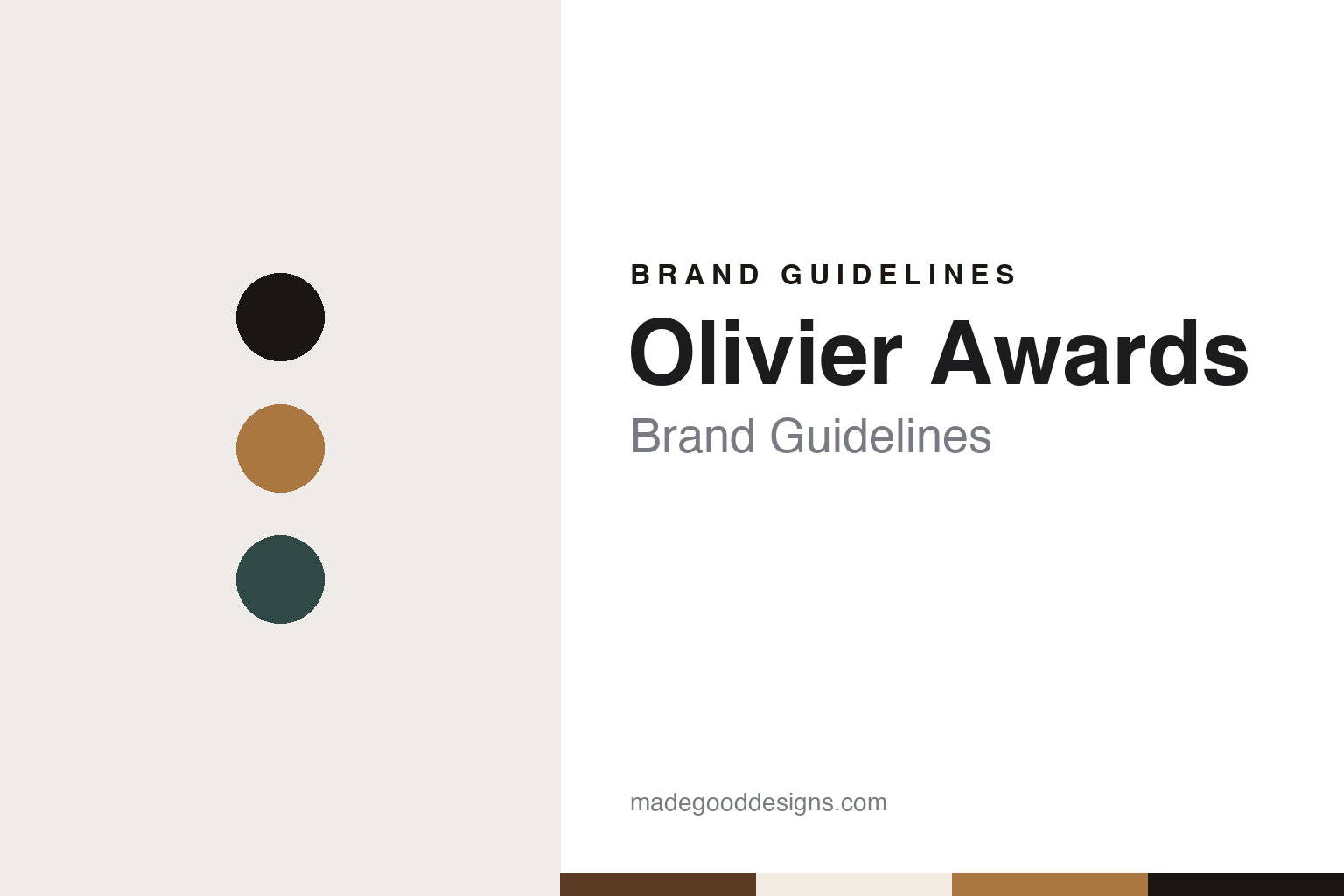
Olivier Awards Brand Guidelines
An urn, a renaming and a bronze king from the Old Vic.
Aa
Two constants: a patina brown, cast bronze and verdigris palette and a West End serif register. Abstract homage — not an Olivier Awards asset or mark; no statuette, logo, key visual or wordmark is reproduced.
The SWET Awards
London producers, the Café Royal and an urn.
The Olivier Awards began in London in 1976 as the Society of West End Theatre Awards, presented by the Society of West End Theatre, the association of London theatre producers, owners and managers that is now the Society of London Theatre (SOLT). The first ceremony took place in December 1976 at the Café Royal, according to a history of the awards published by SOLT’s Official London Theatre site in April 2026 and to English Wikipedia. SOLT’s account says leading producers wanted achievement on the London stage formally recognised, and that Broadway’s Tony Awards were an example in mind. Highlights of that first evening were shown at the end of the BBC’s early-evening magazine programme Nationwide, SOLT says, the start of a long relationship with the BBC.
For the first eight years the prizes kept the society’s name. Official London Theatre, in a 2017 article, says they also had a nickname, the “Urnies,” after the trophy of those years: a specially commissioned blue Wedgwood urn. In 1984 Laurence Olivier, the actor and director who founded the National Theatre Company, agreed to give his name to the awards, SOLT’s awards pages say, and they became the Laurence Olivier Awards, generally shortened to the Olivier Awards. SOLT’s 2026 history says the name was put forward as a snappier alternative to the SWET or SOLT acronyms by a president of the society who had once worked for Olivier.
The ceremony has moved around London. English Wikipedia lists venues including the Café Royal, the London Palladium, the Theatre Royal Drury Lane, the Dominion Theatre and the Park Lane Hilton; Official London Theatre says Grosvenor House has hosted the whole event four times and the after-show reception nine times. The awards were held at the Royal Opera House from 2012 to 2016 and moved to the Royal Albert Hall in 2017, English Wikipedia says. SOLT’s pages place the 2025 ceremony there on 6 April 2025 and the fiftieth-anniversary ceremony on Sunday 12 April 2026.
Colour
Theatre, opera, dance and affiliate stages.
The awards cover plays, musicals, opera, dance and the smaller theatres in SOLT’s affiliate membership. SOLT’s awards FAQ, updated in September 2025, lists twenty-six categories, not all given every year: twenty-one for theatre, two for opera, two for dance and one for productions presented by affiliate members. The society may also present a Special Award and a Lifetime Achievement Award, and Industry Recognition Awards were presented before the main ceremony.
Eligibility is set by place and run. Any new production that opens in a theatre represented in SOLT’s membership can be considered, provided it plays the minimum number of performances for its category; for the 2025 awards the window ran from 28 February 2024 to 14 February 2025, the FAQ says.
SOLT describes the judging on its “How the Olivier Award winners are chosen” page. Five panels — theatre, affiliates, opera, dance and family — debate the work. The affiliate, dance and opera panels combine professionals chosen for their knowledge of the field, such as journalists, casting directors, arts administrators and publishers; the theatre panel is made up solely of members of the public with no professional theatre background, recruited each year through a written show review and an interview, and given tickets to eligible shows. Panellists are chosen by SOLT’s co-chief executives on advice from the awards office and outside advisers. For the specialist panels, members select the nominations and then vote on a winner at the end of the judging period. The theatre awards run in two stages: the theatre panel draws up a long list that goes to SOLT members for a vote, which is combined with the panellists’ votes to form the nominations; members and panellists then vote again on the shortlist to decide the winners. Until the ceremony, SOLT says, the results are known only to a small part of the awards team and the engraver of the statuettes.
Typography
Awards with a trophy for a name.
Film, television, music and theatre awards tend to present themselves through a short name. The formal title of a prize is often long, naming an academy, a society or a person, while the name people use is a single word or a nickname that fits a headline, a poster and a broadcast caption. Many programmes use both, keeping the formal title for rules and records and the short name for everything public.
Behind each name sits an organisation: an academy of practitioners, a society of producers or theatre owners, a union of broadcasters or a company that produces the show. That body writes the rules, sets the categories and decides who votes, and its own name usually appears beside the prize in smaller type, as the signature rather than the headline.
The trophy is the most visible part of the identity. A statuette, a mask, a gramophone, a globe or a medallion can be kept for decades, with changes of material, maker or base. Because the object recurs in every photograph of the ceremony, it works as the visual shorthand for the whole programme.
The year gives these brands their rhythm. An eligibility period, usually a calendar year or a season, is followed by entries, members’ votes or jury rounds, a published list of nominations and a televised ceremony in a named venue. Sister programmes, honorary awards and separate ceremonies for other formats sit around the main event, each described in the same plain, institutional voice as the main categories.
Aa
A West End serif — old-style capitals for a name taken from a stage career. (Specimen set in Cormorant Garamond, a serif STAND-IN; NOT the Olivier Awards logo.)
Henry V in bronze
A Putney foundry, title partners and the broadcast.
The blue urns gave way to the bronze statuette used today. SOLT’s FAQ describes it as a portrayal of a young Laurence Olivier as Henry V at the Old Vic in 1937, commissioned by SOLT from the sculptor Harry Franchetti and weighing 1.6 kg. The Victoria and Albert Museum, which holds an example presented in 1994, says in its catalogue that Franchetti was asked in 1988 to create the new statuette from an image of Olivier in the role. He modelled it in Plastoline, a mixture of clay and wax, and carved “Laurence Olivier as Henry V 1937” by hand into a plaster-coated base; the words “The Old Vic” were added in later years. The figure is a crowned bust in a high, buttoned collar on a plinth, mounted on a square base with an engraved plaque. The V&A says the statuettes have been cast from the start at Arch Bronze, a small foundry in Putney, and are still made there, with Franchetti adjusting the crown and lettering over time, checking the patina of each cast and adding a wooden base.
Title partners have joined the name. SOLT’s pages refer to the “Olivier Awards with Mastercard” in 2012, 2017 and 2025, and on 14 January 2026 SOLT announced the cruise line Cunard as headline partner, making the event the “Olivier Awards with Cunard,” with Cunard also giving its name to the new-musical award. Television has followed the awards since the early years. English Wikipedia says regular broadcasts of the ceremony began on BBC1 in 1981, moved to BBC2 from 1993 to 2003 and gave way to radio coverage until 2011, and that ITV held the television rights from 2013. SOLT’s January 2026 announcement named the BBC as broadcast partner for a prime-time slot on 12 April 2026, produced with Penny Lane Entertainment.
For a design guide, the Olivier Awards show how a renaming and a figurative trophy can anchor a prize: a society acronym replaced by a performer’s name, and a bronze bust that ties the award to one historic London production. Compare the Tony Awards, the Broadway prize SOLT cites as an early model, and the Royal Albert Hall, the ceremony’s venue since 2017. For this guide we use patina brown, cast bronze and verdigris with an old-style serif, an unofficial interpretation; no product or logo is reproduced.
Explore & save
Keep Olivier Awards’s identity on hand — save it to a board in the Made Good inspiration library.
Olivier Awards identity set
Pin the patina brown, cast bronze and verdigris palette and the West End serif register to your own board.
Source & notes
Frequently Asked Questions
What font can I use to match the Olivier Awards look?
This guide describes Olivier Awards’ type as “A West End serif — old-style capitals for a name taken from a stage career”. Its type specimen is set in Cormorant Garamond from Google Fonts as a stand-in; Cormorant Garamond is not Olivier Awards’ own lettering.
What colours are in the Olivier Awards palette?
This guide’s Olivier Awards palette is Patina brown #5B3B22, Ink #1A1612, Cast bronze #A9773F, Verdigris #2F4A44 and Paper #F8F5EF. The tones are the guide’s own unofficial interpretation, not official Olivier Awards hex codes.