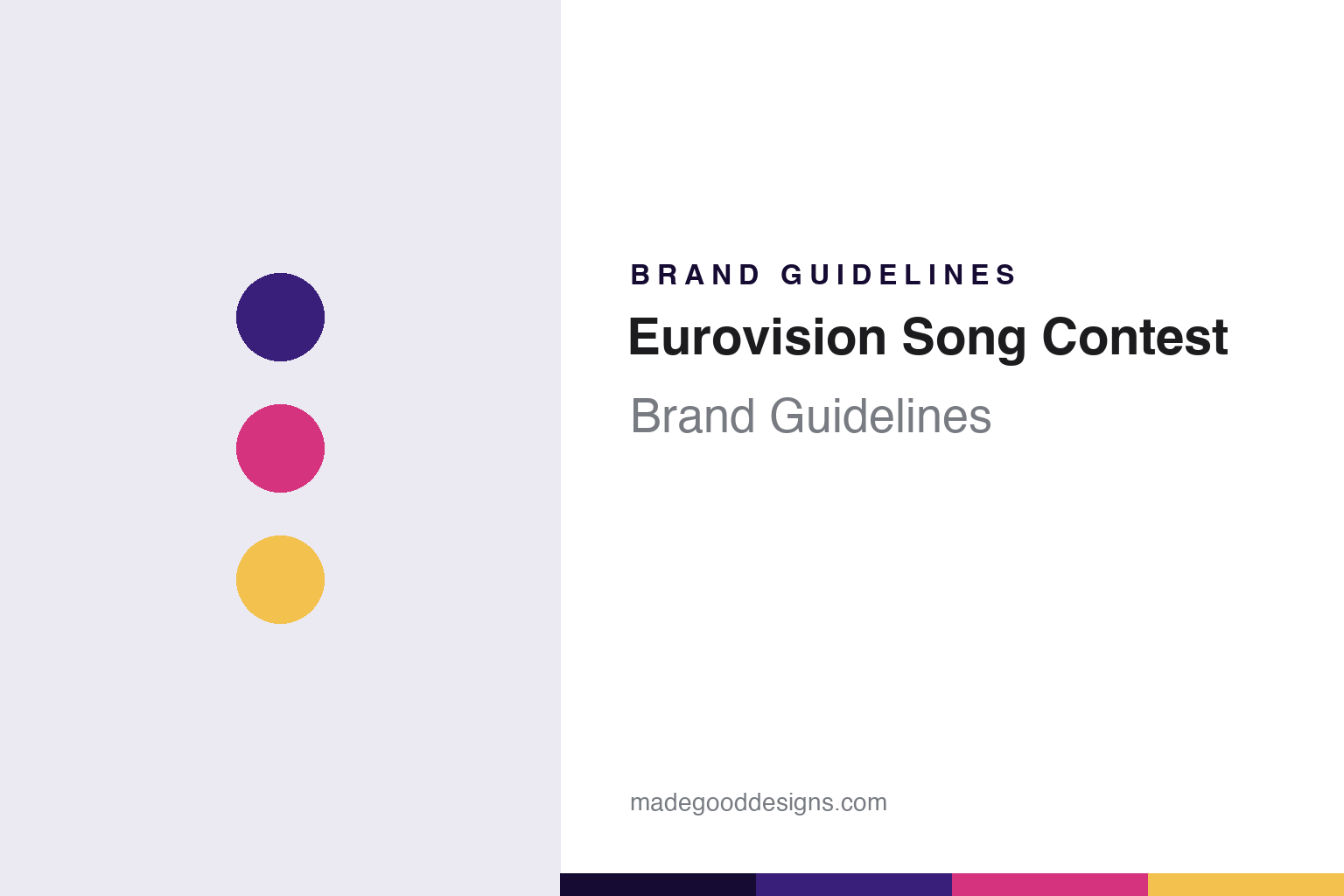
Eurovision Song Contest Brand Guidelines
The broadcasters’ song contest, staged every spring since 1956.
Aa
Two constants: a night violet, pink and gold palette and a rounded geometric sans register. Abstract homage — not a Eurovision Song Contest mark; no logo, heart or trophy is reproduced.
A broadcasters’ contest
From an EBU committee to a stage in Lugano.
The Eurovision Song Contest is organised every year by the European Broadcasting Union (EBU), the association of broadcasters formed in 1950 by 23 broadcasting organisations, English Wikipedia says. The word “Eurovision” itself first appeared in the London Evening Standard in 1951, when a British journalist used it for a programme relayed between broadcasters, and it became the name of the EBU’s programme-exchange network.
The contest grew out of that network. In January 1955 an EBU committee headed by Marcel Bezençon was set up to look for new ways for broadcasters to work together, and it approved for further study a European song competition proposed by a manager at the Italian broadcaster RAI. The EBU’s general assembly agreed to stage it in October 1955 under the working title European Grand Prix, and accepted an offer from the Swiss broadcaster SRG SSR to host it in Lugano in the spring of 1956. Italy’s Sanremo Music Festival, held since 1951, served as the model for the early planning, English Wikipedia says, with changes for an international format. The aim was to test live television across borders and to encourage new songs.
Seven countries took part in 1956, each with two songs, the only edition to allow more than one entry per country. Voting that year took place behind closed doors. A scoreboard and a public reading of the votes followed in 1957, the year national juries were also barred from voting for their own country, and the custom of the winning broadcaster staging the next contest began in 1958. Colour broadcasts started in 1968, streaming in 2000, widescreen in 2005 and high definition in 2007.
The early names varied by language: the first edition was the Grand Prix Eurovision de la chanson européenne in French. “Eurovision Song Contest” and “Concours Eurovision de la chanson” became the usual forms over the following decades, and the names were standardised in 2004, when the contest was rebranded. English Wikipedia counts 70 contests as of 2026; the 2020 contest did not take place, and the organisers produced a special non-competitive broadcast in its place.
Colour
Host broadcasters, semi-finals and two sets of points.
The contest is a programme made by broadcasters. Each participating country is represented by one EBU member broadcaster, usually its national public broadcaster, which chooses its song and performer in any way it likes: a televised national final with a jury or public vote, an internal choice by a committee, or a mix of both. The songs are performed live in a single show sent over the Eurovision and Euroradio networks to every participating country.
As a general rule, the broadcaster of the winning country stages the following year’s contest. That host broadcaster selects a host city, usually a national or regional capital, and the rules ask for a venue for at least 10,000 spectators and a press centre for 1,500 journalists. Since 2008 each edition has normally been three live shows in one week: two semi-finals on the Tuesday and Thursday and a final on the Saturday. The semi-finals were introduced in 2004 and doubled in 2008. The host country and the five broadcasters that contribute most to the costs, those of France, Germany, Italy, Spain and the United Kingdom, go straight to the final; ten songs qualify from each semi-final.
The scoring keeps the 1–8, 10 and 12 points pattern introduced in 1975. Under the version in use in 2026, each country gives two sets of those points to its ten favourite songs: one from a jury of seven music professionals and one from viewers voting by telephone, text message or the official app. Televoting was tried in five countries in 1997 and became mandatory in 2004, and juries returned to the final in 2009. Since 2023 viewers in non-participating countries can also vote online, their votes counted together as one extra set. The jury points are read out country by country by national spokespeople, then the public points are added by the presenters, and the full breakdown is published online after the final.
The winning performers and songwriters receive a trophy that has had a standard design since 2008: a handmade piece of sandblasted glass with painted details, shaped like a 1950s-style microphone, designed by Kjell Engman of the Swedish glassworks Kosta Boda, English Wikipedia says. The EBU also runs sister contests, among them the Junior Eurovision Song Contest for young singers, Eurovision Young Musicians and Eurovision Young Dancers.
Typography
Design and documentation.
Film, television, music and theatre awards tend to present themselves through a short name. The formal title of a prize is often long, naming an academy, a society or a person, while the name people use is a single word or a nickname that fits a headline, a poster and a broadcast caption. Many programmes use both, keeping the formal title for rules and records and the short name for everything public.
Behind each name sits an organisation: an academy of practitioners, a society of producers or theatre owners, a union of broadcasters or a company that produces the show. That body writes the rules, sets the categories and decides who votes, and its own name usually appears beside the prize in smaller type, as the signature rather than the headline.
The trophy is the most visible part of the identity. A statuette, a mask, a gramophone, a globe or a medallion can be kept for decades, with changes of material, maker or base. Because the object recurs in every photograph of the ceremony, it works as the visual shorthand for the whole programme.
The year gives these brands their rhythm. An eligibility period, usually a calendar year or a season, is followed by entries, members’ votes or jury rounds, a published list of nominations and a televised ceremony in a named venue. Sister programmes, honorary awards and separate ceremonies for other formats sit around the main event, each described in the same plain, institutional voice as the main categories.
Aa
A rounded, friendly sans for a contest that changes city every year. (Specimen set in Outfit, a sans STAND-IN; NOT the Eurovision Song Contest logo or its Singing Sans typeface.)
The heart
One logo for every host city.
For most of its history the contest had no fixed look. Until 2004 each edition used its own logo and visual identity, chosen by that year’s host broadcaster. To give the event a consistent identity, the EBU introduced a generic logo ahead of the 2004 contest: a hand-drawn script wordmark with a heart, designed by the London agency JM International, English Wikipedia says. Each year the host broadcaster adds its own theme artwork around it, with the host country’s flag placed in the centre of the heart. The mark was revised in 2014 by the Amsterdam agency Cityzen for the 60th edition.
A larger refresh was unveiled by the EBU in August 2025 for the 70th edition. Euronews reported on 18 August 2025 that the hand-drawn script logo had been simplified into a single smooth marque built from a custom typeface, Singing Sans, with the heart kept at the centre. Creative Boom reported in September 2025 that the work was led by the Sheffield studio Pals with a team of more than twenty freelancers, that Singing Sans replaced Gotham as the contest’s typeface, and that the heart, nicknamed the Chameleon Heart, became the base of a flexible system that can change style, colour and movement for host countries, themes or artists. For the anniversary year the logo was animated in 3D with 70 layered forms, one for each year of the contest. Martin Green, the contest’s director, told both outlets that the refresh honoured 70 years while taking the brand forward.
Other recurring parts of the show carry the identity too. Short filmed “postcards” between the songs, introduced in 1970, usually present the host country and introduce each act. A slogan for each edition was introduced in 2002, and from 2024 a permanent slogan, “United by Music,” first used for the 2023 contest, has been kept for every edition. Broadcasts open with the Eurovision network ident and its theme, the Prelude from Marc-Antoine Charpentier’s Te Deum, which belongs to the EBU network rather than to the contest itself. Since 2004 the EBU has owned the copyright of each contest; before that, the host broadcaster did.
For a design guide, the Eurovision Song Contest shows how a single heart and a script wordmark can stay constant while every host city dresses them differently. Compare the Grammy Awards and the Emmy Awards, two music and television programmes built around a single trophy. For this guide we use night violet, heart pink and spotlight gold with a rounded geometric sans, an unofficial interpretation; no product or logo is reproduced.
Explore & save
Keep Eurovision Song Contest’s identity on hand — save it to a board in the Made Good inspiration library.
Eurovision Song Contest identity set
Pin the night violet, pink and gold palette and the rounded geometric sans register to your own board.
Source & notes
Frequently Asked Questions
What font can I use to match the Eurovision Song Contest look?
This guide describes Eurovision Song Contest’s type as “A rounded, friendly sans for a contest that changes city every year”. Its type specimen is set in Outfit from Google Fonts as a stand-in; Outfit is not Eurovision Song Contest’s own lettering.
What colours are in the Eurovision Song Contest palette?
This guide’s Eurovision Song Contest palette is Night violet #3A1F7A, Studio ink #160C33, Heart pink #D6337F, Spotlight gold #F2C14E and Stage white #F8F6FB. The tones are the guide’s own unofficial interpretation, not official Eurovision Song Contest hex codes.
When was Eurovision Song Contest founded?
Eurovision Song Contest was founded in 1956 (first contest), in Lugano, Switzerland.