Emmy Awards Brand Guidelines
Three television academies and one winged statuette.
Aa
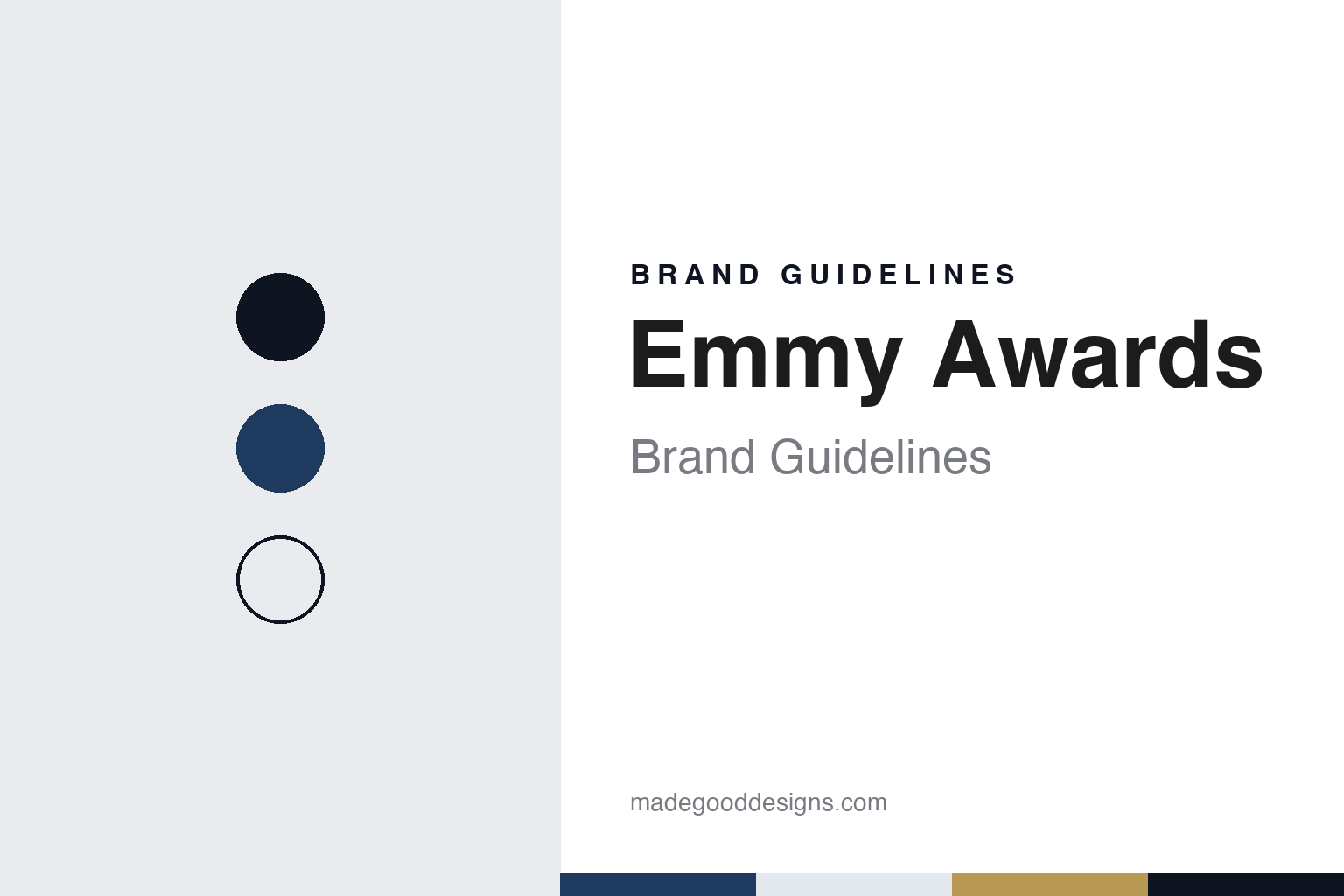
Two constants: a navy, grey and gold palette and a broadcast sans register. Abstract homage — not an Emmy Awards asset; no statuette, logo or mark is reproduced.
A television academy
A Los Angeles academy and a camera tube.
The Emmy Awards began with the Academy of Television Arts & Sciences (ATAS), now called the Television Academy, which Syd Cassyd founded in Los Angeles in 1946, according to History.com and TheWrap (2022). History.com says Cassyd at first objected to awards, wanting the group to be cultural and educational, before accepting the need for a visible event to raise its profile.
The first Emmy ceremony took place on 25 January 1949 at the Hollywood Athletic Club, and honoured only programmes produced and shown in the Los Angeles area. English Wikipedia says the Academy made the Emmys a national event in the 1950s, honouring programmes broadcast across the country.
The name comes from a camera tube. The Television Academy says Cassyd first proposed “Ike,” the nickname of the iconoscope tube, but members wanted a name less tied to a famous public figure who shared that nickname. Harry Lubcke, a television engineer and the Academy’s third president, suggested “Immy,” the industry term for the image orthicon tube used in early cameras; it was later changed to “Emmy,” which members thought suited a female figure, the Academy wrote in 2013.
The programme then spread across three organisations. In 1955 the National Academy of Television Arts & Sciences (NATAS) was formed in New York as a sister body for members on the East Coast, and it built regional chapters across the country, each with its own local Emmy ceremony. The International Academy of Television Arts & Sciences (IATAS) began in 1969 as NATAS’s International Council, later formed its own board, and held the first International Emmy Awards in 1973, English Wikipedia says. In 1977 ATAS and NATAS separated and agreed to share ownership of the statuette and the Emmy trademark, each running its own set of ceremonies.
Colour
One name, many ceremonies.
Today the name covers a family of competitions, each with its own rules, categories and voting. The Television Academy runs the Primetime Emmy Awards, for American primetime programming, usually in September, with a separate Creative Arts ceremony a few days earlier for behind-the-camera crafts such as art direction, costume design, cinematography, casting and sound. English Wikipedia says members of each of the Academy’s branches vote around June to choose nominees in their own categories, all members may vote for nominations in the programme categories, and final voting is held in August. The Academy also presents the Primetime Engineering Emmys and the Los Angeles Area Emmys.
NATAS, which describes itself as founded in 1955, runs the national Emmy Awards for Children’s & Family, Daytime, News & Documentary, Sports and Technology & Engineering programming, and administers Regional Emmy Awards through 19 chapters, its website says. The first separate Daytime ceremony was held in 1974. NATAS juries are peer judging panels drawn from professionals with national credits, and the Children’s & Family Emmys, announced on 17 November 2021, were first presented in 2022, according to English Wikipedia.
The International Academy, a nonprofit membership organisation based in New York with members from more than sixty countries, presents the International Emmy Award in sixteen categories for programmes produced outside the United States, at a ceremony in New York, it says. Its other events include the International Emmy World Television Festival.
Eligibility follows reach and platform rather than one calendar. English Wikipedia says cable programmes became eligible for the Primetime Emmys in 1988 and the Daytime Emmys in 1989, online-only series from 2013, and that a programme is generally treated as national if it reaches more than half of American households; a show may enter only one national competition. In December 2021 ATAS and NATAS announced a realignment that sorts programmes by genre and format rather than time of day.
Typography
The category.
Film, television, music and theatre awards tend to present themselves through a short name. The formal title of a prize is often long, naming an academy, a society or a person, while the name people use is a single word or a nickname that fits a headline, a poster and a broadcast caption. Many programmes use both, keeping the formal title for rules and records and the short name for everything public.
Behind each name sits an organisation: an academy of practitioners, a society of producers or theatre owners, a union of broadcasters or a company that produces the show. That body writes the rules, sets the categories and decides who votes, and its own name usually appears beside the prize in smaller type, as the signature rather than the headline.
The trophy is the most visible part of the identity. A statuette, a mask, a gramophone, a globe or a medallion can be kept for decades, with changes of material, maker or base. Because the object recurs in every photograph of the ceremony, it works as the visual shorthand for the whole programme.
The year gives these brands their rhythm. An eligibility period, usually a calendar year or a season, is followed by entries, members’ votes or jury rounds, a published list of nominations and a televised ceremony in a named venue. Sister programmes, honorary awards and separate ceremonies for other formats sit around the main event, each described in the same plain, institutional voice as the main categories.
Aa
A clean broadcast sans for a mid-century television prize. (Specimen set in Josefin Sans, a sans STAND-IN; NOT the Emmy Awards logo.)
Emmy Awards
The muse of art and the electron of science.
The statuette came first and the name second. The Television Academy wrote in August 2013 that its members rejected 47 proposals before choosing, in 1948, a design by the television engineer Louis McManus: a winged woman holding an atom. In the Academy’s words, the wings represent the muse of art and the atom the electron of science. TheWrap reported in 2022 that McManus received an Emmy of his own in 1949 for designing the award.
The Academy says the R.S. Owens company in Chicago makes close to four hundred statuettes each year for the Primetime Emmys, presented at the Creative Arts ceremony and the Primetime telecast, and between two hundred fifty and three hundred for the Los Angeles Area Emmys. Each Primetime statuette weighs six pounds twelve ounces, is made of copper, nickel, silver and gold, and takes five and a half hours to make; makers handle it with white gloves. The Academy orders extra figures in case of ties and stores the surplus for the following year. English Wikipedia notes that R.S. Owens also made the Academy Awards statuettes until 2016, and that Regional Emmy statuettes are smaller.
The figure is also a closely guarded mark. English Wikipedia says the two academies, as joint trademark owners, require the statuette always to appear facing left, ask for copyright notices to read “ATAS/NATAS,” and require permission for promotional use even by recipients. Both academies’ websites carry a line naming Emmy and the Emmy statuette as trademarks of ATAS and NATAS, and the Television Academy’s statuette page shows a graphic rendering of the figure captioned as redesigned in 2014.
The ceremonies move around the year: Technology & Engineering in January, Sports in spring in New York, the Primetime awards in September and the International Emmys in November, according to English Wikipedia and the organisers. TV Technology noted in October 2024 that the Primetime telecast rotates among the four major commercial networks.
For a design guide, the Emmy Awards show how one figure and one short name can hold together a family of competitions run by three separate academies. Compare the Grammy Awards, the music prize with its own handmade trophy, and the Academy Awards, whose statuettes came from the same Chicago maker until 2016. For this guide we use navy, grey and gold with a sans, an unofficial interpretation; no product or logo is reproduced.
Explore & save
Keep Emmy Awards’s identity on hand — save it to a board in the Made Good inspiration library.
Emmy Awards identity set
Pin the Emmy Awards navy, grey and gold palette and the broadcast sans register to your own board.
Source & notes
Frequently Asked Questions
What font can I use to match the Emmy Awards look?
This guide describes Emmy Awards’ type as “A clean broadcast sans for a mid-century television prize”. Its type specimen is set in Josefin Sans from Google Fonts as a stand-in; Josefin Sans is not Emmy Awards’ own lettering.
What colours are in the Emmy Awards palette?
This guide’s Emmy Awards palette is Studio navy #1F3A5F, Night ink #0E1420, Signal grey #E3E8EF, Satin gold #B89A55 and Paper #F7F8FA. The tones are the guide’s own unofficial interpretation, not official Emmy Awards hex codes.