BAFTA Brand Guidelines
From a 1947 film academy to a bronze mask for film, television and games.
Aa
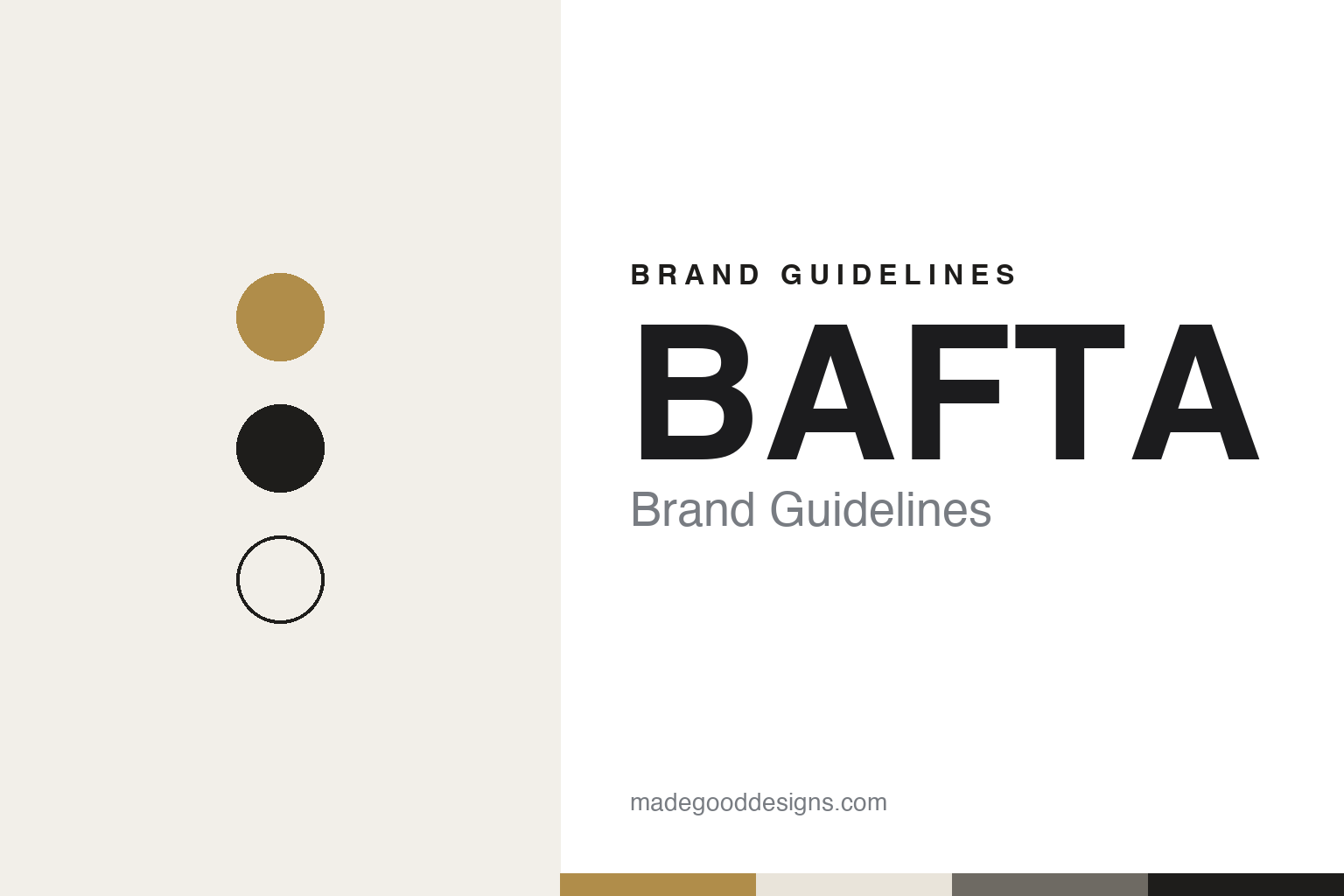
Two constants: a bronze, charcoal and stone palette and a Franklin-style sans register. Abstract homage — not a BAFTA mask, trophy or mark; no logo is reproduced.
British Film Academy
A film academy, a television guild and a merger.
BAFTA, the British Academy of Film and Television Arts, is a London-based membership organisation and charity that runs annual awards for film, television and games. It began as the British Film Academy. English Wikipedia dates its first meeting to 16 April 1947, chaired by the director David Lean, who became the founding chairman; later that year a committee of directors and producers was formed to draft a constitution. The Academy presented its first film awards in May 1949, for films made in 1947 and 1948.
Television came through a separate body. The Guild of Television Producers and Directors was set up in 1953 and held its first awards in October 1954, English Wikipedia says. In 1958 the two bodies merged to form the Society of Film and Television Arts. A 2020 peer-reviewed article on that merger, held in the University of East Anglia’s research repository, describes the society as the institution later renamed BAFTA, and argues that a shared wish to build training schemes across film and television was a key reason for the merger, despite tensions between the two industries at the time.
The present name arrived with a permanent home. The society took over the former Prince’s Hall at 195 Piccadilly in London, previously used by the Royal Institute of Painters in Water Colours; the headquarters was opened in 1976, and the organisation became the British Academy of Film and Television Arts in March 1976, according to English Wikipedia. The Grade II listed building was renovated from 2016 and reopened in 2022.
The academy now reaches well beyond London. English Wikipedia counts about 8,000 members working in the film, television and games industries, lists offices in Scotland and Wales and in Los Angeles and New York, and dates BAFTA North America to 1987. Jane Millichip has been chief executive since October 2022. Alongside its ceremonies the academy runs screenings, lectures and masterclasses through the year.
Colour
Film in February, television in spring, games in March.
BAFTA presents its awards at several ceremonies a year. The British Academy Film Awards, often simply called “the BAFTAs”, have been held since 1949. English Wikipedia says the ceremony, once held in April or May, has taken place in February since 2002, ahead of the Academy Awards in the United States. Films of any nationality are eligible if they have had a UK cinema release of at least seven days in the relevant year, while two categories are reserved for British films or British debut talent.
The film awards have changed venue over the years. Variety reported in February 2023 that the ceremony had moved that year to the Royal Festival Hall on London’s South Bank, describing the Royal Albert Hall as the film awards’ home in the previous years; the same report said the final four categories of the 2023 ceremony went out live on the BBC.
Television has its own pair of ceremonies. The British Academy Television Awards, usually held in April or May, have been presented every year since 1954, by the Guild until 1958. A few weeks later come the British Academy Television Craft Awards, which cover work behind the camera such as visual effects and costume design. English Wikipedia says the film and television awards were presented together from 1968 until 1997 and at separate ceremonies from 1998. Only British programmes broadcast in the preceding calendar year are eligible, apart from a publicly voted audience award, and programmes shown only online have been eligible since 2014.
Games arrived later. BAFTA held its first Interactive Entertainment Awards in 1998; in 2003 that ceremony was divided into separate video-games and interactive awards, and in 2006 the academy announced that it would give video games equal status with film and television, English Wikipedia says. The British Academy Games Awards are now usually held in March, after the film awards.
Younger audiences and entrants have their own programmes. The British Academy Children’s Awards, first presented in 1996 and held in November, cover film, television, games and online work made for children, and since 2007 have included a Kids Vote award chosen by children aged seven to 14. The academy also runs Student Film Awards and, since 2010, the Young Game Designer awards, now split into game-making and game-concept awards for two age groups between 10 and 18.
Typography
How screen, music and stage awards present themselves.
Film, television, music and theatre awards tend to present themselves through a short name. The formal title of a prize is often long, naming an academy, a society or a person, while the name people use is a single word or a nickname that fits a headline, a poster and a broadcast caption. Many programmes use both, keeping the formal title for rules and records and the short name for everything public.
Behind each name sits an organisation: an academy of practitioners, a society of producers or theatre owners, a union of broadcasters or a company that produces the show. That body writes the rules, sets the categories and decides who votes, and its own name usually appears beside the prize in smaller type, as the signature rather than the headline.
The trophy is the most visible part of the identity. A statuette, a mask, a gramophone, a globe or a medallion can be kept for decades, with changes of material, maker or base. Because the object recurs in every photograph of the ceremony, it works as the visual shorthand for the whole programme.
The year gives these brands their rhythm. An eligibility period, usually a calendar year or a season, is followed by entries, members’ votes or jury rounds, a published list of nominations and a televised ceremony in a named venue. Sister programmes, honorary awards and separate ceremonies for other formats sit around the main event, each described in the same plain, institutional voice as the main categories.
Aa
A Franklin-style sans for a five-letter acronym. (Specimen set in Libre Franklin, a sans STAND-IN; NOT the BAFTA logo or mask.)
The mask
A 1955 commission from a television guild.
The academy’s visual shorthand is its trophy. The BAFTA mask was designed in 1955 by the American sculptor Mitzi Cunliffe, who had moved to Britain in 1949, after the Guild of Television Producers commissioned a new award from her, CNN reported in 2019. A 2021 article by the University of Liverpool’s Victoria Gallery & Museum says she based the design on the masks of tragedy and comedy from classical Greek theatre, and that the mask has become the main branding for BAFTA, which uses an image of it as its logo.
The details reward a close look. The Victoria and Albert Museum, which holds examples of the award, describes the hollow reverse of the mask as carrying an electronic symbol around one eye and a screen symbol around the other, linking dramatic production with television technology; its catalogue dates the design to 1955. The Liverpool museum’s article records the same hidden motifs. The mask stayed with the merged society through its renamings, and CNN reported that the first bronze BAFTA mask was presented in 1976, the year of the present name.
Making the masks is a foundry craft. CNN said in 2019 that the same foundry in West Drayton, in the London borough of Hillingdon, had produced them since then, casting about 270 a year in batches of ten in a phosphor bronze alloy. English Wikipedia gives the finished award, mask and marble base together, as about 27 centimetres high and 3.7 kilograms, with the mask itself 16 centimetres high.
For a design guide, BAFTA shows how a single sculpted object, first made for a television guild in 1955, can become the logo of an academy that now covers film, television and games. Compare the Academy Awards in Los Angeles and the César Awards in Paris. For this guide we use a warm bronze, charcoal and stone with a sans, an unofficial interpretation; no product or logo is reproduced.
Explore & save
Keep BAFTA’s identity on hand — save it to a board in the Made Good inspiration library.
BAFTA identity set
Pin the bronze, charcoal and stone palette and the Franklin-style sans register to your own board.
Source & notes
Frequently Asked Questions
What font can I use to match the BAFTA look?
This guide describes BAFTA’s type as “A Franklin-style sans for a five-letter acronym”. Its type specimen is set in Libre Franklin from Google Fonts as a stand-in; Libre Franklin is not BAFTA’s own lettering.
What colours are in the BAFTA palette?
This guide’s BAFTA palette is Mask bronze #B08D4A, Charcoal #1E1D1B, Stone #E9E4DA, Smoke grey #6E6A63 and Paper #FAF8F4. The tones are the guide’s own unofficial interpretation, not official BAFTA hex codes.
When was BAFTA founded?
BAFTA was founded in 1947 (British Film Academy), in London, United Kingdom.