Prix Pictet Brand Guidelines
A photography prize rebuilt around one word every cycle.
Aa
Two constants: a forest green, stone and silver palette and an editorial serif register. Abstract homage — not a Prix Pictet asset; no trophy, logo or photograph is reproduced.
One word per cycle
A Geneva group’s photography prize, run in themed cycles.
The Prix Pictet was founded in 2008 by the Geneva-based Pictet Group as an award for photography and sustainability, according to English Wikipedia and to Wallpaper*, which recounted the founding in July 2025. The group, which describes itself as a wealth and asset management group, appears in this guide only in that founding role. The prize’s own website, published under the name Prix Pictet Ltd., describes it as a programme for photography and sustainability, built around a single theme in each cycle and run with its own jury, nominators and exhibition tour.
Each cycle starts with one word. The prize says a new cycle opens every second year, with the theme revealed at the Rencontres d’Arles, the summer photography festival in the south of France. The opening theme, in 2008, was Water; Earth followed in 2009, Growth in 2011 and Power in 2012, according to the prize’s list of cycles. Consumption came in 2014, Disorder in 2015 and Space in 2017, and Hope, Fire and Human followed in 2019, 2021 and 2023. The eleventh cycle, Storm, ran in 2025. On 9 July 2026, in the Théâtre Antique during the opening week of the Arles festival, Jungle was announced as the theme of the twelfth cycle, the prize says. An older passage of English Wikipedia describes a cycle of about 18 months; the prize’s current pages describe a two-year rhythm.
The organiser presents each theme as one facet of sustainability, “open to countless interpretations,” in the prize’s words. The early cycles also carried a commission: for the first five cycles, English Wikipedia says, a nominated photographer was sent to a specific country or region, in association with a partner organisation, to make a photographic report on a sustainability issue. That commission has since been discontinued, and the prize’s own timeline records the final one in the 2014 cycle.
Colour
Nominators, a jury and a shortlist of twelve.
Entry is by nomination only. The prize keeps a network of more than 350 nominators, which it describes as critics, curators, directors of museums and galleries, editors and other photography specialists, listed by region on its website. In each cycle, the prize says, every nominator proposes between one and five photographers whose work fits the theme, and those photographers are then invited to submit work. English Wikipedia says each nominee submits a coherent series of up to ten images focused on the theme. The prize’s FAQ says there are no criteria on age, nationality or professional status, and that the judges make no distinction between genres or photographic mediums. Since the prize began, the FAQ says, more than 5,600 photographers have been nominated; the prize’s about page gives a figure of more than 6,000.
An independent jury then works in two stages. It reviews the submissions and draws up a shortlist of twelve, announced at the next Rencontres d’Arles, and from that shortlist it selects one winner. English Wikipedia describes the stages as a conference to settle the shortlist, followed by a review of the shortlisted work at the exhibition. Wallpaper* reported in July 2025 that the shortlist is chosen for artistic and photographic merit, originality in conception and execution, relevance to the cycle’s theme and the ability to address a pressing sustainability challenge. The jury changes from cycle to cycle; the prize’s published lists show museum curators of photography, editors and critics among its members.
The winner is announced at the Victoria and Albert Museum in London, at a ceremony that opens the exhibition of the twelve shortlisted photographers. The V&A reported in November 2013 that the fifth cycle’s shortlist, of eleven artists, had been announced in Paris, and that the winner would be named on 21 May 2014 at the opening of the shortlist exhibition at the museum, which ran from 22 May to 14 June 2014. For the eleventh cycle the ceremony took place on 25 September 2025, and the V&A showed the shortlisted work in its Photography Centre from 26 September to 19 October 2025, according to the museum’s exhibition listing. English Wikipedia dates the partnership with the V&A from May 2014 and says the Musée d’Art Moderne de la Ville de Paris was also a partner for two cycles.
The prize is also an object. For each cycle, the prize says, a bespoke trophy, inspired by a location associated with the prize, is designed and made by the silversmith Vicki Ambery-Smith and presented to the winner at the ceremony. The trophy therefore changes from one cycle to the next rather than repeating a single statuette.
Typography
Foundations, juries and exhibitions.
Architecture, art and photography prizes tend to present themselves through the institution behind the name. A family foundation, a professional institute, a museum, a gallery or a company usually sets the rules, chooses the jury and publishes the result, and its own name often sits in the title or in a line such as “sponsored by” at the foot of the page.
The object handed over is rarely a statuette. Many of these programmes give a medal, a bronze, a certificate or a written citation, and some give an exhibition instead of, or as well as, an object. A medal can carry an inscription or ornament borrowed from architectural history, and a citation puts the jury’s reasoning on paper, so the identity leans on lettering and text as much as on a symbol. Organisers also tend to publish the names of the jury and the criteria it applies, which adds another layer of text to the identity.
Selection follows a recognisable rhythm. Nominations or entries close on a fixed date, a jury or panel deliberates, and in many cases a shortlist is published months before the result; some prizes publish no shortlist at all and keep their deliberations confidential. The cycle can be yearly, or longer, and the announcement or ceremony is often staged in a different building or city each time.
What carries the identity between ceremonies is the record. Touring exhibitions, catalogues and books, websites with archives of past citations, and photographs of buildings, artworks and images keep the programme visible, and for a designer they set the tone: neutral grounds, careful type and plenty of room for the work being shown.
Aa
An editorial serif — a register for a prize that speaks in single words. (Specimen set in Newsreader, a serif STAND-IN; NOT the Prix Pictet logo.)
Prix Pictet
A touring exhibition and a book for every cycle.
After the London opening, the shortlist exhibition tours. English Wikipedia says each cycle’s exhibition reaches more than a dozen countries during its touring period. The prize’s own timeline records the 2008 awards exhibition at the Palais de Tokyo in Paris; touring shows in Eindhoven, Thessaloniki and Hong Kong in the 2009–10 cycle; a London awards exhibition at the Saatchi Gallery in the 2012–13 cycle; and, in the 2019–20 cycle, a tour that began at Hillside Forum in Tokyo. The 2015–16 awards exhibition was shown at the Musée d’Art Moderne de Paris, the timeline says, and in the 2022–23 cycle a survey of work by previously nominated photographers opened at the International Red Cross and Red Crescent Museum in Geneva.
Books carry the identity between exhibitions. English Wikipedia says a book accompanies each cycle, with work by each shortlisted artist, images from the wider group of nominees and essays on the theme. The prize’s timeline names teNeues as the publisher of the opening book in 2008 and of a special edition, ten, marking the prize’s first decade; it also lists Confinement, published in 2020 with work by artists shortlisted in earlier cycles, and Collage, published by Gestalten in the 2021–22 cycle. The timeline says the Financial Times became the prize’s global media partner in 2008, and that the Rencontres d’Arles staged exhibitions of past winners’ work in 2014 and again in the 2017–18 cycle.
The programme has a sister award in Japan. The Prix Pictet Japan Award, inaugurated in 2015, is for Japanese photographers aged 40 or under, with entry by nomination, and is supported by the Prunier Foundation, English Wikipedia says; the prize’s timeline lists its second and third editions in the 2017–18 and 2019–20 cycles.
For a design guide, the Prix Pictet shows how a prize can renew its identity around a single word each cycle while keeping the same format: nomination, a shortlist of twelve, a London ceremony, a tour and a book. Compare the Hasselblad Award, a photography prize run by a Swedish foundation, and the Sony World Photography Awards, another photography programme in this series. For this guide we use a deep forest green, warm stone and a silver grey with a serif, an unofficial interpretation; no product or logo is reproduced.
Explore & save
Keep Prix Pictet’s identity on hand — save it to a board in the Made Good inspiration library.
Prix Pictet identity set
Pin the Prix Pictet forest green, stone and silver palette and the editorial serif register to your own board.
Source & notes
Frequently Asked Questions
What font can I use to match the Prix Pictet look?
This guide describes Prix Pictet’s type as “An editorial serif — a register for a prize that speaks in single words”. Its type specimen is set in Newsreader from Google Fonts as a stand-in; Newsreader is not Prix Pictet’s own lettering.
What colours are in the Prix Pictet palette?
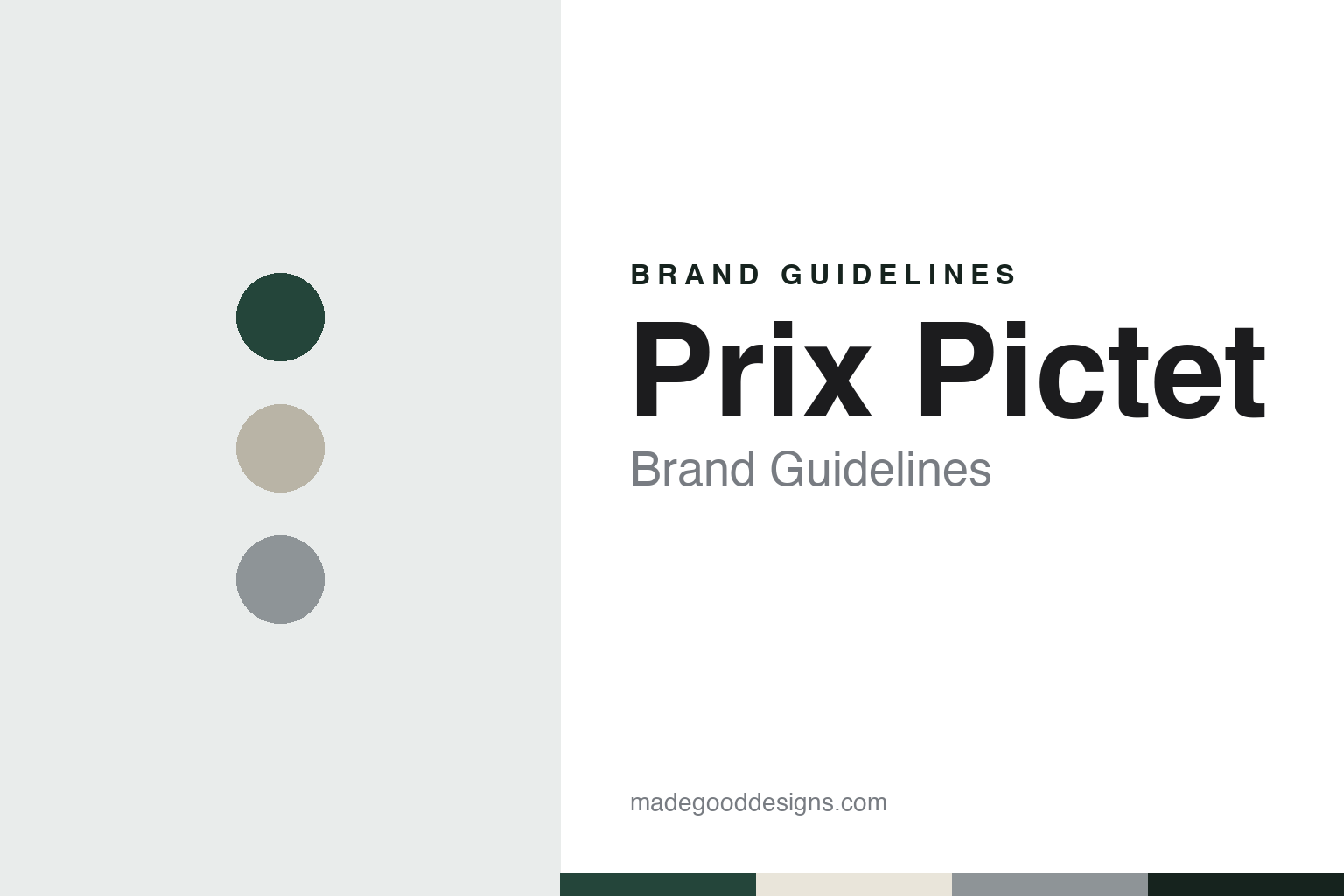
This guide’s Prix Pictet palette is Forest green #24453A, Night ink #16231E, Warm stone #E9E5DA, Silver grey #8E9497 and Paper #F7F5F0. The tones are the guide’s own unofficial interpretation, not official Prix Pictet hex codes.
When was Prix Pictet founded?
Prix Pictet was founded in 2008, in Geneva-based Pictet Group.