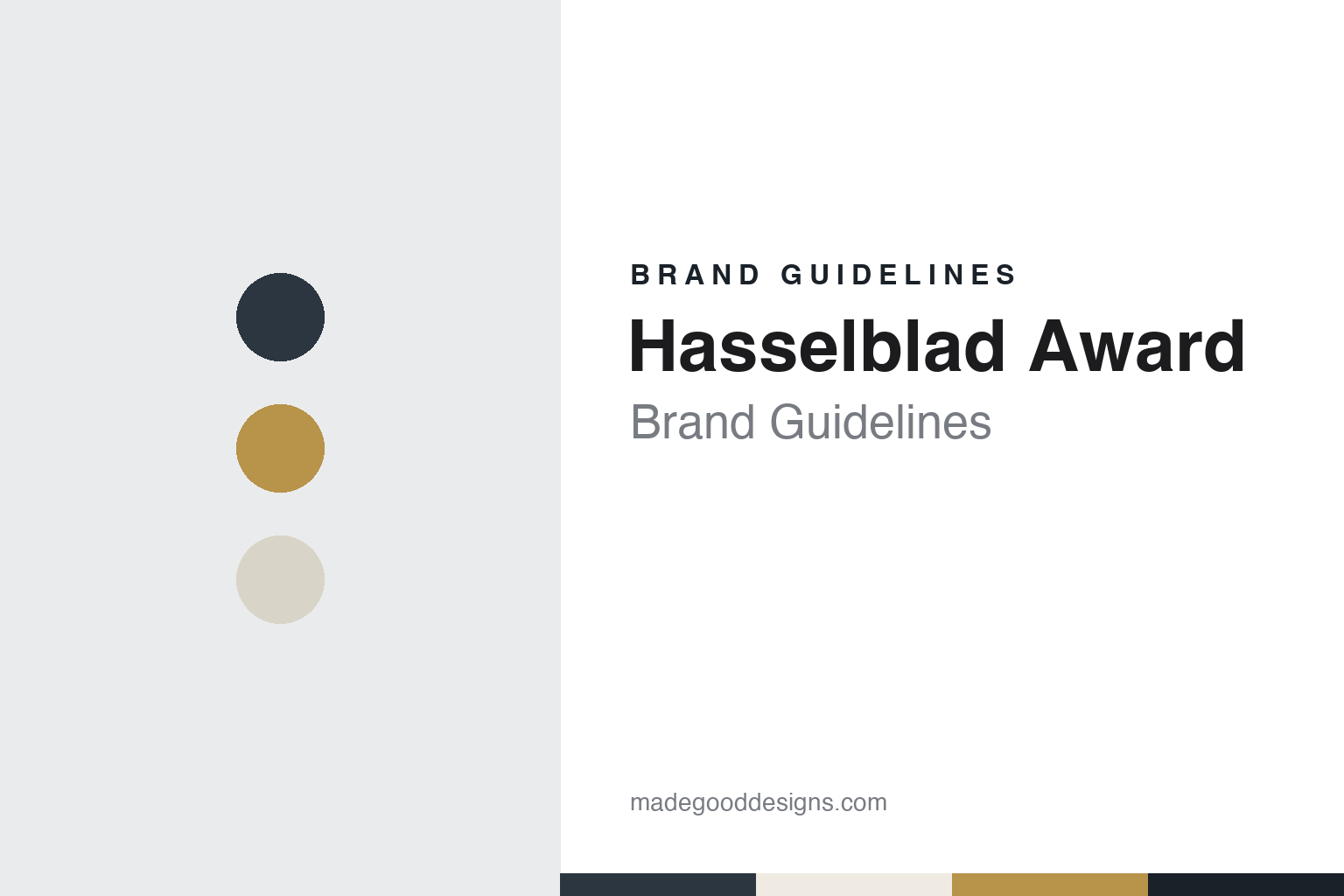
Hasselblad Award Brand Guidelines
A photography prize drawn from a will, a medal and one Gothenburg hall.
Aa
Two constants: a slate, gold and stone palette and a plain grotesque register. Abstract homage — not a Hasselblad Foundation asset; no medal, logo, camera or photograph is reproduced.
A prize from a will
A Gothenburg foundation and an award given since 1980.
The Hasselblad Award — in full, the Hasselblad Foundation International Award in Photography — is given by Erna and Victor Hasselblad’s Foundation in Gothenburg, Sweden. In Swedish it is called Hasselbladstiftelsens internationella pris i fotografi, or simply Hasselbladpriset, Swedish Wikipedia says. The foundation says it was established in 1979 in accordance with the last will and testament of Erna and Victor Hasselblad; Swedish Wikipedia describes it as an independent, non-profit foundation formed that year. In its own words, it promotes research and academic teaching in the natural sciences and photography, through grants and stipends, the award, photographic research and exhibitions.
The award was presented for the first time in 1980, according to the foundation and English Wikipedia, and has been given annually since then with the exception of 1983 and 2021, the foundation says. Its criterion comes from the will itself: the award goes to “a photographer recognized for major achievements,” in the words the foundation quotes from the testament. The foundation adds that the recipient may be someone whose achievements in photographic art have had a decisive effect on younger generations of photographers, who has realised several internationally significant projects and who has continued to develop artistically.
The name is shared with a camera. The foundation’s history says Victor Hasselblad presented the Hasselblad camera in New York in 1948, a single-lens, medium-format design with interchangeable lenses and film magazines, and that interest from photographers followed. The foundation describes its own work as grants, stipends, research and exhibitions in photography and the natural sciences, and the award as one part of that programme.
Colour
A committee, a board and a gold medal.
Selection follows a two-step model set out by the foundation. Each year its board of directors appoints an award committee of internationally prominent experts and scholars in photography. The committee nominates three to five candidates, and the foundation’s board selects the winner from among them.
The winner is usually announced around 8 March, the foundation says, the date of Victor Hasselblad’s birthday. Later in the same year an exhibition of the winner’s work opens at the Hasselblad Center, and a symposium with the winner is held on the same occasion. Swedish Wikipedia describes the award as presented in the autumn, alongside the exhibition and the publication of a book. For 2026 the foundation listed a Hasselblad Award Week in Gothenburg built around those elements: a seminar with the County Administrative Board of Västra Götaland, a concert with the Gothenburg Symphony Orchestra, an exhibition opening, a book launch, a formal award ceremony on 9 October and an artist talk at Moderna Museet in Stockholm on 13 October. Artforum reported the same ceremony date and the Hasselblad Center venue in March 2026.
The award has physical parts as well as a title. The foundation lists a gold medal and a diploma, and English Wikipedia names the same two along with an exhibition at the Hasselblad Center in the Göteborg Museum of Art. In March 2026 Artforum reported that the prize also included a camera from Hasselblad, the camera maker that carries the same family name; the foundation’s 2026 announcement lists the camera too.
Typography
Foundations, juries and exhibitions.
Architecture, art and photography prizes tend to present themselves through the institution behind the name. A family foundation, a professional institute, a museum, a gallery or a company usually sets the rules, chooses the jury and publishes the result, and its own name often sits in the title or in a line such as “sponsored by” at the foot of the page.
The object handed over is rarely a statuette. Many of these programmes give a medal, a bronze, a certificate or a written citation, and some give an exhibition instead of, or as well as, an object. A medal can carry an inscription or ornament borrowed from architectural history, and a citation puts the jury’s reasoning on paper, so the identity leans on lettering and text as much as on a symbol. Organisers also tend to publish the names of the jury and the criteria it applies, which adds another layer of text to the identity.
Selection follows a recognisable rhythm. Nominations or entries close on a fixed date, a jury or panel deliberates, and in many cases a shortlist is published months before the result; some prizes publish no shortlist at all and keep their deliberations confidential. The cycle can be yearly, or longer, and the announcement or ceremony is often staged in a different building or city each time.
What carries the identity between ceremonies is the record. Touring exhibitions, catalogues and books, websites with archives of past citations, and photographs of buildings, artworks and images keep the programme visible, and for a designer they set the tone: neutral grounds, careful type and plenty of room for the work being shown.
Aa
A plain grotesque — a quiet register for a medal, a diploma and an exhibition hall. (Specimen set in Archivo, a sans STAND-IN; NOT the Hasselblad Foundation logo.)
Hasselblad Award
An exhibition hall inside an art museum.
The award’s public home is the Hasselblad Center. The foundation says the centre opened in 1989. Swedish Wikipedia, citing the foundation, says it began that year as a separate foundation set up by the Hasselblad Foundation to promote research and teaching in photography, and that its activities have been part of the Hasselblad Foundation since 2008. Today it is the foundation’s exhibition hall within the premises of the Göteborg Museum of Art, reached through the museum’s main entrance, while the foundation’s library and offices have their own entrance.
Swedish Wikipedia says the centre presents three large exhibitions a year, one of them devoted to that year’s award winner, with a focus on established and younger Swedish and international photographers. The foundation’s own listings show the pattern: the award exhibition of 2024 ran from 12 October 2024 to 19 January 2025, and that of 2025 from 11 October 2025 to 18 January 2026. A permanent exhibition, I Am the Camera, formerly titled Hasselblad and the Moon, covers the camera’s development and the people behind both the camera company and the foundation, Swedish Wikipedia says.
The award sits within a wider programme. Alongside it, the foundation lists research grants, a postdoctoral fellowship, seminars and publications in photographic research, photo book grants, a nature photography grant, a writing residency, and Hasselblad Science Grants and stipends in the natural sciences. Its research library opened in 1999; Swedish Wikipedia puts its holdings at about 16,000 books and catalogues on photography, open to students, researchers and others interested in the medium, with Erna and Victor Hasselblad’s archive, including historical material, kept alongside it. The foundation also stages Fotosalongen, an exhibition it held at the centre in 2025.
For a design guide, the Hasselblad Award shows how a prize can draw its identity from a will, a name and a place: a single criterion quoted from a testament, a medal and diploma, a March announcement and an autumn exhibition in one Gothenburg hall. Compare the Prix Pictet, a photography prize founded by a Geneva group, and Hasselblad, the camera maker that shares the name. For this guide we use a deep slate, a medal gold and a pale stone with a sans, an unofficial interpretation; no product or logo is reproduced.
Explore & save
Keep Hasselblad Award’s identity on hand — save it to a board in the Made Good inspiration library.
Hasselblad Award identity set
Pin the Hasselblad Award slate, gold and stone palette and the plain grotesque register to your own board.
Source & notes
Frequently Asked Questions
What font can I use to match the Hasselblad Award look?
This guide describes Hasselblad Award’s type as “A plain grotesque — a quiet register for a medal, a diploma and an exhibition hall”. Its type specimen is set in Archivo from Google Fonts as a stand-in; Archivo is not Hasselblad Award’s own lettering.
What colours are in the Hasselblad Award palette?
This guide’s Hasselblad Award palette is Deep slate #2C3640, Charcoal #1A2128, Medal gold #B8934A, Pale stone #EFEBE3 and Paper #F8F6F2. The tones are the guide’s own unofficial interpretation, not official Hasselblad Award hex codes.
When was Hasselblad Award founded?
Hasselblad Award was founded in 1980 (first award), in Gothenburg, Sweden.