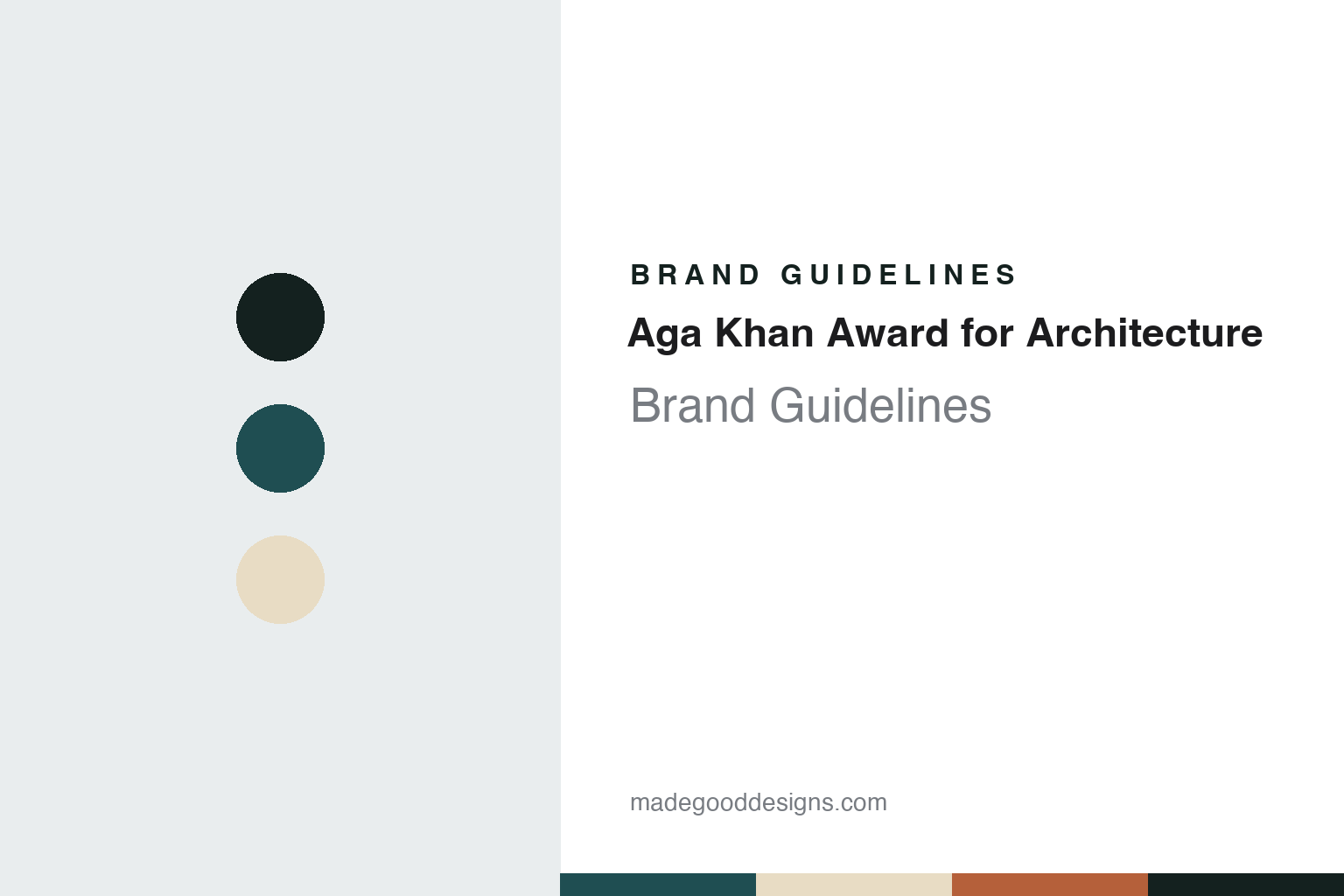
Aga Khan Award for Architecture Brand Guidelines
A three-year architecture prize, judged on site and staged in a new city each cycle.
Aa
Two constants: a teal, sand and terracotta palette and a classical serif register. Abstract homage — not an Aga Khan Award for Architecture mark; no logo, certificate or building is reproduced.
A prize from 1977
A cultural trust, a Geneva office and a three-year rhythm.
The Aga Khan Award for Architecture was established in 1977. It is part of the Aga Khan Trust for Culture (AKTC), which the Aga Khan Development Network (AKDN) describes as its cultural agency, and it is administered from Geneva, according to English Wikipedia and Architectural Record (September 2025). AKDN says the award is given every three years to projects that set new standards in architecture, planning practice, historic preservation and landscape architecture, and that it looks for building concepts that address the needs and aspirations of societies around the world in which Muslims have a significant presence.
The years before the first presentation were spent defining the programme. English Wikipedia says a founding group of architects and historians travelled widely, from Morocco to Indonesia, consulted chambers of architects and ministries of urbanism and culture, and held the first Aga Khan Award for Architecture Seminar in April 1978 at Aiglemont, in Gouvieux, France. Later seminars took place in cities including Istanbul, Jakarta, Fez, Amman, Beijing, Dakar and Granada. The first cycle ran from 1978 to 1980 and closed with a ceremony at the Shalimar Gardens in Lahore.
That three-year rhythm has held since. AKDN counts 16 cycles since 1977 and says documentation has been compiled on almost 10,000 building projects, of which master juries have selected 136 to receive the award. English Wikipedia names Farrokh Derakhshani as Director of the Award since 1982, and AKDN still gave him that title in a release of 18 September 2026 about a public talk, “Beyond Buildings,” which the award organised in Singapore with Ismaili CIVIC, with the Asian Civilisations Museum as venue partner.
Colour
Steering committee, nominators, reviewers and a master jury.
Each cycle begins with a steering committee. AKDN says a new committee is constituted for every cycle to set the eligibility criteria for submissions, give thematic direction in response to emerging issues and plan for the future of the award; it also selects and appoints the master jury and oversees the programme of international seminars, lectures, exhibitions and publications. English Wikipedia adds that past juries have included sociologists, philosophers and artists as well as architects. For the 2025 award the master jury had nine architects and scholars, Architectural Record reported.
Projects reach the jury through nominations. English Wikipedia describes a network of about 500 nominators who live in Muslim societies and whose identities are kept anonymous, alongside independent nominations made under the published guidelines; it gives 424 projects presented in the cycle that closed in 1998 and 343 in the cycle that closed in 2007. Eligibility is set cycle by cycle: for 2025, projects had to have been completed between 2018 and 2023 and in use for at least a year, Architectural Record reported.
The jury first narrows the field to a shortlist. Technical reviewers then visit each shortlisted project, AKDN says, speaking with users and contributors, examining construction and craft and reporting back to the jury; the three-year cycle, AKDN explains, lets projects be examined after ideas have become lived realities. The award looks beyond the architect: AKDN says it considers municipalities, builders, clients, master artisans and engineers alongside designers. English Wikipedia also lists a separate Chairman’s Award, for lifetime achievement outside the master jury’s mandate, presented four times, in 1980, 1986, 2001 and 2010.
The 2025 cycle shows the calendar. The shortlist was unveiled in July 2025, Architectural Record reported; the winners were announced on 2 September 2025, Dezeen reported; and the prize-giving took place on 15 September 2025 at the Kyrgyz National Philharmonic Hall in Bishkek, according to AKDN, after a week of related events in the city. A book edited by a member of the steering committee presented both the shortlisted and the awarded projects, Architectural Record noted.
Typography
Foundations, institutes and museums behind the name.
Architecture, art and photography prizes tend to present themselves through the institution behind the name. A family foundation, a professional institute, a museum, a gallery or a company usually sets the rules, chooses the jury and publishes the result, and its own name often sits in the title or in a line such as “sponsored by” at the foot of the page.
The object handed over is rarely a statuette. Many of these programmes give a medal, a bronze, a certificate or a written citation, and some give an exhibition instead of, or as well as, an object. A medal can carry an inscription or ornament borrowed from architectural history, and a citation puts the jury’s reasoning on paper, so the identity leans on lettering and text as much as on a symbol. Organisers also tend to publish the names of the jury and the criteria it applies, which adds another layer of text to the identity.
Selection follows a recognisable rhythm. Nominations or entries close on a fixed date, a jury or panel deliberates, and in many cases a shortlist is published months before the result; some prizes publish no shortlist at all and keep their deliberations confidential. The cycle can be yearly, or longer, and the announcement or ceremony is often staged in a different building or city each time.
What carries the identity between ceremonies is the record. Touring exhibitions, catalogues and books, websites with archives of past citations, and photographs of buildings, artworks and images keep the programme visible, and for a designer they set the tone: neutral grounds, careful type and plenty of room for the work being shown.
Aa
A classical serif for a prize staged in historic settings. (Specimen set in Cormorant Garamond, a serif STAND-IN; NOT the Aga Khan Award for Architecture logo.)
Aga Khan Award for Architecture
A ceremony in a different city each cycle.
The ceremonies move with each cycle, and their settings carry much of the award’s public image. English Wikipedia lists the Topkapı Palace in Istanbul for 1983, El Badi Palace in Marrakesh for 1986, the Citadel of Salah Ed-Din in Cairo for 1989, Registan Square in Samarkand for 1992, the Kraton Surakarta in Indonesia for 1995, the Alhambra in Granada for 1998 and Humayun’s Tomb in New Delhi for 2004. AKDN’s own page pictures the 2013 ceremony at the Castle of São Jorge in Lisbon, held in September 2013; English Wikipedia gives Al Ain in the United Arab Emirates for November 2016, Kazan for September 2019 and Muscat for October 2022, before Bishkek in 2025.
Around each ceremony sits a wider programme. AKDN describes seminars, lectures, exhibitions and publications as part of every cycle, and the award has taken its process to public audiences outside the ceremony city: at the Singapore talk in September 2026, AKDN reported, speakers described the award as a form of cultural infrastructure and explained how reviewers visit projects, speak with the people who use them and report to a multidisciplinary jury. The award’s name has stayed the same since 1977, and the record it keeps, almost 10,000 documented projects by AKDN’s count, is as much a part of its identity as the prize-giving itself.
For a design guide, the Aga Khan Award for Architecture shows a prize identity built on place and process: a three-year cycle, on-site review and a ceremony staged in a historic setting. Compare The Pritzker Architecture Prize and the RIBA Stirling Prize, two other architecture prizes in this series. For this guide we use a deep teal, sand and a terracotta with a serif, an unofficial interpretation; no product or logo is reproduced.
Explore & save
Keep Aga Khan Award for Architecture’s identity on hand — save it to a board in the Made Good inspiration library.
Aga Khan Award for Architecture identity set
Pin the teal, sand and terracotta palette and the classical serif register to your own board.
Source & notes
Frequently Asked Questions
What font can I use to match the Aga Khan Award for Architecture look?
This guide describes Aga Khan Award for Architecture’s type as “A classical serif for a prize staged in historic settings”. Its type specimen is set in Cormorant Garamond from Google Fonts as a stand-in; Cormorant Garamond is not Aga Khan Award for Architecture’s own lettering.
What colours are in the Aga Khan Award for Architecture palette?
This guide’s Aga Khan Award for Architecture palette is Courtyard teal #1F4E52, Ink #14211F, Sand #E8DCC4, Terracotta #B5603A and Paper #F7F4EE. The tones are the guide’s own unofficial interpretation, not official Aga Khan Award for Architecture hex codes.