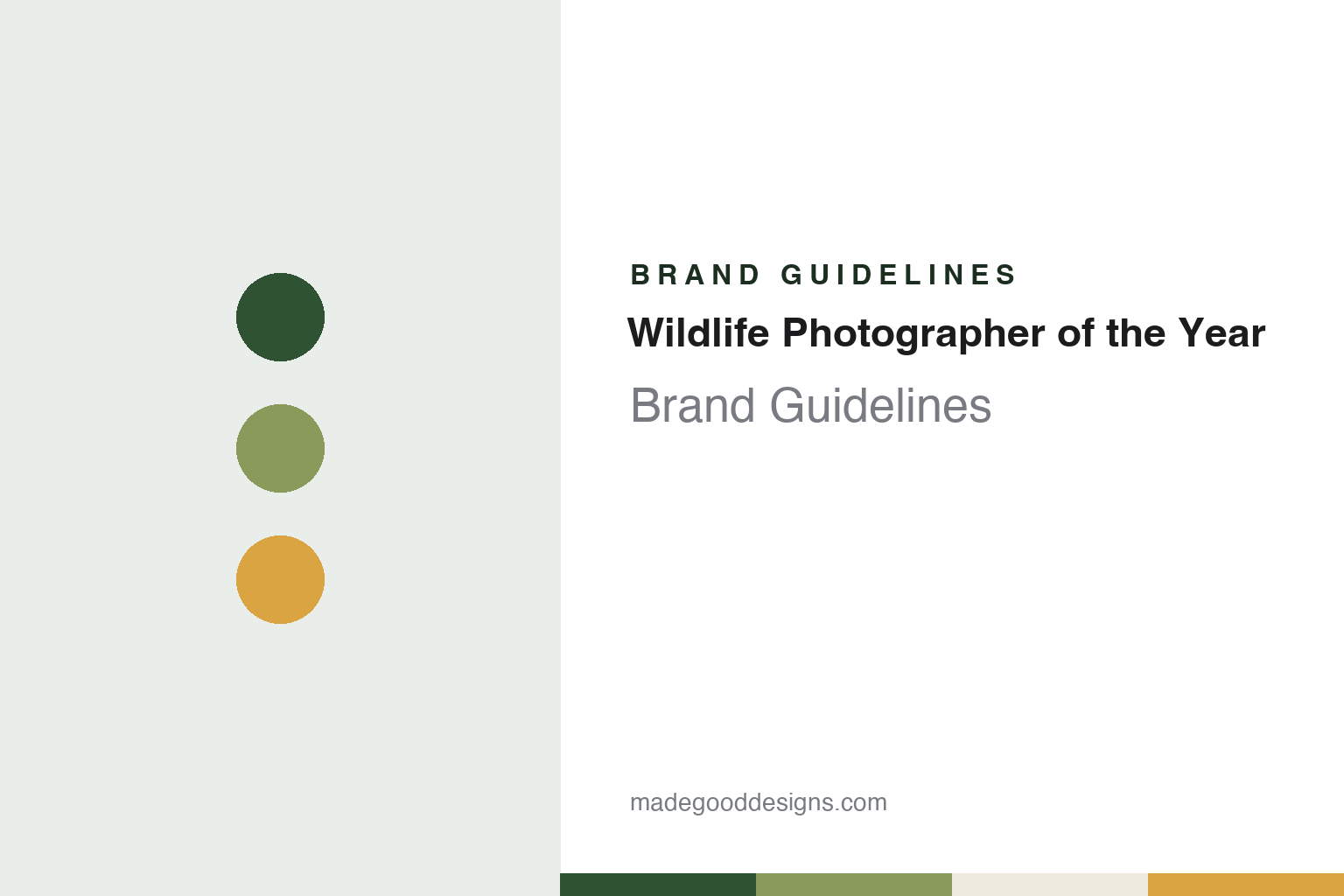
Wildlife Photographer of the Year Brand Guidelines
The Natural History Museum’s yearly nature photography competition, from a magazine contest to a touring exhibition.
Aa
Two constants: a fern green, moss and amber palette and a Field serif register. Abstract homage — not a Wildlife Photographer of the Year mark or image; no logo, photograph or award is reproduced.
From magazine to museum
A contest that found a home in South Kensington.
Wildlife Photographer of the Year is an annual international competition for nature photography, run by the Natural History Museum in London. It began in the mid-1960s as a magazine contest rather than a museum programme, and sources differ on the first year. English Wikipedia gives 1964, citing the museum’s own history page, with around 600 entries. The museum’s numbering counts from 1965: in February 2022 the Discover Wildlife website of BBC Wildlife magazine described the competition opening for entries that October as the fifty-ninth.
The museum and BBC Wildlife magazine long ran it together: when The Guardian previewed the competition in September 2002, it described BBC Wildlife magazine as joint organiser of the event, and said the exhibition of winning and commended photographs would open at the museum that October and be reproduced in the magazine. By December 2018 the magazine’s own website described the competition as run by the Natural History Museum, and its exhibition guide of February 2022 said the same.
Colour
Categories, levels and a yearly calendar.
The title has carried sponsors’ names. English Wikipedia records the competition as BG Wildlife Photographer of the Year from 1990 to 2003, and The Guardian used that name in 2002. Wikipedia lists shorter periods under the names of Shell, Kodak and Prudential, and its table of overall titles gives the name Veolia Environnement Wildlife Photographer of the Year for 2009 and 2013; from 2014 the same table uses the plain title, which is the name the museum uses today.
Entries are grouped by subject and approach, and the list changes from year to year, English Wikipedia notes. The Guardian’s 2002 preview counted more than 15 categories and reported that an innovation award had been added that year for photographers using new technology. The 2026 categories, as listed in The Guardian’s gallery of 14 October 2026, included Animal Portraits, Animals in their Environment, Plants and Fungi and Under Water; behaviour categories for mammals, for invertebrates and for amphibians and reptiles; Urban Wildlife and Natural Artistry; and two “Bigger Picture” categories, one for oceans and one for wetlands. Photojournalism has its own single-image category and a Photojournalist Story Award, and a Portfolio Award judges a body of work, alongside a Rising Star Award for younger adults.
The young competition runs in parallel, in three age bands: 10 Years and Under, 11–14 Years and 15–17 Years. Two overall titles sit above the categories. According to English Wikipedia, since 2003 the grand titles have been chosen from among the category winners: Wildlife Photographer of the Year for adults and Young Wildlife Photographer of the Year for photographers aged 17 and under. Within a category the usual levels are winner, runner-up and highly commended, and judges may leave a place empty.
Selection is by jury. Discover Wildlife described the jury in 2022 as photographers, editors, journalists, conservationists and scientists, and English Wikipedia describes a three-round judging process. The public has its own say through the People’s Choice award. In December 2018 Discover Wildlife reported voting open for the LUMIX People’s Choice Award, with 25 images shortlisted by the museum from more than 45,000 submissions from 95 countries; in February 2025 The Guardian reported a shortlist of 25 and a record 76,000 votes, figures it attributed to the museum.
The calendar runs across two years. In 2022, Discover Wildlife reported, entries opened on 17 October and closed on 8 December, with adults allowed up to 25 images and entrants aged 17 and under up to 10. Results follow the next autumn. The Guardian reported a record 59,228 entries from 117 countries and territories for 2024, with the exhibition opening on 11 October; the 2026 winners were published on 14 October 2026, with the exhibition opening at the museum on 16 October 2026. In 2002, by comparison, the newspaper counted more than 18,500 entries from 60 countries.
Typography
Design and documentation.
Architecture, art and photography prizes tend to present themselves through the institution behind the name. A family foundation, a professional institute, a museum, a gallery or a company usually sets the rules, chooses the jury and publishes the result, and its own name often sits in the title or in a line such as “sponsored by” at the foot of the page.
The object handed over is rarely a statuette. Many of these programmes give a medal, a bronze, a certificate or a written citation, and some give an exhibition instead of, or as well as, an object. A medal can carry an inscription or ornament borrowed from architectural history, and a citation puts the jury’s reasoning on paper, so the identity leans on lettering and text as much as on a symbol. Organisers also tend to publish the names of the jury and the criteria it applies, which adds another layer of text to the identity.
Selection follows a recognisable rhythm. Nominations or entries close on a fixed date, a jury or panel deliberates, and in many cases a shortlist is published months before the result; some prizes publish no shortlist at all and keep their deliberations confidential. The cycle can be yearly, or longer, and the announcement or ceremony is often staged in a different building or city each time.
What carries the identity between ceremonies is the record. Touring exhibitions, catalogues and books, websites with archives of past citations, and photographs of buildings, artworks and images keep the programme visible, and for a designer they set the tone: neutral grounds, careful type and plenty of room for the work being shown.
Aa
A field serif — a museum name on a nature exhibition. (Specimen set in Fraunces, a serif STAND-IN; NOT the Wildlife Photographer of the Year logo.)
Wildlife Photographer of the Year
An exhibition, a book and a credit line.
The competition’s public face is its exhibition. Each year the winning and highly commended images go on show at the museum in South Kensington, and the show then travels. Discover Wildlife’s 2022 guide listed tour stops around the United Kingdom, including Bristol and Cardiff.
Books are the second carrier. English Wikipedia records a book of winning and runner-up images every year since 1992, the first published by Fountain Press, and says the latest portfolio is published on the day of the awards ceremony at the museum. A third, smaller carrier is the credit line. When newspapers reproduce the photographs, they credit them to the photographer followed by the competition’s name, as The Guardian’s galleries do, so the title travels with every published image.
The competition’s history is told through two institutions. The Guardian named BBC Wildlife magazine as joint organiser in 2002; today the Natural History Museum runs the competition, its exhibition and its People’s Choice vote, according to Discover Wildlife and The Guardian.
For a design guide, Wildlife Photographer of the Year shows how a museum programme can carry an identity through an exhibition, a yearly book and a credit line rather than through a trophy. Compare the Natural History Museum, which runs it, and the BBC, whose BBC Wildlife magazine was joint organiser in 2002, The Guardian reported. For this guide we use a fern green, a moss, a bone white and an amber with a serif, an unofficial interpretation; no product or logo is reproduced.
Explore & save
Keep Wildlife Photographer of the Year’s identity on hand — save it to a board in the Made Good inspiration library.
Wildlife Photographer of the Year identity set
Pin the Wildlife Photographer of the Year fern green, moss and amber palette and the Field serif register to your own board.
Source & notes
Frequently Asked Questions
What font can I use to match the Wildlife Photographer of the Year look?
This guide describes Wildlife Photographer of the Year’s type as “A field serif — a museum name on a nature exhibition”. Its type specimen is set in Fraunces from Google Fonts as a stand-in; Fraunces is not Wildlife Photographer of the Year’s own lettering.
What colours are in the Wildlife Photographer of the Year palette?
This guide’s Wildlife Photographer of the Year palette is Fern green #2F5233, Moss #8A9A5B, Bone #EFEADF, Amber light #D9A441 and Night soil #1C2E1F. The tones are the guide’s own unofficial interpretation, not official Wildlife Photographer of the Year hex codes.
When was Wildlife Photographer of the Year founded?
Wildlife Photographer of the Year was founded in 1964 or 1965 (sources differ), in London, United Kingdom.