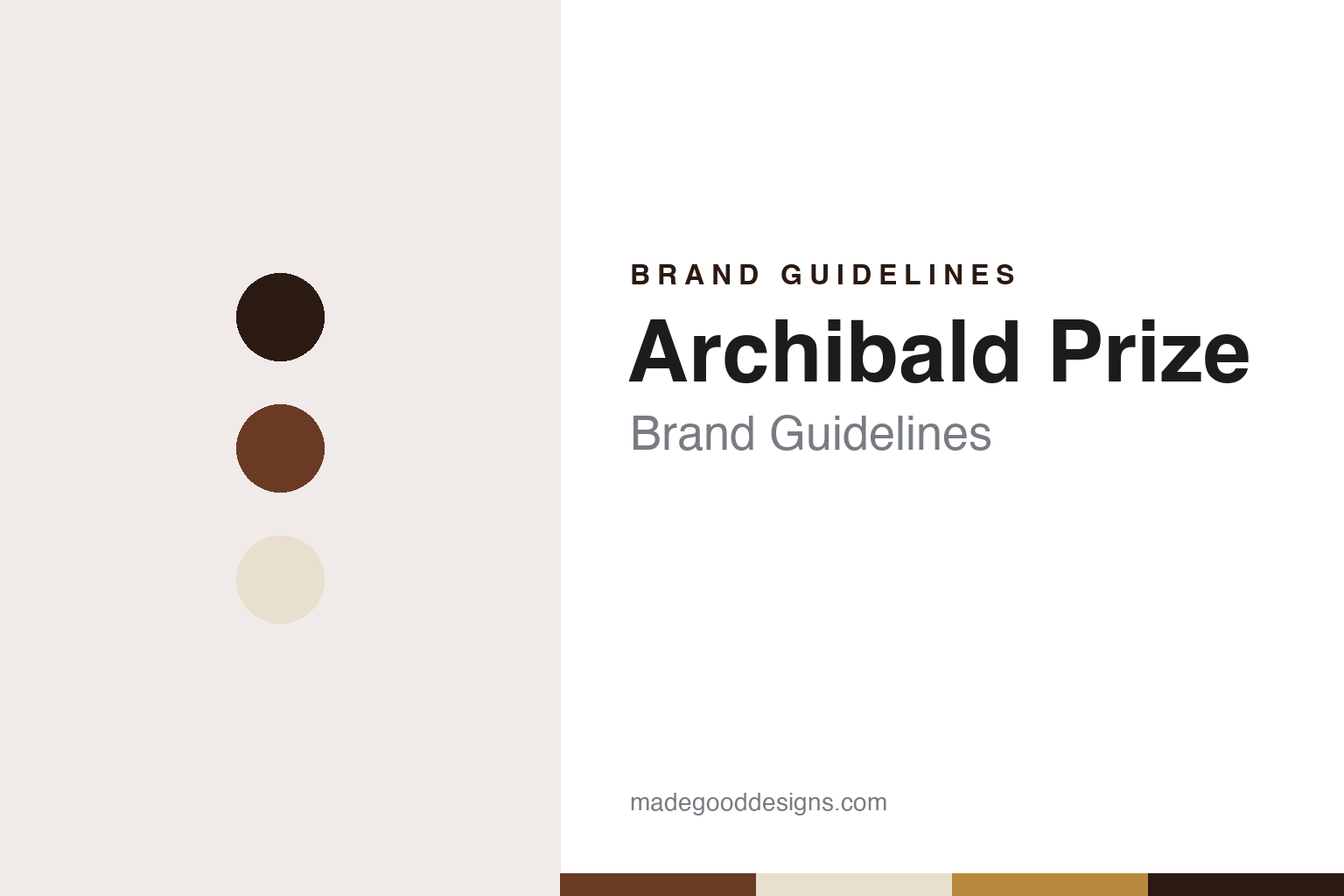
Archibald Prize Brand Guidelines
Sydney’s portrait prize, judged by gallery trustees since 1921.
Aa
Two constants: an umber, ochre and linen palette and a bookish serif register. Abstract homage — not an Archibald Prize asset; no artwork, logo or trophy is reproduced.
The Archibald bequest
A journalist’s will and a gallery’s trustees.
The Archibald Prize was created by a will. J. F. Archibald, born John Feltham Archibald in Geelong, Victoria, in 1856, launched the weekly journal The Bulletin in 1880 and was its founding editor, according to the Dictionary of Sydney entry on the prize (2014) and an essay in The Conversation (June 2021). He later renamed himself Jules François Archibald, The Conversation notes. His will, which took effect in 1919, left a share of his estate to the trustees of what was then the National Art Gallery of New South Wales, today the Art Gallery of New South Wales in Sydney, to fund an annual portrait prize to be judged by those trustees.
The wording of the will still frames the prize. It asks for a portrait, “preferentially” of “some man or woman distinguished in Art, Letters, Science or Politics,” painted by an artist resident in Australasia during the twelve months before the date the trustees set for sending in pictures, as quoted by English Wikipedia and in the 2021 essay. The Dictionary of Sydney entry points to two conditions in that clause: the judges are the gallery’s board of trustees rather than curators or critics, and the portrait must be recent, so the sitters are always people of their own time. The gallery says today that artists from Australia and New Zealand take part.
The first prize was awarded in 1921. The gallery’s own list of past prizes runs year by year from 1921, including the 1940s, with 1991 and 1992 combined into a single edition. English Wikipedia says that since 1985 the Archibald trust has been administered by the Art Gallery of New South Wales itself.
Colour
Trustees, a packing room and a public vote.
The prize keeps a simple yearly rhythm. Artists send in portraits, a selection is hung as finalists in an exhibition at the gallery in the Domain, and the trustees vote on the winner, as The Conversation described in 2021. In 2021, The Conversation reported, 938 works were entered and 52 were hung. The 2025 exhibition ran from 10 May to 17 August 2025, and the 2026 exhibition from 9 May to 16 August 2026, in the lower level of the gallery’s Naala Nura building, the gallery’s website says.
The Archibald is shown together with two sister prizes, as the gallery describes them. The Wynne Prize is for landscape painting of Australian scenery or for figure sculpture; the Sulman Prize is for subject painting, genre painting or a mural project. Each year, the gallery says, the trustees judge the Archibald and the Wynne and invite a guest artist to judge the Sulman. A single ticket covers all three.
Around the main prize sit smaller awards. According to English Wikipedia, a People’s Choice award, decided by votes from visitors to the exhibition, began in 1988, and the Packing Room Prize, voted by the staff who receive and install the portraits, began in 1992; a Salon des Refusés showing a selection of works not chosen as finalists has run since 1992. The gallery names the People’s Choice award after its presenting partner, the bank ANZ, which it said in 2025 had supported the prize for sixteen years in a row. Young Archie, a portrait competition for children aged 5 to 18 that English Wikipedia dates to 2013, has its own free display in the gallery’s Kaldor Hall.
After Sydney the finalists travel. The gallery’s tour page for the 2025 prize lists six venues across Victoria and New South Wales, opening at Geelong Gallery on 30 August 2025 and closing at Yarrila Arts and Museum in Coffs Harbour on 13 September 2026. The gallery published a catalogue of the 2025 finalists, and in 2021, the centenary year, the ABC screened a documentary series on the prize’s history, The Conversation reported.
Typography
Design and documentation.
Architecture, art and photography prizes tend to present themselves through the institution behind the name. A family foundation, a professional institute, a museum, a gallery or a company usually sets the rules, chooses the jury and publishes the result, and its own name often sits in the title or in a line such as “sponsored by” at the foot of the page.
The object handed over is rarely a statuette. Many of these programmes give a medal, a bronze, a certificate or a written citation, and some give an exhibition instead of, or as well as, an object. A medal can carry an inscription or ornament borrowed from architectural history, and a citation puts the jury’s reasoning on paper, so the identity leans on lettering and text as much as on a symbol. Organisers also tend to publish the names of the jury and the criteria it applies, which adds another layer of text to the identity.
Selection follows a recognisable rhythm. Nominations or entries close on a fixed date, a jury or panel deliberates, and in many cases a shortlist is published months before the result; some prizes publish no shortlist at all and keep their deliberations confidential. The cycle can be yearly, or longer, and the announcement or ceremony is often staged in a different building or city each time.
What carries the identity between ceremonies is the record. Touring exhibitions, catalogues and books, websites with archives of past citations, and photographs of buildings, artworks and images keep the programme visible, and for a designer they set the tone: neutral grounds, careful type and plenty of room for the work being shown.
Aa
A bookish serif for a prize born at a newspaper editor’s desk. (Specimen set in Libre Caslon Text, a serif STAND-IN; NOT the Archibald Prize logo.)
Archibald Prize
A will, a wall of portraits and a touring show.
On the gallery’s own pages, what carries the prize is the exhibition: a hang of recent portraits under the Archibald name from May to August in Sydney, shown beside the Wynne and Sulman finalists and followed by a regional tour. The gallery’s pages present the prize as one of three, sharing an exhibition title, a ticket, a catalogue and a children’s trail.
The name has stayed fixed since 1921. Archibald’s will directed that the prize be “styled The Archibald Prize,” in the wording quoted by the Dictionary of Sydney, and the smaller awards around it have been added under their own names rather than renaming the main prize. Sponsors appear beside the prize rather than in its title: the presenting partner’s name is attached to the People’s Choice award, not to the Archibald itself.
The judging model is also part of how the prize presents itself. The Dictionary of Sydney entry stresses that the judges are the gallery’s board of trustees rather than curators, art historians or critics, and the gallery’s pages still describe the trustees as the judges of both the Archibald and the Wynne. The essay in The Conversation (2021) and the Dictionary of Sydney entry (2014) both describe the prize as a record of the sitters of each year, which the gallery’s own pages echo when they describe portraits from Australia and New Zealand as reflecting their times.
The season has several moments of its own. The staff who receive and hang the portraits vote for the Packing Room Prize; visitors vote for the People’s Choice award during the run, with voting in 2025 closing on 27 July, the gallery said; and after the Sydney showing the works leave for regional galleries. The gallery also keeps an online list of past works and winners for every year from 1921 onwards.
For a design guide, the Archibald Prize shows how a prize can be carried by an exhibition, a will’s wording and a recurring calendar rather than by a trophy. Compare the Turner Prize, another art prize run by a public gallery, and Wildlife Photographer of the Year, a museum-run competition that also tours. For this guide we use umber, ochre and linen with a serif, an unofficial interpretation; no product or logo is reproduced.
Explore & save
Keep Archibald Prize’s identity on hand — save it to a board in the Made Good inspiration library.
Archibald Prize identity set
Pin the Archibald Prize umber, ochre and linen palette and the bookish serif register to your own board.
Source & notes
Frequently Asked Questions
What font can I use to match the Archibald Prize look?
This guide describes Archibald Prize’s type as “A bookish serif for a prize born at a newspaper editor’s desk”. Its type specimen is set in Libre Caslon Text from Google Fonts as a stand-in; Libre Caslon Text is not Archibald Prize’s own lettering.
What colours are in the Archibald Prize palette?
This guide’s Archibald Prize palette is Portrait umber #6B3A24, Studio dark #2A1A12, Gilt ochre #B88A3E, Primed linen #E9DFCF and Gallery wall #F6F2EA. The tones are the guide’s own unofficial interpretation, not official Archibald Prize hex codes.
When was Archibald Prize founded?
Archibald Prize was founded in 1921 (first award), in Sydney, Australia.