Turner Prize Brand Guidelines
A yearly prize for British art that travels between Tate Britain and the regions.
Aa
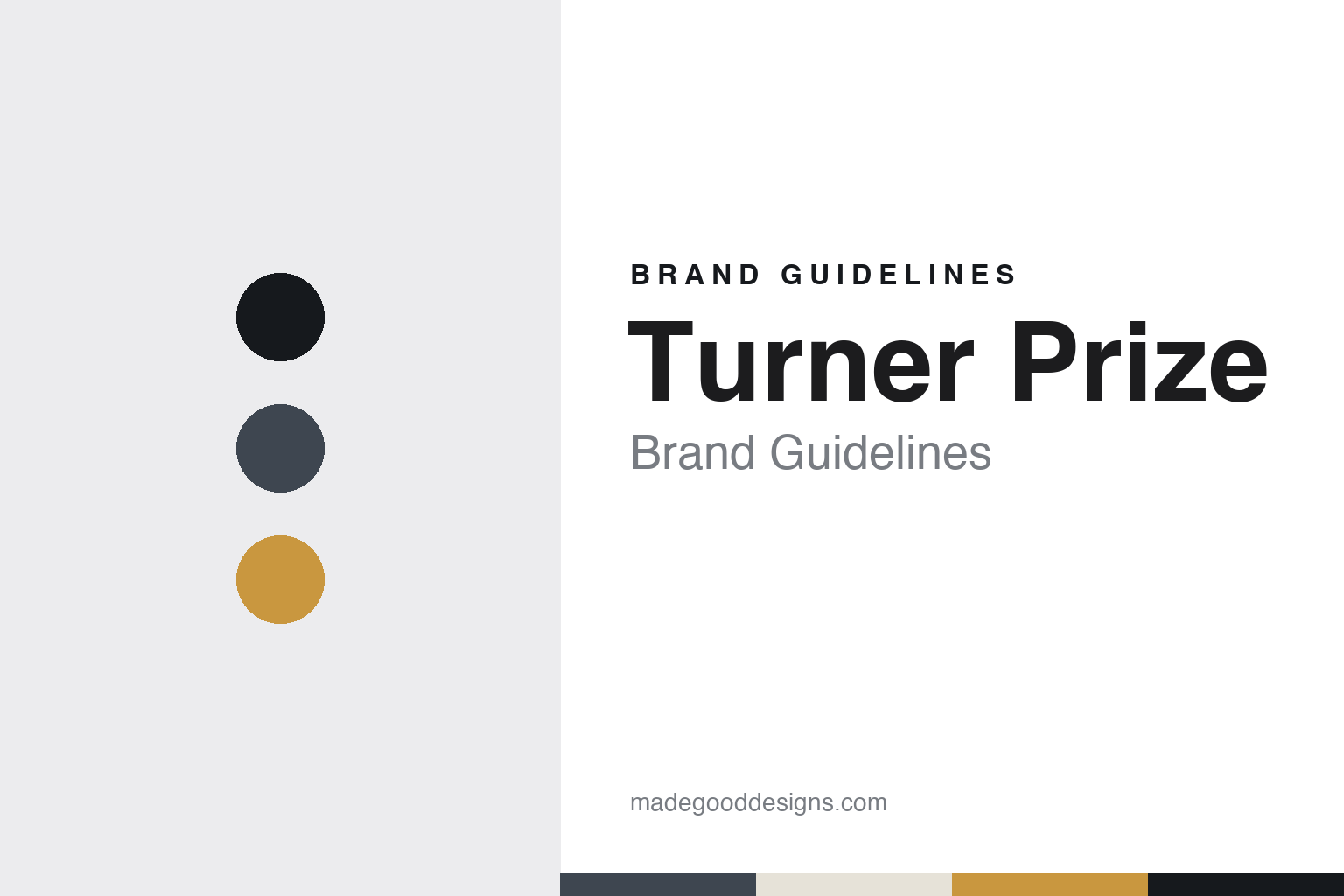
Two constants: a storm grey, ochre and mist palette and a gallery sans register. Abstract homage — not a Turner Prize or Tate mark; no artwork, logo or poster is reproduced.
Patrons of New Art
A patrons’ group, a namesake painter and a Tate jury.
The Turner Prize was first awarded in 1984. Tate says it was founded by a group called the Patrons of New Art, under the directorship of Alan Bowness, which had formed to encourage wider interest in contemporary art and to help Tate acquire new works; the group felt that Britain should have its own award for the visual arts, an equivalent to the Booker Prize. The prize is named after the painter J. M. W. Turner, and Tate notes that Turner had himself wanted to establish a prize for young artists.
Tate runs the prize through Tate Britain in London. The jury is chaired by the director of Tate Britain, Alex Farquharson, Tate said in its April 2026 announcement. Each year, Tate says, it selects a new panel of gallery directors, curators, critics and writers, with at least one member from abroad, to balance those who focus on British art or work in Britain with those who see British art in a broader context. Jurors are not paid, Tate says, though they receive a small amount to cover expenses. English Wikipedia adds that nominations are usually invited from the public, and that public nominations were not actively sought for the 2020 and 2021 prizes.
The prize has relied on sponsors at different times. English Wikipedia says that by 1987 the money came from the investment bank Drexel Burnham Lambert and that no prize was given in 1990 after that support ended. The broadcaster Channel 4 stepped in from 1991, adding documentaries and live broadcasts of the prize-giving, and the drinks brand Gordon’s Gin took over as sponsor in 2004, the same source says. Tate’s own record of past prizes notes that the 2015 prize was presented during a live broadcast on Channel 4.
Colour
British artists, a shortlist of four and a December decision.
The prize goes to a British artist for an outstanding exhibition or other presentation of their work, Tate says, and “British” can mean an artist working primarily in Britain or an artist born in Britain who works globally. Tate describes its focus as recent developments rather than a lifetime’s achievement, and English Wikipedia adds that it is open to work in all media.
Age was once part of the rules. From 1991 to 2016 only artists under 50 were eligible, Tate says. The Art Newspaper reported on 30 March 2017 that Tate had scrapped the limit, so that artists of any age became eligible, and that the works shown in the Turner Prize exhibition itself would also be taken into account in judging, where nominees had previously been assessed on earlier shows and projects. Tate explains the change as a recognition that artists can make a breakthrough in their work at any age.
The year follows a fixed shape. The jury announces a shortlist of four artists, Tate says, each nominated for a recent exhibition or presentation. An exhibition of the shortlisted artists’ work follows in the autumn and runs into the new year, and the winner is announced at a ceremony in December. Tate says the jury decides on the day of the announcement, through a series of discussions until it reaches a consensus, and that a well-known guest presents the prize. In 2020 the exhibition did not take place, and Tate gave one-off bursaries to ten artists instead.
The 2026 edition shows the cycle in detail. Tate announced the shortlist on 23 April 2026 at a press conference broadcast online from Tate Britain, The Art Newspaper reported. The 2026 exhibition opened at Teesside University’s MIMA, the Middlesbrough Institute of Modern Art, on 26 September 2026, according to Tate and the Museums Journal (April 2026).
Typography
Foundations, institutes and museums behind the name.
Architecture, art and photography prizes tend to present themselves through the institution behind the name. A family foundation, a professional institute, a museum, a gallery or a company usually sets the rules, chooses the jury and publishes the result, and its own name often sits in the title or in a line such as “sponsored by” at the foot of the page.
The object handed over is rarely a statuette. Many of these programmes give a medal, a bronze, a certificate or a written citation, and some give an exhibition instead of, or as well as, an object. A medal can carry an inscription or ornament borrowed from architectural history, and a citation puts the jury’s reasoning on paper, so the identity leans on lettering and text as much as on a symbol. Organisers also tend to publish the names of the jury and the criteria it applies, which adds another layer of text to the identity.
Selection follows a recognisable rhythm. Nominations or entries close on a fixed date, a jury or panel deliberates, and in many cases a shortlist is published months before the result; some prizes publish no shortlist at all and keep their deliberations confidential. The cycle can be yearly, or longer, and the announcement or ceremony is often staged in a different building or city each time.
What carries the identity between ceremonies is the record. Touring exhibitions, catalogues and books, websites with archives of past citations, and photographs of buildings, artworks and images keep the programme visible, and for a designer they set the tone: neutral grounds, careful type and plenty of room for the work being shown.
Aa
A plain gallery sans for wall labels and announcements. (Specimen set in Archivo, a sans STAND-IN; NOT the Turner Prize or Tate logo.)
Turner Prize
Tate Britain one year, a regional gallery the next.
The prize travels. Tate says that every other year a venue outside Tate Britain hosts it, and its April 2026 announcement lists the places where the exhibition has been staged since 2011: Gateshead, Derry-Londonderry, Glasgow, Hull, Margate, Coventry, Liverpool, Eastbourne and Bradford. Tate records the 2011 prize, at Baltic in Gateshead, as the earliest to be presented outside Tate. Other host galleries it names include the Ferens Art Gallery in Hull, Ebrington in Derry~Londonderry, Turner Contemporary in Margate, the Herbert Art Gallery and Museum in Coventry and Towner Eastbourne. The 2025 edition was held at Cartwright Hall in Bradford and broadcast live from the city in December 2025, Tate says, and the 2026 edition moved to MIMA in Middlesbrough.
Tate describes this pattern as part of its work with museums and galleries across the UK, alongside exhibition tours, research projects and loans. For the public, the identity of the prize is carried by a sequence rather than a single object: the spring shortlist announcement, the autumn exhibition in its host city, and the December ceremony, which English Wikipedia says Channel 4 began broadcasting live in 1991. The name itself has stayed unchanged since 1984.
For a design guide, the Turner Prize shows an identity carried by a yearly exhibition that moves between a national gallery in London and galleries across the UK. Compare Tate, which organises it, and the Archibald Prize, another art prize in this series. For this guide we use a storm grey, a warm ochre and a pale mist with a sans, an unofficial interpretation; no product or logo is reproduced.
Explore & save
Keep Turner Prize’s identity on hand — save it to a board in the Made Good inspiration library.
Turner Prize identity set
Pin the storm grey, ochre and mist palette and the gallery sans register to your own board.
Source & notes
Frequently Asked Questions
What font can I use to match the Turner Prize look?
This guide describes Turner Prize’s type as “A plain gallery sans for wall labels and announcements”. Its type specimen is set in Archivo from Google Fonts as a stand-in; Archivo is not Turner Prize’s own lettering.
What colours are in the Turner Prize palette?
This guide’s Turner Prize palette is Storm grey #3E4650, Ink #16191D, Ochre haze #C9973F, Mist #E6E2D8 and Paper #F8F7F4. The tones are the guide’s own unofficial interpretation, not official Turner Prize hex codes.