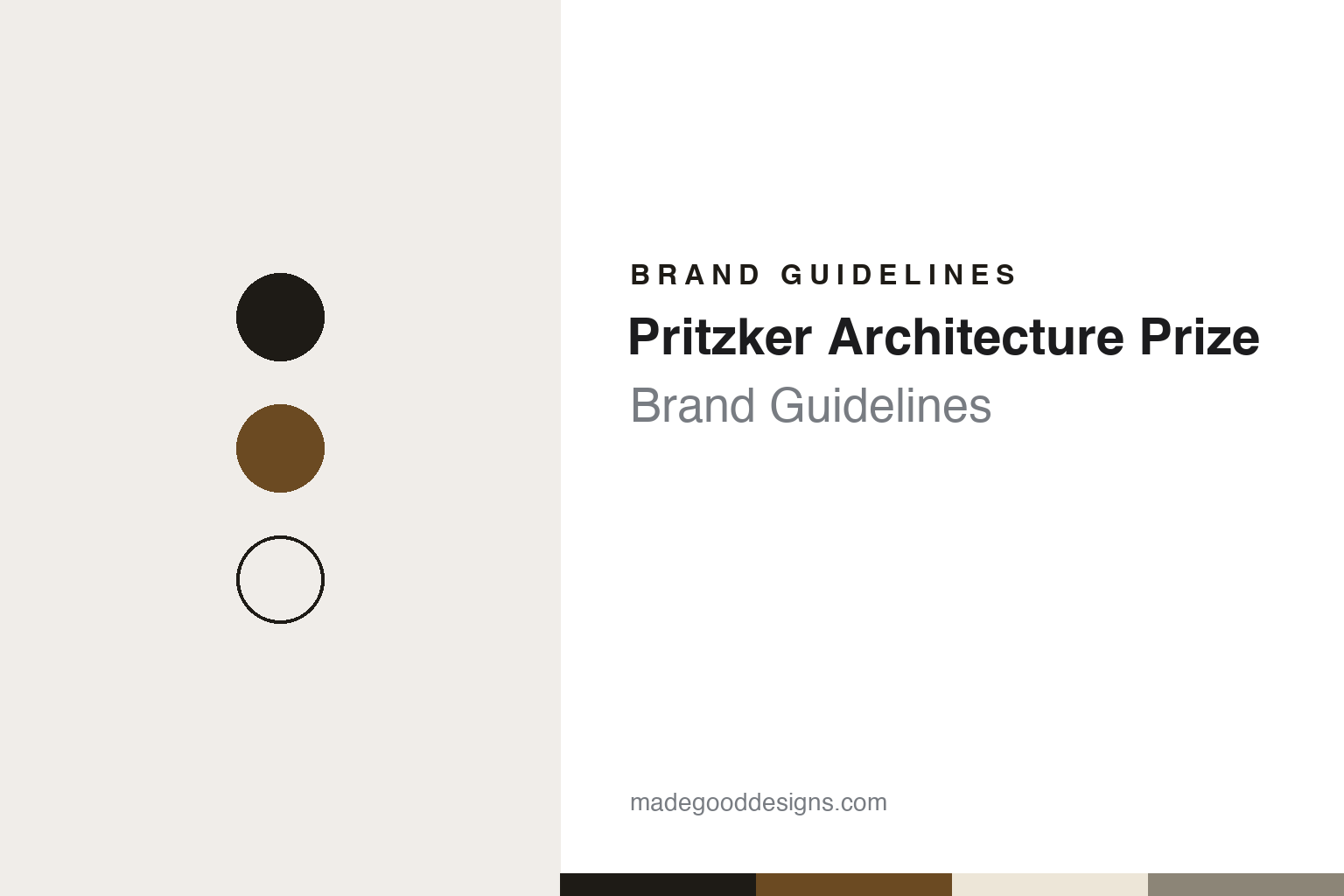
Pritzker Architecture Prize Brand Guidelines
A Chicago family prize, a bronze medallion and a ceremony that travels.
Aa
Two constants: a bronze, ink and limestone palette and an engraved serif register. Abstract homage — not a Pritzker Architecture Prize medallion, mark or certificate; nothing official is reproduced.
A family prize
Chicago, the Hyatt Foundation and 1979.
The Pritzker Architecture Prize was set up in 1979 by Jay A. Pritzker and his wife Cindy Pritzker, through the family’s Hyatt Foundation, according to the prize’s own website. The prize takes its name from the Pritzker family, whose business interests are headquartered in Chicago, and the website says the founders wanted a prize that would raise public awareness of buildings and encourage creativity within the profession.
Independent coverage gives the same outline. The Christian Science Monitor wrote in April 1996 that the prize had been established by the Hyatt Foundation in 1979, that Jay Pritzker was president of the foundation, and that the many hotels built by his company had given him a particular interest in architecture. English Wikipedia describes the award as funded by the Pritzker family and sponsored by the Hyatt Foundation, and the prize’s website today still carries the line “Sponsored by The Hyatt Foundation” at the foot of every page.
The prize is awarded once a year to a living architect or architects, and never to a firm. The organiser says it is not linked to a type of architecture or to a single building, but to a body of built work, and that it is given irrespective of nationality, race, creed or ideology. Its statement of purpose speaks of honouring built work that shows talent, vision and commitment and that has made consistent and significant contributions to humanity and the built environment through the art of architecture.
The organiser also says that many of the prize’s procedures and rewards were modelled on the Nobel Prize. Each year the award may go to one architect or to a small group, and it comes with a written jury citation, a formal certificate and a medal rather than a statuette.
Colour
Nominations, a confidential jury and no shortlist.
The selection process is described in detail on the prize’s website. Its executive director invites nominations from past laureates, architects, academics, critics and people in other fields with an interest in architecture, and any licensed architect may also put a name forward. Nominations close on 1 November each year for the following year’s prize; there are no forms, and the organiser asks only for a name, with a website and a list of completed buildings if the work may be unfamiliar to the jury. Nominations that do not lead to the award are carried over to the next year, English Wikipedia and the website agree.
The jury has between five and nine members, who serve for several years so that new and longer-serving members overlap. The organiser describes them as recognised professionals in architecture, business, education, publishing and culture. The jury normally meets early in the calendar year, and the website says that no members of the Pritzker family and no outside observers attend its deliberations. There is no shortlist: the organiser says all of the jury’s processes are confidential, and the laureate is typically announced in March.
The award itself has three parts. Alongside a grant, laureates receive a formal citation certificate and, since 1987, a bronze medallion. Before that year each laureate received a limited-edition sculpture, according to both the organiser and English Wikipedia. The medallion is based on designs by Louis Sullivan, the Chicago architect, the organiser says. One side carries the name of the prize; the reverse is inscribed with three words, “firmness, commodity and delight,” the English form of the Roman triad firmitas, utilitas, venustas.
Typography
Medals, juries and exhibitions.
Architecture, art and photography prizes tend to present themselves through the institution behind the name. A family foundation, a professional institute, a museum, a gallery or a company usually sets the rules, chooses the jury and publishes the result, and its own name often sits in the title or in a line such as “sponsored by” at the foot of the page.
The object handed over is rarely a statuette. Many of these programmes give a medal, a bronze, a certificate or a written citation, and some give an exhibition instead of, or as well as, an object. A medal can carry an inscription or ornament borrowed from architectural history, and a citation puts the jury’s reasoning on paper, so the identity leans on lettering and text as much as on a symbol. Organisers also tend to publish the names of the jury and the criteria it applies, which adds another layer of text to the identity.
Selection follows a recognisable rhythm. Nominations or entries close on a fixed date, a jury or panel deliberates, and in many cases a shortlist is published months before the result; some prizes publish no shortlist at all and keep their deliberations confidential. The cycle can be yearly, or longer, and the announcement or ceremony is often staged in a different building or city each time.
What carries the identity between ceremonies is the record. Touring exhibitions, catalogues and books, websites with archives of past citations, and photographs of buildings, artworks and images keep the programme visible, and for a designer they set the tone: neutral grounds, careful type and plenty of room for the work being shown.
Aa
An engraved serif — the register of a lettered bronze medal. (Specimen set in Cormorant Garamond, a serif STAND-IN; NOT the Pritzker Architecture Prize logo or medallion lettering.)
The ceremony
A new architecturally significant site each year.
The official ceremony takes place each year, usually in May, at what the organiser calls an architecturally significant site, and it moves to a different country or city each time. The website says the venue is normally chosen before the laureate is selected, so there is no intended link between the two, and that the setting is meant to honour the architecture of other eras or the work of earlier laureates. The event is invitation-only, attended by international guests and guests from the host country, and it normally consists of welcoming remarks from a dignitary of the host country, comments from the jury chair, the presentation of the prize by a member of the Pritzker family and an acceptance speech.
In the days after the ceremony, the laureate gives a public lecture at an institution in the host country, the organiser says. The 2020 and 2021 ceremonies were held online, English Wikipedia records, and the website says special ceremony videos have been made since 2020 so that an international audience can watch the full remarks. The prize’s website is published in English and in Simplified Chinese, and it keeps an archive of laureates, jury citations and ceremony material, with press images credited to their photographers.
The visual language of the prize is restrained. It rests on the name, on a bronze medal with an inscription drawn from classical architectural writing, and on photographs of buildings rather than on a mascot or a statuette. That gives a designer a clear brief: lettering that could be cut into metal or stone, warm metallic and mineral tones, and a lot of quiet space around images of architecture.
For a design guide, the Pritzker Architecture Prize shows how a medal, a citation and a travelling ceremony can carry an identity without a logo doing the work. Compare the RIBA Stirling Prize, a yearly British building award run by a professional institute, and the Aga Khan Award for Architecture, which works on a longer cycle. For this guide we use bronze, ink, limestone and a terracotta with a serif, an unofficial interpretation; no product or logo is reproduced.
Explore & save
Keep Pritzker Architecture Prize’s identity on hand — save it to a board in the Made Good inspiration library.
Pritzker Architecture Prize identity set
Pin the bronze, ink and limestone palette and the engraved serif register to your own board.
Source & notes
Frequently Asked Questions
What font can I use to match the Pritzker Architecture Prize look?
This guide describes Pritzker Architecture Prize’s type as “An engraved serif — the register of a lettered bronze medal”. Its type specimen is set in Cormorant Garamond from Google Fonts as a stand-in; Cormorant Garamond is not Pritzker Architecture Prize’s own lettering.
What colours are in the Pritzker Architecture Prize palette?
This guide’s Pritzker Architecture Prize palette is Foundry ink #1E1B16, Patina bronze #6B4A22, Limestone #EDE6D8, Terracotta ornament #A4583A and Weathered stone #8C8577. The tones are the guide’s own unofficial interpretation, not official Pritzker Architecture Prize hex codes.
When was Pritzker Architecture Prize founded?
Pritzker Architecture Prize was founded in 1979, in Chicago, USA.
Who founded Pritzker Architecture Prize?
Pritzker Architecture Prize was founded by Jay A. Pritzker and Cindy Pritzker in 1979.