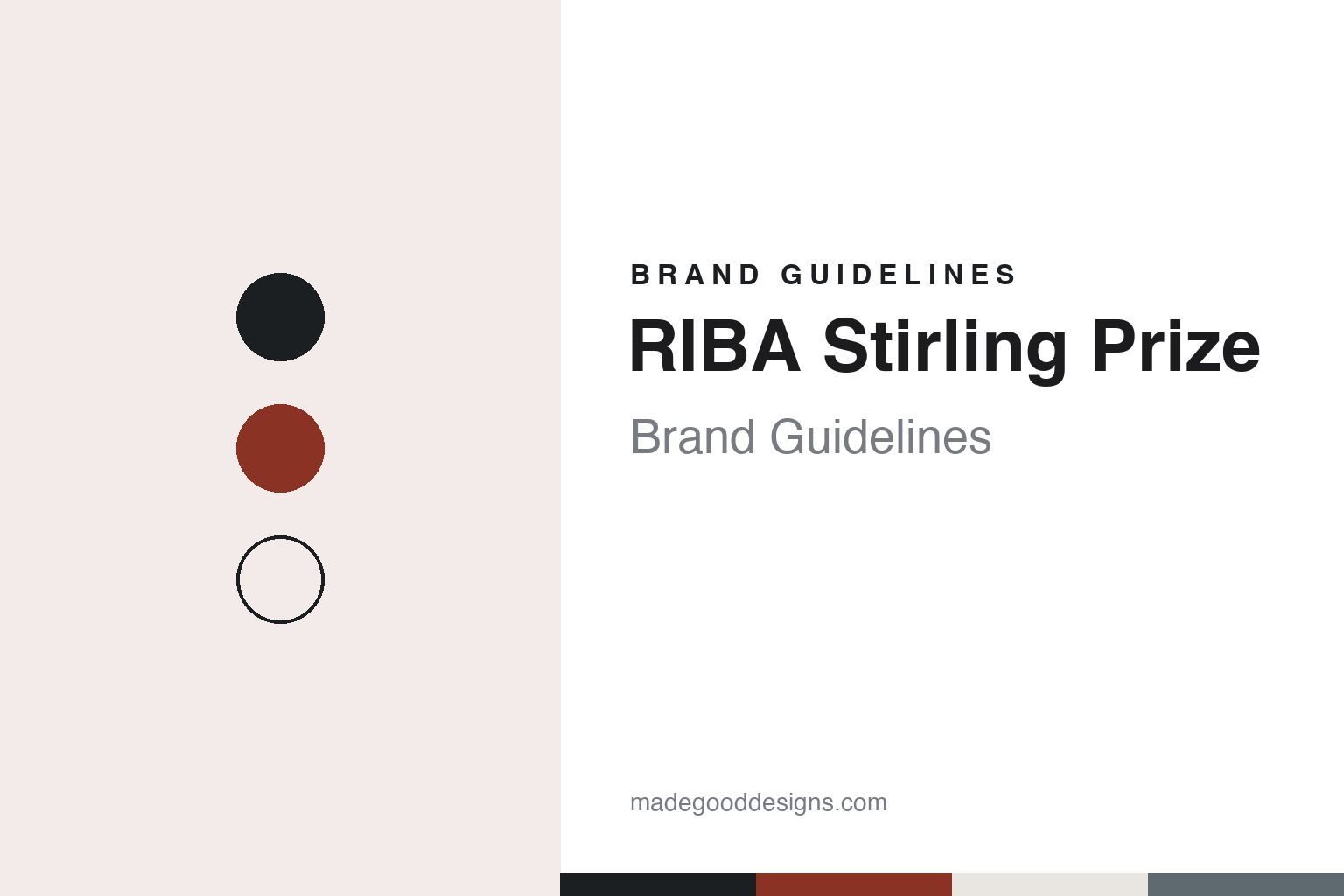
RIBA Stirling Prize Brand Guidelines
A professional institute’s yearly prize for a single building.
Aa
Two constants: a brick, slate and concrete palette and a grotesque sans register. Abstract homage — not a RIBA or RIBA Stirling Prize mark or trophy; nothing official is reproduced.
A successor award
From Building of the Year to Stirling.
The RIBA Stirling Prize is organised and awarded each year by the Royal Institute of British Architects, which describes itself as a global professional membership body for architects. The institute says the prize was launched in 1996 and that it succeeded RIBA’s earlier Building of the Year Award; English Wikipedia lists that award from 1987 until 1995, before the change of name.
The prize is named in honour of the British architect James Stirling. RIBA notes that Stirling received the institute’s Royal Gold Medal in 1980, recognising both his built work and his unbuilt designs. The name is a tribute to him; the prize itself is given to a building and its architects, not to a career.
The Stirling Prize sits at the top of a wider awards programme. RIBA says its awards have been running since 1966, that they are for buildings in the United Kingdom by RIBA Chartered Architects and RIBA International Fellows, and that entries are submitted to the region or nation where the building stands. Regional winners can go on to receive a RIBA National Award, and the Stirling Prize is chosen from those national winners.
The geography of the prize has changed once, and the change is written into its eligibility rules rather than its name. English Wikipedia says that until 2014 the building could stand anywhere in the European Union, and that since 2015 entries have had to be in the United Kingdom. RIBA’s current description matches the later rule: the prize goes to a project in the UK designed by a RIBA Chartered Architect or a RIBA International Fellow.
Colour
National Awards, a shortlist of six and a jury.
The cycle runs through the year. Buildings first win regional awards, then a long list receives RIBA National Awards, and from that list six buildings are shortlisted for the Stirling Prize, English Wikipedia says. In 2026, RIBA published the six-project shortlist on 16 July, and ArchDaily reported on 17 July 2026 that the shortlist marked the prize’s 30th anniversary and that the result would be announced on 15 October at Old Billingsgate in London. RIBA announced the 2026 prize on 15 October 2026, and its exhibition page places that evening’s anniversary celebration at Old Billingsgate.
RIBA lists the criteria the jury applies to shortlisted buildings: design vision; innovation and originality; sustainability and accessibility; functionality and fitness for purpose; client satisfaction; and the building’s ability to engage, stimulate and delight the people who use and visit it. In its own words, the prize goes to the architect of the project thought to be the most significant of the year for the evolution of architecture and the built environment.
The 2026 jury, as RIBA lists it, was chaired by the RIBA President and included practising architects, a museum director, a specialist in net-zero policy and a representative of the headline sponsor. Because the shortlist is drawn from national award winners, every building reaching the jury has already been through the regional and national stages of the same programme.
The prize has had gaps and shifts in its calendar. English Wikipedia records that on 30 September 2020 RIBA postponed that year’s award to 2021, and that the 2021 prize was chosen from the 2020 shortlist. For 2026, RIBA names Autodesk, the design-software company, as headline sponsor.
Typography
Medals, juries and exhibitions.
Architecture, art and photography prizes tend to present themselves through the institution behind the name. A family foundation, a professional institute, a museum, a gallery or a company usually sets the rules, chooses the jury and publishes the result, and its own name often sits in the title or in a line such as “sponsored by” at the foot of the page.
The object handed over is rarely a statuette. Many of these programmes give a medal, a bronze, a certificate or a written citation, and some give an exhibition instead of, or as well as, an object. A medal can carry an inscription or ornament borrowed from architectural history, and a citation puts the jury’s reasoning on paper, so the identity leans on lettering and text as much as on a symbol. Organisers also tend to publish the names of the jury and the criteria it applies, which adds another layer of text to the identity.
Selection follows a recognisable rhythm. Nominations or entries close on a fixed date, a jury or panel deliberates, and in many cases a shortlist is published months before the result; some prizes publish no shortlist at all and keep their deliberations confidential. The cycle can be yearly, or longer, and the announcement or ceremony is often staged in a different building or city each time.
What carries the identity between ceremonies is the record. Touring exhibitions, catalogues and books, websites with archives of past citations, and photographs of buildings, artworks and images keep the programme visible, and for a designer they set the tone: neutral grounds, careful type and plenty of room for the work being shown.
Aa
A grotesque sans — the register of plans, labels and section drawings. (Specimen set in Archivo, a sans STAND-IN; NOT the RIBA or RIBA Stirling Prize logo.)
Stirling at 30
A ceremony, broadcasts and a touring exhibition.
The announcement has moved between television and online release. English Wikipedia says the ceremony was televised by Channel 4 in earlier years, and that more recent presentations have been released online by RIBA. In 2026 RIBA’s prize page collected radio and television coverage of the result from the following day, 16 October.
The 30th anniversary in 2026 was marked with an exhibition, Stirling Prize at 30, which RIBA describes as a touring show bringing together past winners, shortlisted projects and the latest winning building. According to RIBA, it opened as a one-day presentation at Old Billingsgate on 15 October 2026 and ran at the Farrell Centre in Newcastle from 21 October to 27 November 2026. RIBA also ran an anniversary public poll and an online awards map covering three decades of shortlisted and winning projects.
For a designer, the prize’s identity is built from the institute’s name and the namesake rather than from a trophy image: the four letters of RIBA, Stirling’s surname, photographs of buildings, plans and the language of a professional body. Because the subject is the architecture itself, a designer can let the graphic frame step back, with neutral grounds and a working sans serif of the kind found on drawings and labels.
The rhythm of the year also shapes the material. Regional and national awards, a summer shortlist and an autumn announcement each need their own set of graphics, and each shortlisted building is presented with the same weight until the result. An identity for this kind of programme has to hold six equal projects on one page as comfortably as it holds one result.
For a design guide, the RIBA Stirling Prize shows how a professional institute can turn a judging ladder into a recognisable yearly event. Compare the Pritzker Architecture Prize, which honours a body of work rather than one building, and the London Festival of Architecture, another architecture programme in the same city. For this guide we use brick, slate, concrete and ink with a sans, an unofficial interpretation; no product or logo is reproduced.
Explore & save
Keep RIBA Stirling Prize’s identity on hand — save it to a board in the Made Good inspiration library.
RIBA Stirling Prize identity set
Pin the brick, slate and concrete palette and the grotesque sans register to your own board.
Source & notes
Frequently Asked Questions
What font can I use to match the RIBA Stirling Prize look?
This guide describes RIBA Stirling Prize’s type as “A grotesque sans — the register of plans, labels and section drawings”. Its type specimen is set in Archivo from Google Fonts as a stand-in; Archivo is not RIBA Stirling Prize’s own lettering.
What colours are in the RIBA Stirling Prize palette?
This guide’s RIBA Stirling Prize palette is Drawing-board ink #1C1F22, London brick #8A3324, Board-marked concrete #B9B4AC, Slate #5E6A70 and Tracing paper #E9E6E1. The tones are the guide’s own unofficial interpretation, not official RIBA Stirling Prize hex codes.
When was RIBA Stirling Prize launched?
RIBA Stirling Prize was launched in 1996, in London, UK.