The Game Awards Brand Guidelines
A December awards show for video games, built around a winged statuette.
Aa
Two constants: a stage black, bronze and pewter palette and a wide display sans register. Abstract homage — not a The Game Awards mark; no logo, angel or statuette is reproduced.
After the VGAs
A journalist’s show, backed by the console makers.
The Game Awards is a yearly awards show for the video game industry, established in 2014 and produced and hosted by the Canadian games journalist Geoff Keighley, English Wikipedia says. The show is held in December; Creative Bloq wrote in July 2025 that that year’s show was coming up in December.
The show has a predecessor. Keighley had worked for more than ten years on the Spike Video Game Awards, a ceremony broadcast on the American cable channel Spike TV from 2003 to 2013, serving as producer and often as host. In 2013 Spike renamed that show VGX and cut it to one hour, streamed online before it aired on television. When Spike offered to continue in 2014 only as an online stream, Keighley declined, and Spike’s show came to an end, English Wikipedia says. Earlier still, as a teenager, he had helped write material for Cybermania ’94, an early televised awards show for video games.
For the new show Keighley worked with the three console makers, Sony, Microsoft and Nintendo, and several large publishers, which backed it financially and helped shape it. With no television partner, the producers chose to stream the first show on the consoles’ own networks and on Valve’s Steam service. The first edition was staged at The AXIS theatre in Las Vegas in 2014. Later shows moved to the Peacock Theater in Los Angeles, the venue formerly called the Microsoft Theater.
Keighley has turned down offers from broadcast networks to air the show, keeping control over how it is presented and structured, and has instead partnered with many streaming services around the world. The 2019 show was also shown in selected Cinemark cinemas in the United States, in partnership with Sony Pictures. The 2020 show was held online rather than in a theatre, and the 2021 show returned to the Microsoft Theater with a smaller audience; the 2022 show had a full live audience again.
Colour
A committee, a media jury and a ten per cent fan vote.
The organiser describes a two-step system. An advisory committee made up of representatives of hardware companies, among them Microsoft, Sony, Nintendo and AMD, and several game publishers chooses the news organisations that make up the voting jury. The committee does not nominate or vote, and neither does Keighley. In the nomination round each outlet submits a list of games in each category, with the esports categories handled by a smaller group of outlets; the committee compiles the lists, and the most-nominated games go back to the same outlets for the final vote.
The jury has grown over time. English Wikipedia says 28 industry experts and representatives chose the winners before 2017, more than 50 from 2017, that non-English publications joined in 2019, and that by 2024 more than one hundred media outlets around the world served as the jury. Most winners are decided by a blended vote: 90 per cent jury and 10 per cent fans, who vote through social platforms and the show’s website.
Eligibility runs to a cut-off date in November that changes each year. Games released before it compete that year; games released after it move to the following year’s show. Expansions, seasonal and downloadable content, remakes and remasters are eligible across the categories, which span video games and media, esports and creators, and honorary awards.
Alongside the awards, the show presents premieres of upcoming games and news on titles already announced, which Keighley selects with the studios involved. Digital storefronts including Steam, the Xbox Games Store, the Nintendo eShop and the PlayStation Store put nominated games on sale around the event. Side projects have followed: a Game Festival of demos on Steam in 2019, an Inside the Game Awards podcast with Spotify in 2021, and, in June 2023, a 10-Year Celebration concert of video game music at the Hollywood Bowl with the Los Angeles Philharmonic.
Typography
Design and documentation.
Film, television, music and theatre awards tend to present themselves through a short name. The formal title of a prize is often long, naming an academy, a society or a person, while the name people use is a single word or a nickname that fits a headline, a poster and a broadcast caption. Many programmes use both, keeping the formal title for rules and records and the short name for everything public.
Behind each name sits an organisation: an academy of practitioners, a society of producers or theatre owners, a union of broadcasters or a company that produces the show. That body writes the rules, sets the categories and decides who votes, and its own name usually appears beside the prize in smaller type, as the signature rather than the headline.
The trophy is the most visible part of the identity. A statuette, a mask, a gramophone, a globe or a medallion can be kept for decades, with changes of material, maker or base. Because the object recurs in every photograph of the ceremony, it works as the visual shorthand for the whole programme.
The year gives these brands their rhythm. An eligibility period, usually a calendar year or a season, is followed by entries, members’ votes or jury rounds, a published list of nominations and a televised ceremony in a named venue. Sister programmes, honorary awards and separate ceremonies for other formats sit around the main event, each described in the same plain, institutional voice as the main categories.
Aa
A wide, confident display sans for a show staged on screens as much as on a stage. (Specimen set in Unbounded, a sans STAND-IN; NOT The Game Awards logo.)
The angel
A statuette, then a logo drawn from its wings.
English Wikipedia says the statuette was designed by Keighley in collaboration with Weta Workshop, the New Zealand effects and props company, and that it is meant to represent “the evolution of the video game medium by way of an angel that ascends through digital building blocks.” The Spanish games site VidaExtra reported in November 2024 that the idea came from Keighley, that the statuette is simply called a Game Award, and that it shows a female figure with open wings. It said Weta’s designers spent three to four months from first sketches to manufacture, using digital modelling, 3D printing, hand sculpting and a metallic finish, and that the aim was to represent no single game but the medium as a whole. VidaExtra also noted the likeness to the winged figure of the Emmy statuette.
The logo follows the trophy. The original mark was designed by Pentagram, Creative Bloq reported in July 2025, and for the 10th-anniversary show in 2024 the Vienna studio Studio Herrström redrew it as a simpler, bold, monolinear mark that is still based on the wings of the angel statuette. According to the same report, the logo’s symmetrical geometry was used to build a library of frames and patterns for on-screen overlays and stage backdrops, and a set of linear and curved motion elements, inspired by the sweep of the wings, directs attention to moments such as a winner announcement or a nominee highlight. The system is meant to frame any artist, presenter or game in different layouts while staying consistent from digital channels to the stage.
For a design guide, The Game Awards shows how a trophy can supply a whole visual system, from the statuette to the logo to the motion graphics around it. Compare the Emmy Awards, whose winged statuette VidaExtra compared it with, and BAFTA, which also gives awards for games. For this guide we use stage black, burnished bronze and pewter with a wide display sans, an unofficial interpretation; no product or logo is reproduced.
Explore & save
Keep The Game Awards’s identity on hand — save it to a board in the Made Good inspiration library.
The Game Awards identity set
Pin the stage black, bronze and pewter palette and the wide display sans register to your own board.
Source & notes
Frequently Asked Questions
What font can I use to match the The Game Awards look?
This guide describes The Game Awards’ type as “A wide, confident display sans for a show staged on screens as much as on a stage”. Its type specimen is set in Unbounded from Google Fonts as a stand-in; Unbounded is not The Game Awards’ own lettering.
What colours are in the The Game Awards palette?
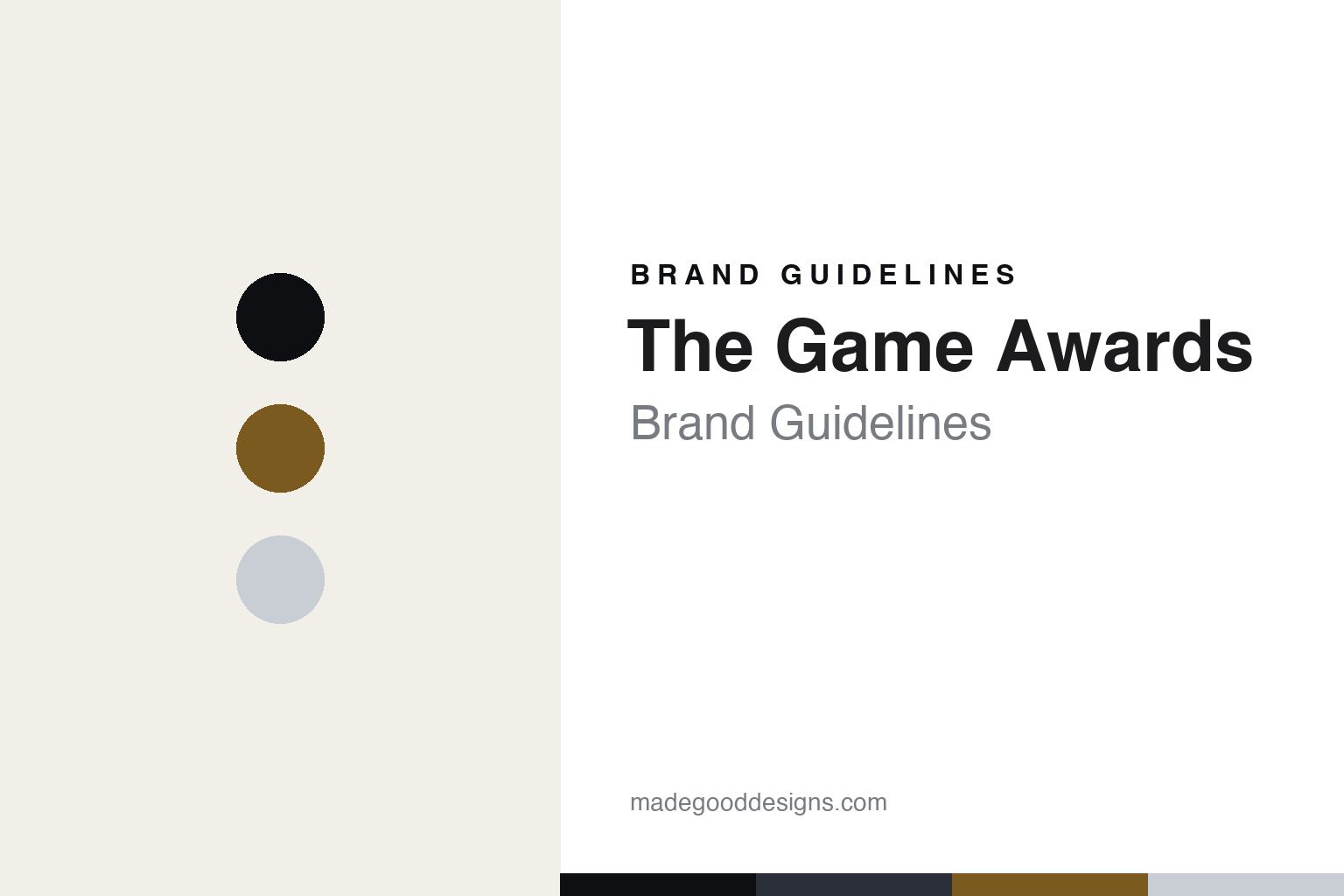
This guide’s The Game Awards palette is Stage black #0E0F12, Graphite #2B2F38, Burnished bronze #7A5A1E, Pewter #C9CDD4 and Screen white #F5F5F3. The tones are the guide’s own unofficial interpretation, not official The Game Awards hex codes.
When was The Game Awards founded?
The Game Awards was founded in 2014 (first show), in Las Vegas, USA.
Who founded The Game Awards?
The Game Awards was founded by Geoff Keighley (producer) in 2014 (first show).