Giller Prize Brand Guidelines
Toronto’s fiction prize, founded in 1994 for Doris Giller.
Aa
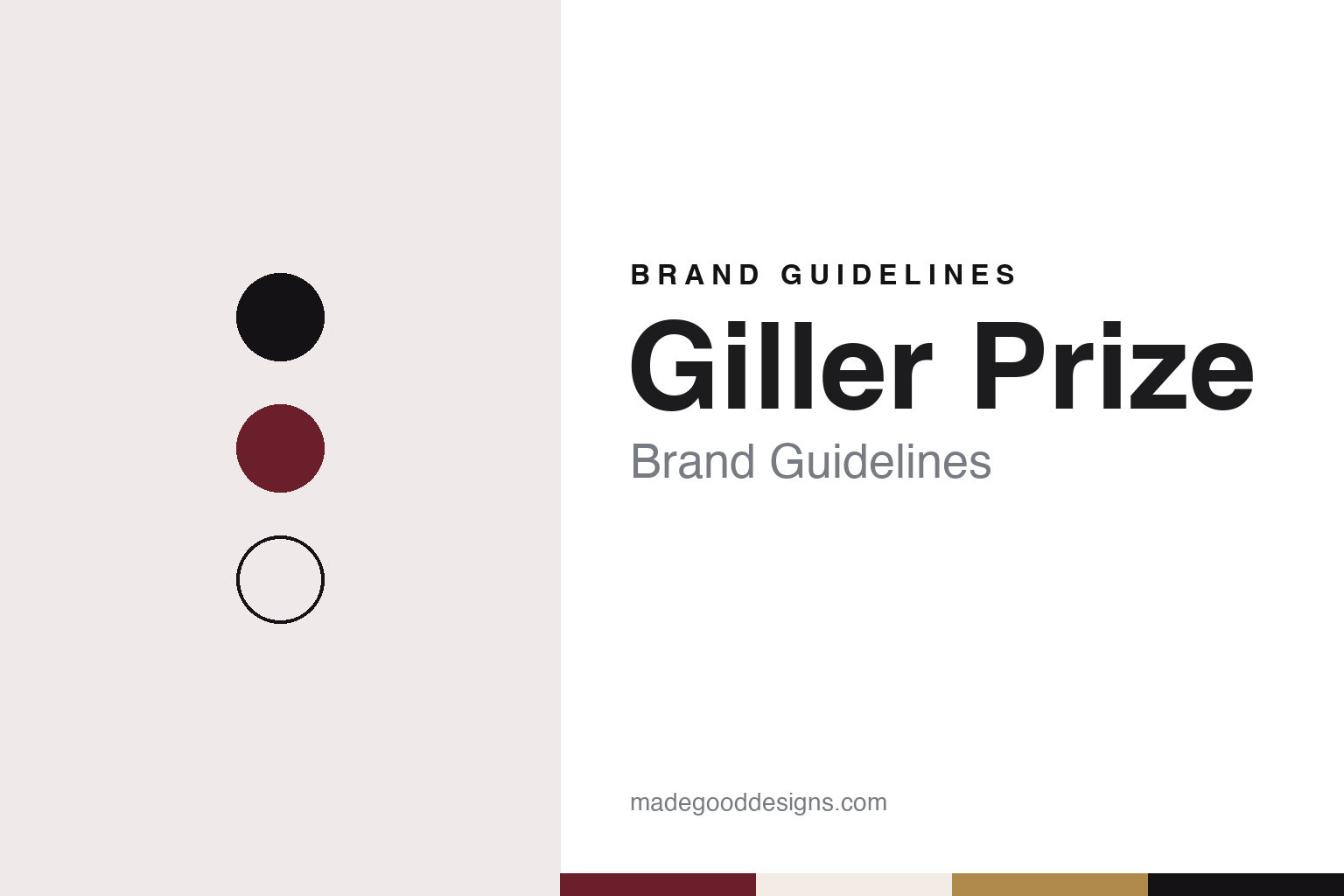
Two constants: an oxblood, cream and bronze palette and a bookish serif register. Abstract homage — not a Giller Prize trophy or mark; no trophy, logo or wordmark is reproduced.
Founded in 1994
A Toronto prize named after a literary journalist.
The Giller Prize was founded in Toronto in 1994 by Jack Rabinovitch, and first awarded that year. It is named after Doris Giller, whom the prize describes as a literary journalist and English Wikipedia as a former literary editor at the Toronto Star. The prize says it was created to recognise Canadian fiction, in long form or short stories, with an annual cash award.
The prize is run by the Giller Foundation. Its executive director, Elana Rabinovitch, speaks for the prize in its announcements, and English Wikipedia says she has overseen the foundation since 2017.
The name has changed with its sponsorship. In 2005 the prize entered a partnership with the Canadian bank Scotiabank and was renamed the Scotiabank Giller Prize, the foundation says; English Wikipedia dates the agreement to 22 September 2005. The bank’s name was removed from the title in September 2024, when, The Canadian Press reported on 4 September 2024, the executive director said the change was meant to keep the focus on the authors. The foundation’s 20-year partnership with Scotiabank ended in February 2025, The Canadian Press reported on 3 February 2025, and the prize’s 2026 submission rules record the same date.
Since then the prize has continued under its original name. In September 2026 The Canadian Press reported multi-year funding announced that August by the Hilary and Galen Weston Foundation, and a new advisory council, the Giller Prize Writers’ Circle. The prize’s 2026 partner list names CBC/Radio-Canada, the Banff Centre for Arts and Creativity and the Mantella Corporation among its supporters.
Colour
Four deadlines, a longlist and a shortlist.
The Giller Prize is awarded each year to the author of a Canadian novel, graphic novel or short story collection published in English, either originally or in translation, according to its 2026 submission guidelines; graphic novels have been accepted since 2020, and the prize is for fiction only. When a translation is chosen, the translator shares the award.
Entries come from publishers. Since 2016 the number of books an imprint may submit has depended on its history with the prize: one title for imprints never listed, two for those with earlier longlisted or shortlisted books, while publishers also supply a full list of eligible titles from which the jury can call in others. For 2026 there were four submission deadlines, in February, April, June and August, each covering a band of publication dates.
An appointed jury does the rest. The rules describe a longlist of typically 10 to 14 titles, a shortlist of typically three to five, and one winner chosen from the shortlist. English Wikipedia says the longlist was introduced in 2006 and the jury grew from three to five members in 2015. For 2026, the prize announced its first jury made up entirely of independent Canadian booksellers, drawn from the North, the West Coast, the Prairies, Central Canada and the Maritimes, as Shelf Awareness also reported on 13 January 2026; The Canadian Press reported on 8 September 2026 that the jury had chosen a longlist of 14 from more than 140 submitted works.
The year follows a fixed rhythm: a longlist in mid-September, a shortlist in early October and the winner named in mid-November, the prize says. The 2026 ceremony took place in Toronto on 16 November and was broadcast on CBC TV, CBC Gem and CBC’s YouTube channel, with a special on CBC Radio, according to the prize’s viewing notice. Around it sit year-round programmes such as the Giller Book Club, begun in 2021 according to English Wikipedia, the Craving CanLit reading lists, #BookTalk events and the Giller Mantella Scholarship, run with the Mantella Corporation and presented at the ceremony.
Typography
How prizes present themselves.
Literary and book prizes present themselves through a small set of recurring elements. The first is the name. Some carry a namesake, a writer, illustrator or benefactor whose name stands in the title; some carry the name of a foundation, a society, a library association or a university that runs them; and some carry a sponsor’s name, which can change with the sponsorship while the rest of the title stays the same.
The second is an object. Many prizes give a medal, a statuette or a trophy, and some give that piece a name of its own, presented again each year.
The third is the calendar. Most prizes follow a yearly cycle: a call for submissions or an eligibility period, a longlist, a shortlist and an announcement, often at a ceremony or dinner in a fixed month and city. Judges, juries, panels or members’ votes decide each stage, as each organiser describes it, and the names of the levels — longlist, shortlist, honour, winner — become part of how the prize is presented.
Finally, prizes are carried by the places around them. Ceremonies, broadcasts, festivals, bookshop displays and library lists repeat the name and its colours through the year. This guide looks at how each prize sets out those elements: its founders and organiser, its names over time, its cycle and levels, and the object it hands over.
Aa
A bookish serif for a prize that lives on covers and shelves. (Specimen set in Libre Caslon Text, a serif STAND-IN; NOT the Giller Prize logo or any official typeface.)
Giller Prize
A name that came back to its original form.
The clearest identity fact about the Giller Prize is its name. For nearly two decades the bank’s name stood in front of it as the Scotiabank Giller Prize; since September 2024 it has been the Giller Prize again, the form used throughout its own website, its 2026 rules and its announcements. The title now carries the dedication to Doris Giller on its own, with no sponsor’s name.
The prize also has a physical form. English Wikipedia says that from 1994 to 2004 the award included a bronze figure by an artist, and that the current prize includes a separately designed trophy. Beyond the trophy, the prize appears in other ways: on finalists’ book covers in shops, in its longlist and shortlist announcements, and on the evening broadcast from Toronto.
The cycle is visible, too. Each year the prize moves from submissions spread across four deadlines to a public longlist, a shortlist and one televised November evening, then into events with the new winner in Toronto bookshops and libraries and through its online book club. In 2026 the prize listed a #BookTalk event at a Toronto bookshop and a conversation at Toronto Public Library in the days after the ceremony.
For a design guide, the Giller Prize shows how a literary prize can hold its identity through a dedication, a fixed calendar and a broadcast, and how a title can drop a sponsor and keep its name. Compare two other book prizes in this series, the Booker Prize and the National Book Award. For this guide we use oxblood, cream and a bronze with a serif, an unofficial interpretation; no product or logo is reproduced.
Explore & save
Keep Giller Prize’s identity on hand — save it to a board in the Made Good inspiration library.
Giller Prize identity set
Pin the Giller Prize oxblood, cream and bronze palette and the bookish serif register to your own board.
Source & notes
Frequently Asked Questions
What font can I use to match the Giller Prize look?
This guide describes Giller Prize’s type as “A bookish serif for a prize that lives on covers and shelves”. Its type specimen is set in Libre Caslon Text from Google Fonts as a stand-in; Libre Caslon Text is not Giller Prize’s own lettering.
What colours are in the Giller Prize palette?
This guide’s Giller Prize palette is Oxblood #6B1F2A, Ink #141215, Page cream #F2ECE4, Bronze #B08A4A and Paper #FBF8F4. The tones are the guide’s own unofficial interpretation, not official Giller Prize hex codes.
When was Giller Prize founded?
Giller Prize was founded in 1994, in Toronto, Canada.
Who founded Giller Prize?
Giller Prize was founded by Jack Rabinovitch (Named after Doris Giller) in 1994.