Nebula Awards Brand Guidelines
The writers’ science fiction prize with a galaxy set in clear lucite.
Aa
Two constants: a nebula violet, lapis and teal palette and a soft serif register. Abstract homage — not a Nebula Awards trophy, logo or mark; nothing is reproduced.
SFWA, 1966
Writers voting for writers.
The Nebula Awards are presented each year by the Science Fiction and Fantasy Writers Association (SFWA), a non-profit association of professional science fiction and fantasy writers in the United States. SFWA dates its work for writers to 1965. The Encyclopedia of Science Fiction, in an entry updated in November 2026, notes that the group was called Science Fiction Writers of America until 1992, when it became Science Fiction and Fantasy Writers of America; today it uses the name Science Fiction and Fantasy Writers Association on its own website and announcements.
The award was created by SFWA’s founder and president, Damon Knight, according to a history of the first ceremonies that SFWA published in May 2025. English Wikipedia and The Encyclopedia of Science Fiction both say the idea was proposed in 1965 by the association’s then secretary-treasurer, who suggested paying for it with an annual anthology of the winning stories; Wikipedia adds that the model was the Edgar Awards of the Mystery Writers of America. The name “Nebula” appeared, without explanation, on the very first ballot mailed to members, the 2025 history says.
The first ceremonies were held on 11 March 1966, for works published in 1965, and took place in two cities on the same evening: an upstairs room at the Overseas Press Club in Midtown Manhattan, and a restaurant on Beverly Hills’ Restaurant Row in California, SFWA’s 2025 history records. Each presentation followed a banquet and included a film screening. After a ballot of members that year, the rules were changed to admit fantasy, the same account says. The anthology plan held: a volume of winning and nominated stories has appeared every year since, published as Nebula Awards Stories at first and as the Nebula Awards Showcase series since 2000.
Colour
Nominate, ballot, conference.
The Nebulas are voted on by SFWA members. English Wikipedia describes the cycle: members nominate works between 15 November and 15 February, the six works with the most nominations in each category form the final ballot, with more in the case of ties, members vote in March and the results are presented at a ceremony in late spring. Authors may not nominate their own work. An SFWA announcement of November 2018 widened the electorate: from 15 November that year Associate Members gained full voting rights alongside Active Members. The awards are known by the year of publication rather than the year of presentation.
The presentation is part of SFWA’s annual Nebula Awards Conference, held each spring at a different place in the United States. The 61st conference closed with a ceremony on 6 June 2026 at a hotel and conference centre near Chicago O’Hare in Illinois, for works published in 2025, SFWA announced that day.
Eligibility has been reworked several times. In 1980 the eligibility year became the calendar year and a small panel was allowed to add one work to each final ballot, The Encyclopedia of Science Fiction records; for some years authors could also date a book from its later paperback edition. Amended rules, removing the preliminary ballot and the juries, took effect for the awards presented in 2010. Works must appear in English, and translations into English are eligible, English Wikipedia says.
The core of the programme is four categories for prose fiction by length, presented every year since 1966. The Encyclopedia of Science Fiction gives the boundaries: the Novel above 40,000 words, the Novella from 17,500 to 40,000, the Novelette from 7,500 to 17,500 and the Short Story below 7,500. A script or dramatic-presentation category came and went in the 1970s and 2000s, and since 2010 an award for outstanding dramatic presentation has taken its place. SFWA added Game Writing in its 2018 rule update, for “an interactive or playable story-driven work.” The dramatic-presentation award and an award for middle-grade and young-adult fiction, both named after writers, had long been voted with the Nebulas and became official Nebula categories in 2020, English Wikipedia says. Awards for Poem and Comic were presented for the first time in 2026, SFWA said. The ceremony also carries discretionary honours that are not Nebulas, among them the Damon Knight Grand Master Award, given since 1975 for lifetime achievement, and the Kate Wilhelm Solstice Award, given since 2009.
Typography
How literary prizes present themselves.
Literary and book prizes present themselves through a small set of recurring elements. The first is the name. Some carry a namesake, a writer, illustrator or benefactor whose name stands in the title; some carry the name of a foundation, a society, a library association or a university that runs them; and some carry a sponsor’s name, which can change with the sponsorship while the rest of the title stays the same.
The second is an object. Many prizes give a medal, a statuette or a trophy, and some give that piece a name of its own, presented again each year.
The third is the calendar. Most prizes follow a yearly cycle: a call for submissions or an eligibility period, a longlist, a shortlist and an announcement, often at a ceremony or dinner in a fixed month and city. Judges, juries, panels or members’ votes decide each stage, as each organiser describes it, and the names of the levels — longlist, shortlist, honour, winner — become part of how the prize is presented.
Finally, prizes are carried by the places around them. Ceremonies, broadcasts, festivals, bookshop displays and library lists repeat the name and its colours through the year. This guide looks at how each prize sets out those elements: its founders and organiser, its names over time, its cycle and levels, and the object it hands over.
Aa
A soft serif for a prize run by writers. (Specimen set in Fraunces, a serif STAND-IN; NOT the Nebula Awards logo.)
The lucite block
A glitter galaxy over a field of stones.
The Nebula trophy has kept one concept since 1966. SFWA’s history of the first awards says the trophies were designed by Judith Ann Lawrence and Kate Wilhelm and manufactured by the Richley Company: a block of clear Lucite with embedded objects, a spiral galaxy of glitter hand-made by Lawrence and a rock-crystal “landscape.” English Wikipedia and The Encyclopedia of Science Fiction both credit the design to Lawrence, working from a sketch by Wilhelm, and say it has been followed ever since. The same 2025 history points out that the spiral is in fact a galaxy rather than a nebula.
A second SFWA history, published in June 2025, describes the trophy today: a black lucite base and a clear lucite slab carrying the spiral design, with spheres of lapis lazuli, chrysocolla and other minerals that look like floating planets. Sizes have varied from about eight to nine inches high. Early trophies used quartz crystals and even small found objects; more recent ones use spherical stones in different sizes and colours, so that each award stays individual while production stays uniform. The Grand Master award shares the same top on a slightly larger, tapered base, and the young-adult award was redesigned in 2020 to match the other Nebulas, the article says. The dramatic-presentation award is the exception, a cast bronze sculpture. The trophies are made today by the firm Society Awards, the same article says.
The trophy is the whole of the prize: there is no cash award, English Wikipedia notes. Under the 2018 rules, a work by several authors receives one trophy, with co-authors and translators given certificates.
For a design guide, the Nebula Awards show how a trophy built from one clear material and a handful of stones can hold a single image for six decades while every piece is slightly different. Compare the Hugo Award, chosen by convention members, and the National Book Award. For this guide we use deep nebula violet, lapis blue and a chrysocolla teal with a soft serif, an unofficial interpretation; no product or logo is reproduced.
Explore & save
Keep Nebula Awards’s identity on hand — save it to a board in the Made Good inspiration library.
Nebula Awards identity set
Pin the Nebula Awards violet, lapis and teal palette and the soft serif register to your own board.
Source & notes
Frequently Asked Questions
What font can I use to match the Nebula Awards look?
This guide describes Nebula Awards’ type as “A soft serif for a prize run by writers”. Its type specimen is set in Fraunces from Google Fonts as a stand-in; Fraunces is not Nebula Awards’ own lettering.
What colours are in the Nebula Awards palette?
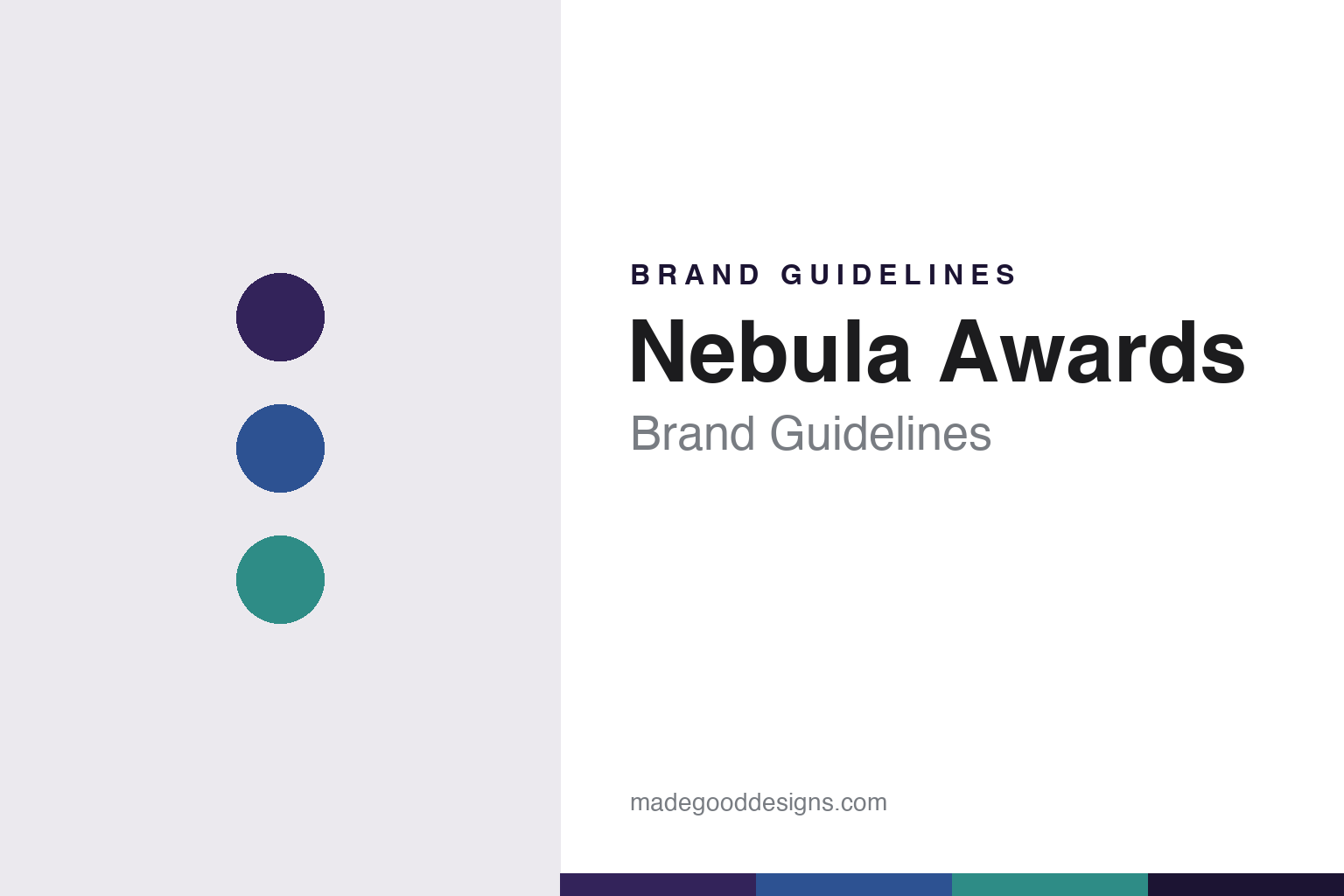
This guide’s Nebula Awards palette is Nebula violet #33235A, Night ink #1C1433, Lapis blue #2D5292, Chrysocolla teal #2E8C86 and Lucite white #F2F3F6. The tones are the guide’s own unofficial interpretation, not official Nebula Awards hex codes.
When was Nebula Awards founded?
Nebula Awards was founded in 1966 (for 1965 works) (New York and Beverly Hills, USA).