The Franklin Institute Brand Guidelines
The 1824 institute and its 1934 Parkway museum.
Aa
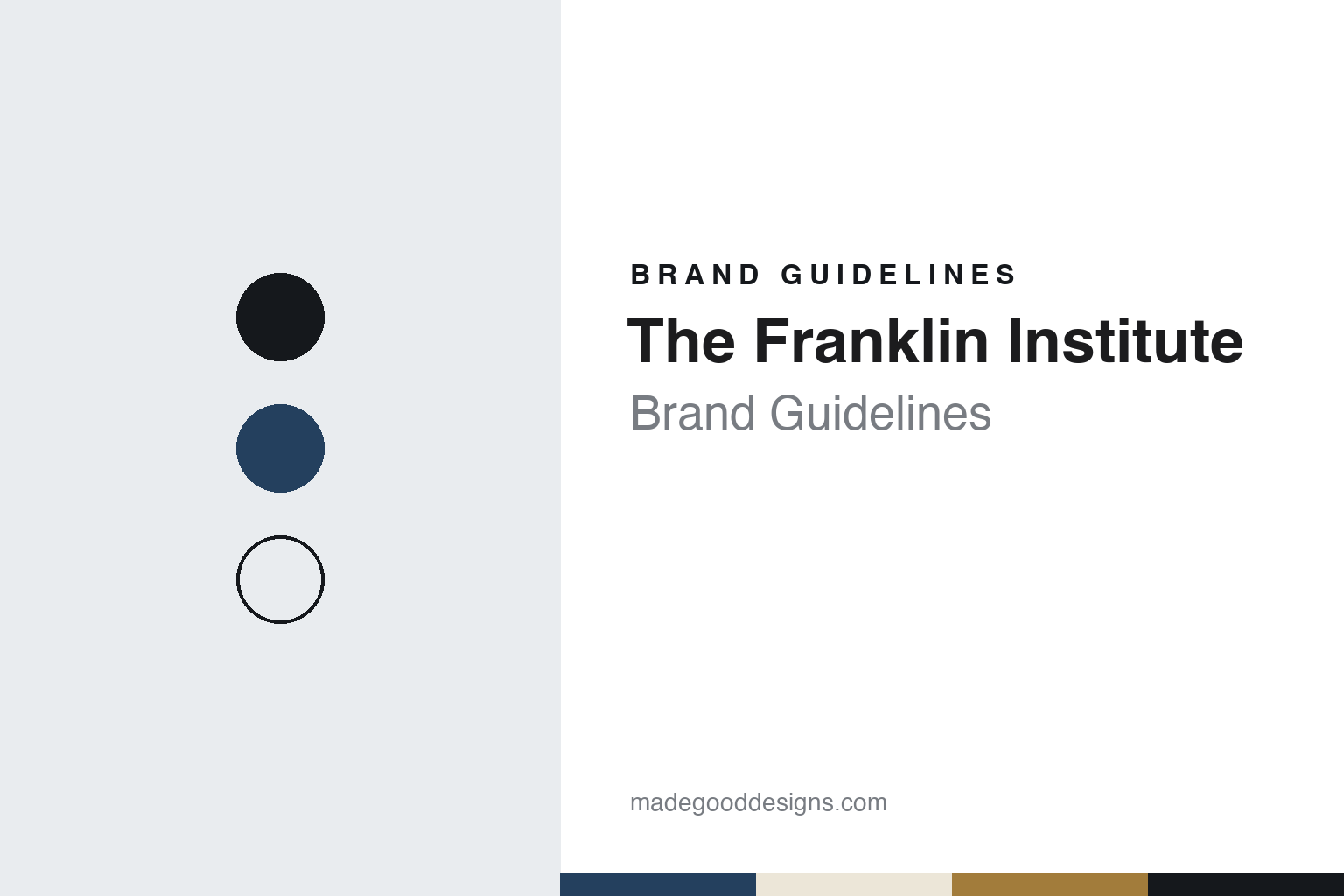
Two constants: a blue, brass and stone palette and a classic serif register. Abstract homage — not a Franklin Institute asset; no logo, exhibit or building image is reproduced.
Philadelphia, 1824
A society for the mechanic arts.
The Franklin Institute was founded in Philadelphia on 5 February 1824. The Encyclopedia of Greater Philadelphia, in a 2016 essay published with Rutgers University, says a group of Philadelphians led by Samuel Vaughan Merrick met that day at the courthouse at Sixth and Chestnut Streets to found the Franklin Institute of the State of Pennsylvania for the Promotion of the Mechanic Arts. The institute takes its name from Benjamin Franklin, whose interest in useful science its members set out to follow. The institute’s own history gives the same date and founding name.
The early institute was a society of manufacturers, mechanics and scientists rather than a museum. The encyclopedia says it held its first exhibition of American industry in October 1824 at Carpenters’ Hall, and that within a year it needed a building of its own. Its first long-term home, on South Seventh Street, went up from 8 June 1825; that building is now the Philadelphia History Museum at the Atwater Kent. The institute’s history lists the activities of its first years as public lectures, a high school, a library, public exhibitions and a research journal.
That journal, the Journal of the Franklin Institute, first appeared in 1826, the encyclopedia says, recording new work in physics, mechanical engineering and chemistry. The institute’s annual exhibitions ran from 1824 to 1858 and returned in 1874, and its medals and prizes became a nineteenth-century yardstick for products: manufacturers quoted Franklin Institute awards in their advertising, and a lithographic firm of the 1840s is shown boasting of its Silver Medal. The encyclopedia adds that women gained membership in the 1830s, that the institute ran a school of design for women from 1850 to 1853 which later became Moore College of Art and Design. English Wikipedia notes that the institute hosted the International Electrical Exhibition in Philadelphia from 2 September to 11 October 1884.
Colour
A museum on the Parkway.
The shift towards a public museum came with a new building. The institute says that in 1930 it began raising funds with the Poor Richard Club for a science museum and memorial hall, that the cornerstone was laid in 1932 at 20th Street and the Benjamin Franklin Parkway, and that the Franklin Institute Science Museum opened to the public on 1 January 1934, calling itself a “Wonderland of Science.” The Encyclopedia of Greater Philadelphia describes the building as Beaux-Arts in style and designed by the architect John T. Windrim. English Wikipedia says only two of the four wings Windrim planned were built, the two that face the Parkway, and that from the start visitors were meant to touch and operate the exhibits to learn how things work.
The Parkway building included the Fels Planetarium, which the encyclopedia calls the second planetarium to open in the United States, after Chicago’s Adler Planetarium; the institute describes it as the second-oldest planetarium in the Western Hemisphere. English Wikipedia says the planetarium was fully rebuilt in 2002, when its original steel dome was replaced by a lighter dome 60 feet across.
At the heart of the building is the Benjamin Franklin National Memorial. English Wikipedia says the rotunda, designed by Windrim and modelled on the Pantheon in Rome, opened in 1938 around a marble statue of Franklin about 20 feet high, in a hall 82 feet in length, width and height, finished in marbles from Portugal, Italy and France. The United States Congress designated the hall and statue as the national memorial on 25 October 1972. The institute says it is one of a handful of national memorials in the care of a private institution.
Inside, the museum is organised as three floors of permanent, hands-on exhibits, the institute says. The encyclopedia names the walk-through Giant Heart, opened in 1954, as one of its long-running exhibits, together with an eighteenth-century Swiss automaton and a collection of Frankliniana that includes a period lightning rod. English Wikipedia lists among the permanent galleries Electricity and Changing Earth, both opened on 27 March 2010; an aviation hall with the Wright brothers’ aeronautical engineering collection and a restored Wright Model B; a train hall built around the Baldwin 60000 steam locomotive, which was rolled into the museum while its walls were still going up; and an observatory with five telescopes, remodelled in 2006.
The building kept growing. The encyclopedia records expansions in 1990 and 2012, and the institute says it opened the 53,000-square-foot Nicholas and Athena Karabots Pavilion in 2014, with a STEM education and conference centre, a gallery for travelling exhibitions and the neuroscience exhibit Your Brain. The institute says the museum reaches more than a million people a year.
Typography
Science centres and their buildings.
Science centres and planetariums tend to present themselves through a small set of parts. Many trace their origins to a founding body: a learned society or academy, a city, a state agency or a non-profit formed to build a museum. That origin often stays in the name, in words such as “academy,” “institute” or “center,” even when the institution itself has changed a great deal since its founding.
The building often carries much of the identity. A geodesic dome, a tower, a set of arches or a planted roof can become the outline by which a centre is recognised in photographs, on signs and in its own publicity. A dome that began as a film theatre may later become a digital planetarium without any change to its shape, so the silhouette outlasts the technology inside it.
Inside, the offer is broadly similar from one centre to the next: hands-on galleries arranged by theme, a planetarium or dome theatre, and sometimes an aquarium, live animals or a living collection of plants. Around these sit programmes for schools and families, such as field trips, workshops, summer camps and training for teachers, along with evening events for adults. An institution that also does research, such as a natural history academy, adds collections and laboratories that visitors rarely see.
A name may change with a new building, a merger or a sponsor, and an older name may later return. For a designer, the useful constants are the founding story, the shape of the building and the plain description of what visitors find inside; the palettes and typefaces in these guides are our own unofficial interpretations, not the institutions’ own.
Aa
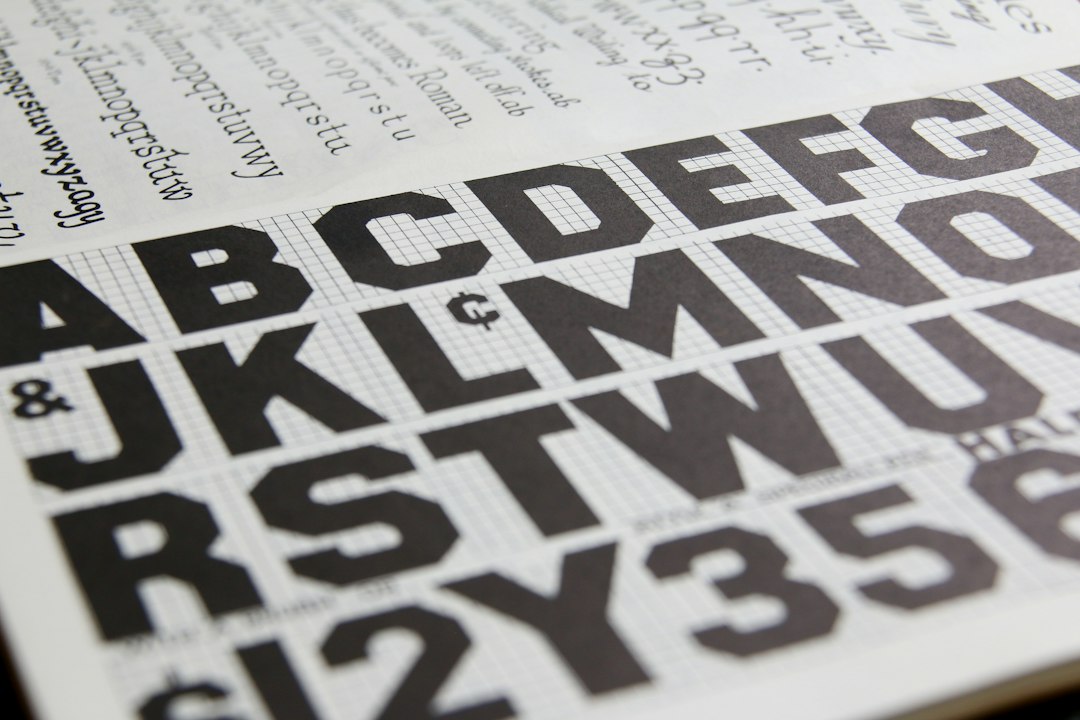
A classic serif for an institute that began in the age of the printed journal. (Specimen set in Libre Caslon Text, a serif STAND-IN; NOT The Franklin Institute logo.)
Medals, schools and a name
An institute, a museum and an awards programme.
The Franklin Institute is still more than its museum. Its awards programme, which the institute dates to its founding years, was reorganised in 1998, English Wikipedia says, when its endowed medals were combined as the Benjamin Franklin Medals; the institute says the medals are now presented each year in seven fields of science and engineering, alongside the Bower awards for science and for business leadership, with winners chosen by its Committee on Science and the Arts. The journal begun in 1826 continues, and English Wikipedia says it now concentrates on engineering and applied mathematics.
Education runs beyond the building. The Encyclopedia of Greater Philadelphia names the Science Leadership Academy, a science-focused public magnet high school opened in 2006 in partnership with the School District of Philadelphia, and the Philadelphia Science Festival, a nine-day citywide event held each year since 2011. The institute’s own pages list programmes for teachers and schools and the PACTS programme for middle and high school students.
The organisation styles itself “The Franklin Institute,” with a capital T, and abbreviates the name to TFI on its own pages. Its visual presence starts with the building: a white Beaux-Arts front on the Parkway, which the encyclopedia says quickly became a landmark, and a domed memorial hall within. There is a printing thread in the story too: the encyclopedia notes that the institute’s first president co-founded what it calls the first American type foundry.
For a design guide, The Franklin Institute shows how a nineteenth-century society of mechanics can carry a namesake, a journal, a medal and a classical building into a hands-on science museum without changing its name. Compare the Adler Planetarium, whose planetarium opened a few years earlier in Chicago, and the Philadelphia Orchestra, another Philadelphia institution. For this guide we use a deep blue, a brass and a pale stone with a serif, an unofficial interpretation; no product or logo is reproduced.
Explore & save
Keep The Franklin Institute’s identity on hand — save it to a board in the Made Good inspiration library.
The Franklin Institute identity set
Pin the Franklin blue, brass and stone palette and the classic serif register to your own board.
Source & notes
Frequently Asked Questions
What font can I use to match the The Franklin Institute look?
This guide describes The Franklin Institute’s type as “A classic serif for an institute that began in the age of the printed journal”. Its type specimen is set in Libre Caslon Text from Google Fonts as a stand-in; Libre Caslon Text is not The Franklin Institute’s own lettering.
What colours are in the The Franklin Institute palette?
This guide’s The Franklin Institute palette is Kite-string blue #24405E, Ink #15181C, Medal brass #A27C3B, Parkway stone #ECE6D8 and Paper #FAF8F3. The tones are the guide’s own unofficial interpretation, not official The Franklin Institute hex codes.
When was The Franklin Institute founded?
The Franklin Institute was founded on 5 February 1824, in Philadelphia, Pennsylvania.