Science Centre Singapore Brand Guidelines
A hexagonal science centre in Jurong, opened in 1977.
Aa
Two constants: a teal, concrete grey and orange palette and a geometric sans register. Abstract homage — not a Science Centre Singapore mark; no logo, exhibit or building image is reproduced.
Jurong, 1977
A science centre beside an industrial estate.
Science Centre Singapore opened as the Singapore Science Centre on 10 December 1977 in Jurong, in the west of the island. Its site was chosen, the National Library Board’s Infopedia says, to sit near the Jurong industrial estate, Singapore’s first industrial hub, at a time when the country was industrialising quickly. The centre was opened by Toh Chin Chye, then Minister for Health, whose speech at the opening is listed in the records of the National Archives of Singapore.
The idea is older than the building. Infopedia traces it to 1955, when a small group who had visited science centres abroad proposed one for Singapore, and to the Science Council of Singapore, set up in 1967, which formed a committee for the project in 1968. In 1969 UNESCO sent a curator from the Science Museum in London to help draw up the proposal. The same year, the National Heritage Board notes, the Science Council suggested moving scientific material out of the National Museum, which became a museum of art and history. Under the Science Centre Act, passed on 22 July 1970, a Science Centre Board was created to run the centre as an autonomous body, and the centre took over the natural history side of the National Museum. The board first met on 21 November 1970, at the National Museum.
Building the centre took most of the decade. A design competition was held in February 1971 and won by the architect Raymond Woo. Construction began on 30 January 1973; later that year a time capsule of 100 items from Singapore industries, from shipbuilding to precision products, was buried at the entrance, to be opened in 1983. Staff worked first from the National Museum and then from a port authority building before moving into the finished centre in October 1976, Infopedia says.
The board still runs the centre. The Singapore Government Directory lists the Science Centre Board among the statutory boards of the Ministry of Education; when it was set up in 1970 it came under the Ministry of Science and Technology, according to Infopedia. On its 30th anniversary in 2007 the Singapore Science Centre was renamed Science Centre Singapore, the name it uses today.
Colour
Galleries, a dome theatre and an observatory.
The centre opened with four exhibition galleries: physical sciences, life sciences, special exhibits and a lobby gallery. Infopedia counts 328 exhibits on 19 themes, among them wave fundamentals, solar radiation, the universe and the origins of life. From the start the centre also worked with schoolteachers, ran guided tours and lectures, screened science films and published its own bulletins and life-sciences broadsheets. It recorded about 233,000 visitors by the end of 1978 and about 348,000 in 1982, according to the same source.
The Omni-Theatre followed in 1987, next to the main building. The centre describes it as an IMAX dome theatre, where films play on a giant domed screen; at its opening it held a 284-seat Omniplanetarium and three exhibition galleries, Infopedia says. An Observatory opened in 1989. Between 1998 and 2003, the centre says, its 14 science galleries were refurbished to make them more interactive, and in 2000 an integrated complex added the Annexe Building, a Kinetic Garden and Snow City, an indoor snow centre beside the main building with slopes for tobogganing, skiing and snowboarding, according to Infopedia.
Later additions reached younger visitors. In 2014 Snow City added The Cliff, a sport climbing wall, and the centre launched KidsSTOP, an interactive science centre for children aged 18 months to eight years. Today the centre lists four strands of work: interactive exhibitions that show the principles of science and technology, school programmes of workshops, experiments and tours that follow Singapore’s school science syllabus, publications such as science magazines and natural history guidebooks, and community events across the island.
Typography
How science centres present themselves.
Science centres in Europe, Asia and Oceania tend to introduce themselves first through the body that runs them. Some are foundations, such as Experimentarium in Denmark, which its own website describes as governed by a foundation board; some belong to a bank’s foundation, as CosmoCaixa in Barcelona belongs to the “la Caixa” Foundation; others are run by a city, a national agency or a charity. That name usually sits close to the centre’s own on signs and in print.
The building is often the second introduction. Several centres occupy reused sites: Experimentarium has used a former Tuborg bottling hall in Hellerup since 1991, and CosmoCaixa keeps part of an early twentieth-century modernist asylum in Barcelona. Some stand in new buildings on rivers, harbours or former industrial land, and their architects are part of the story they tell about themselves.
Inside, the vocabulary is shared. Hands-on galleries invite visitors to touch and try exhibits; some add a planetarium, a dome or a giant-screen theatre; and some keep living collections, such as the indoor Amazon forest at CosmoCaixa or rainforest and aquarium zones elsewhere. Programmes for schools and families sit beside the galleries: the Catalan government’s heritage pages say CosmoCaixa runs activities for state schools and families, and Experimentarium lists teaching rooms in its rebuilt house.
Names change too. CosmoCaixa took its present name when the Museu de la Ciència reopened in 2004, and Experimentarium ran a temporary branch, Experimentarium City, while its Hellerup building was rebuilt before reopening in 2017. This guide sets out, for each centre, who runs it, where it stands, what is inside and how its name has changed, using dated sources, and treats its colours and type as an unofficial interpretation.
Aa
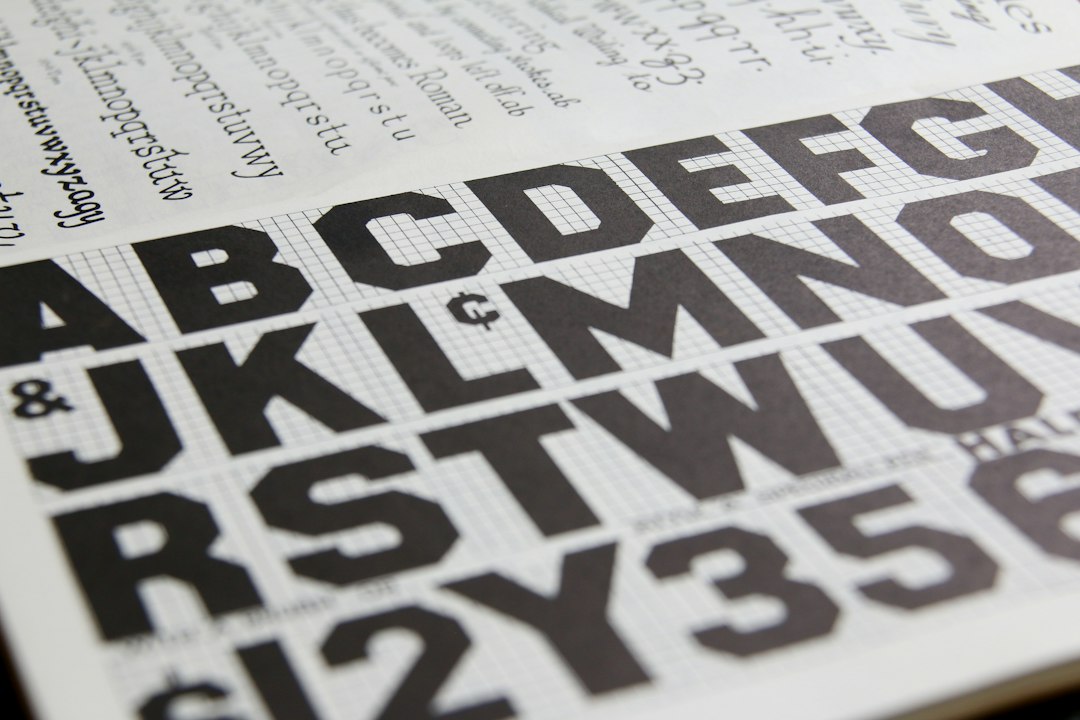
A geometric sans for a hexagonal building. (Specimen set in Space Grotesk, a sans STAND-IN; NOT the Science Centre Singapore logo.)
Science Centre Singapore
A building that shows how it works.
The building is the centre’s most distinctive design asset. Docomomo Singapore, the modern-architecture heritage group, describes it in a 2023 entry: a hexagonal central block resting on truncated pyramidal bases, hollow in the middle with a four-storey void, its upper rooms linked by a circular corridor bridge that shows on the front facade. Woo’s design was chosen over 22 other entries, Docomomo says, and the group notes its likeness to the nearby Jurong Town Hall, on which Woo had worked earlier. Inside, castellated beams with hexagonal openings follow the geometry of the plan, and the beams and air-conditioning pipes were left exposed so that visitors could see how a building works. A large workshop and store behind the galleries let the centre build its own exhibits.
Woo, interviewed in 2016, said he laid the building out as a triangle on plan so that all the galleries and services would fit, and called it “provocative” for its time though simple and well planned. A 2025 article on Stateofbuildings.sg records that critics compared the building to a spaceship, an inverted cup or a moon buggy. The Omni-Theatre of 1987 added a dome beside the main block, so the complex reads as a cluster of strong geometric forms rather than a single box.
For a design guide, Science Centre Singapore shows how a building can teach as much as its exhibits: the structure is left on view, and the hexagon runs from the plan to the beams. Compare Glasgow Science Centre, whose architects also left structure and services exposed as a teaching tool, and the Science Museum in London, one of whose curators helped draw up the Singapore proposal in 1969. For this guide we use a deep teal, a concrete grey, a warm off-white and an orange accent with a geometric sans, an unofficial interpretation; no product or logo is reproduced.
Explore & save
Keep Science Centre Singapore’s identity on hand — save it to a board in the Made Good inspiration library.
Science Centre Singapore identity set
Pin the teal, concrete grey and orange palette and the geometric sans register to your own board.
Source & notes
Frequently Asked Questions
What font can I use to match the Science Centre Singapore look?
This guide describes Science Centre Singapore’s type as “A geometric sans for a hexagonal building”. Its type specimen is set in Space Grotesk from Google Fonts as a stand-in; Space Grotesk is not Science Centre Singapore’s own lettering.
What colours are in the Science Centre Singapore palette?
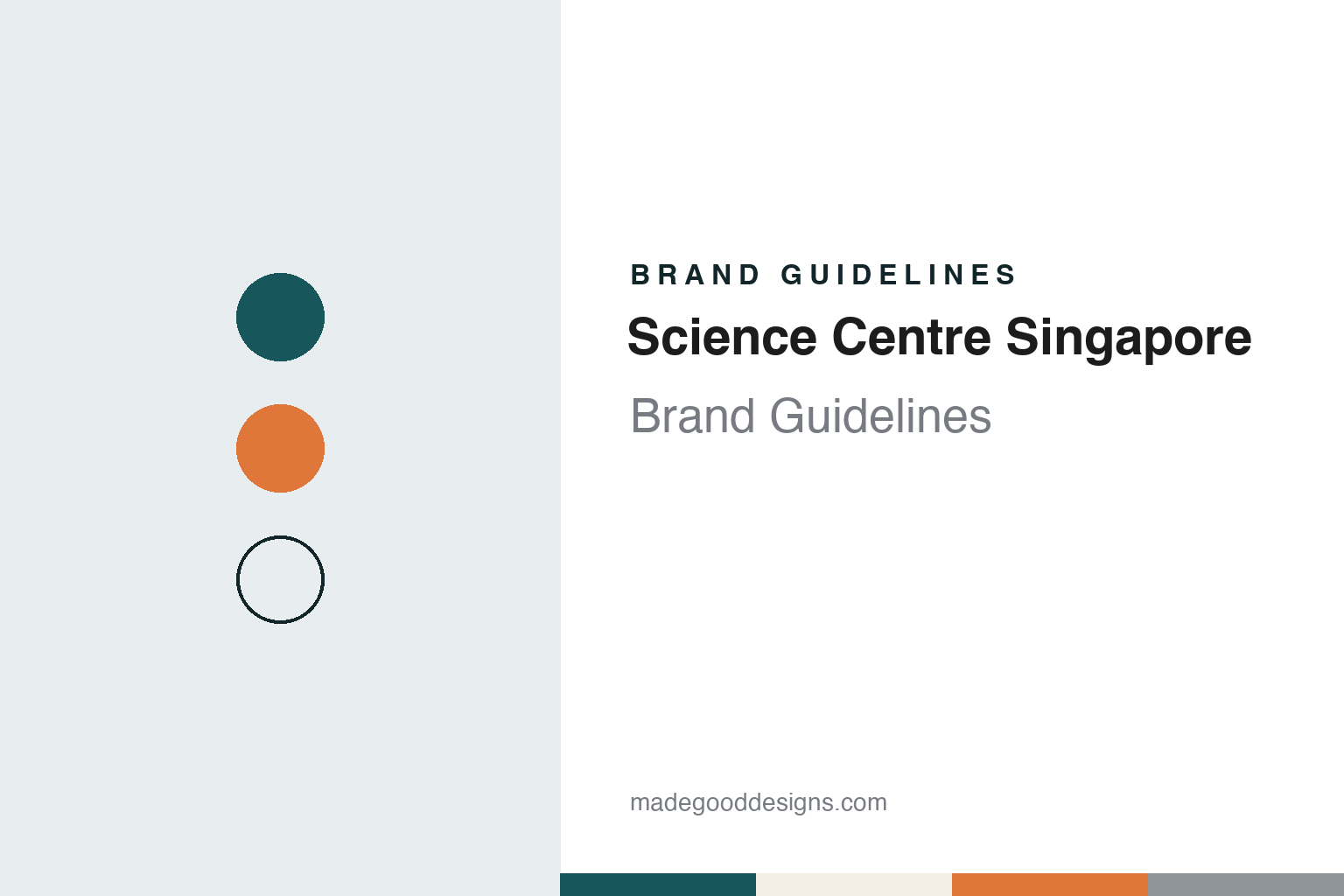
This guide’s Science Centre Singapore palette is Jurong teal #17575C, Ink #12262A, Warm paper #F3EFE7, Signal orange #E0773A and Concrete grey #8E9497. The tones are the guide’s own unofficial interpretation, not official Science Centre Singapore hex codes.
When did Science Centre Singapore open?
Science Centre Singapore opened on 10 December 1977, in Jurong, Singapore.