We The Curious Brand Guidelines
Bristol’s harbourside science centre, once At-Bristol, in a 1906 goods shed.
Aa
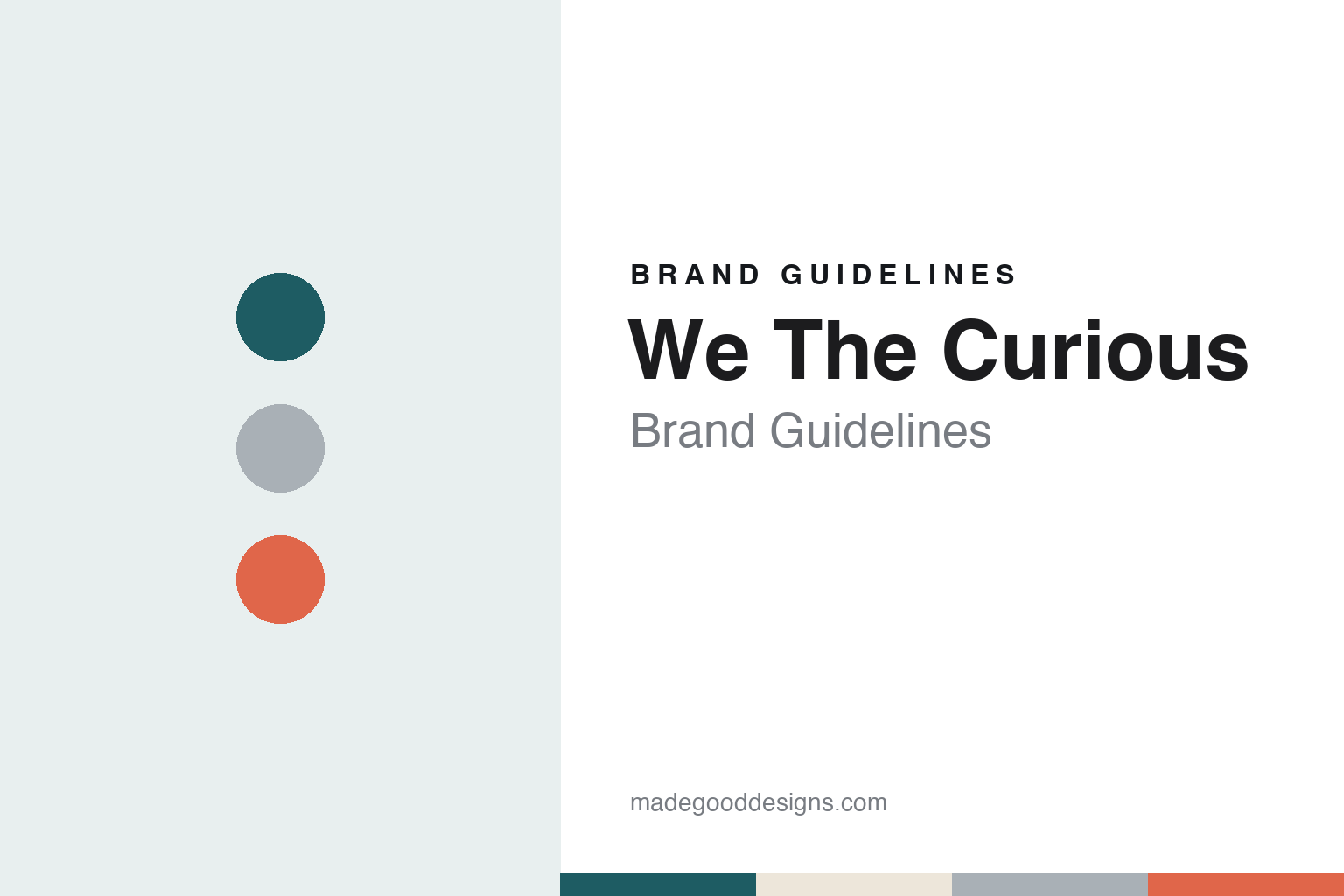
Two constants: a harbour teal, silver and coral palette and a question-led sans register. Abstract homage — not a We The Curious mark or exhibit; no logo, sign or building image is reproduced.
Explore At-Bristol
A millennium project on the Floating Harbour.
We The Curious is an educational charity and science centre on the harbourside in Bristol, England. It opened in 2000 as Explore At-Bristol, a name that, the centre’s own history says, was soon shortened to At-Bristol; it relaunched as We The Curious in 2017. English Wikipedia dates the relaunch to September 2017 and describes the organisation as a science and arts centre and educational charity.
Its roots lie in an earlier Bristol venture. In 1984 the scientist Richard Gregory founded The Exploratory, a hands-on centre where visitors could “play with science,” the centre’s history says. English Wikipedia places the Exploratory in the old train shed at Bristol Temple Meads station and notes that it was a separate organisation: none of its exhibits or staff moved to the new centre. The centre’s history adds that Gregory played a key role in developing its successor, and that the Exploratory closed in 1999.
The new centre grew out of a Millennium Commission project of 1997–98, tied to the redevelopment of Bristol’s harbourside and supported by the National Lottery’s Millennium Commission, Bristol City Council and the South West of England Regional Development Agency, according to the centre. At its opening, English Wikipedia says, it had three parts: Explore, the hands-on science centre; Wildwalk, a biodiversity centre with live animals and plants, an indoor rainforest and aquariums; and an IMAX cinema, which opened first, on 20 April 2000. Wildwalk and the IMAX closed on 31 March 2007, and the Blue Reef Aquarium took over their building, opening in October 2009. Explore itself took the At-Bristol name in June 2010, English Wikipedia says.
In 2015 and 2016 the centre asked visitors, staff, partners and people who did not visit what they wanted it to be; respondents asked it to “be more challenging,” to be “not just for kids” and to change its name, the centre says. English Wikipedia records that more than 400 names were considered before We The Curious was chosen. In 2018 staff toured every Bristol postcode, gathering more than 10,000 questions from residents; these were narrowed to seven, which became the basis of the exhibition Project What If, opened in 2021. The centre closed from April 2022 and reopened on 2 July 2024, BBC News reported that day.
Colour
A goods shed, a glass atrium and a silver ball.
The centre occupies a building with its own history. Built in 1906 as a railway goods shed, it was known as the Cannon Marsh Goods Shed and served the Bristol Harbour Railway, which ran to the city’s wharves and docks, the centre says; it was one of the earliest buildings to use reinforced concrete and is now Grade II listed. The railway yard closed in 1965 and the site became a car park. English Wikipedia gives the shed’s size as about 165 by 41 metres and places it on the former Canon’s Wharf, beside Millennium Square, which was laid out in the same regeneration.
The conversion, completed in 1999, added a large glass atrium on the north side and a stainless-steel sphere on the south to house the planetarium; English Wikipedia names Chris Wilkinson as the architect of the renovation. The building also holds a ten-metre transparent tube filled with balls of eutectic salts, which melt as the building warms and crystallise again as it cools, as part of its heating and cooling system, English Wikipedia says.
Inside, the centre describes more than 200 interactive exhibits across two floors. On the ground floor are Project What If, built from residents’ questions, and the North Gallery, given over to food and flight; the first floor holds giant puzzles, tricks of the light, animation, and exhibits on how brains and bodies work together, according to the centre. Earlier exhibitions named in its history include All About Us, Our World, Animate It, Build It, Food and the Tinkering Space. English Wikipedia says Animate It! was developed with Aardman Animations, the Bristol studio, and that many of the exhibits are built by the centre’s own on-site workshop.
The Planetarium sits on the first floor, inside what the centre calls the “giant silver ball.” It seats 85 under a 360-degree dome, and its 3D and 2D shows are written in-house and presented live by the centre’s Live Science team, the centre says; its history records that the planetarium was built with the 1999 conversion and upgraded for 3D in 2015. Next to it, a Space Gallery deals with life in space and future space travel, and adult evenings called Planetarium Nights run on selected Thursdays.
For schools, the centre combines visits to the two exhibition floors with practical STEM workshops and longer theme days in its classrooms and laboratories, and it runs Relaxed Mornings for visitors who find a busy building overwhelming. During the 2022–24 closure, the centre says, its teams took activities to schools, libraries, children’s centres and festivals across the city.
Typography
Science centres in Europe, Asia and Oceania.
Science centres in Europe, Asia and Oceania tend to introduce themselves first through the body that runs them. Some are foundations, such as Experimentarium in Denmark, which its own website describes as governed by a foundation board; some belong to a bank’s foundation, as CosmoCaixa in Barcelona belongs to the “la Caixa” Foundation; others are run by a city, a national agency or a charity. That name usually sits close to the centre’s own on signs and in print.
The building is often the second introduction. Several centres occupy reused sites: Experimentarium has used a former Tuborg bottling hall in Hellerup since 1991, and CosmoCaixa keeps part of an early twentieth-century modernist asylum in Barcelona. Some stand in new buildings on rivers, harbours or former industrial land, and their architects are part of the story they tell about themselves.
Inside, the vocabulary is shared. Hands-on galleries invite visitors to touch and try exhibits; some add a planetarium, a dome or a giant-screen theatre; and some keep living collections, such as the indoor Amazon forest at CosmoCaixa or rainforest and aquarium zones elsewhere. Programmes for schools and families sit beside the galleries: the Catalan government’s heritage pages say CosmoCaixa runs activities for state schools and families, and Experimentarium lists teaching rooms in its rebuilt house.
Names change too. CosmoCaixa took its present name when the Museu de la Ciència reopened in 2004, and Experimentarium ran a temporary branch, Experimentarium City, while its Hellerup building was rebuilt before reopening in 2017. This guide sets out, for each centre, who runs it, where it stands, what is inside and how its name has changed, using dated sources, and treats its colours and type as an unofficial interpretation.
Aa
A plain, question-led sans for a centre named after its visitors’ curiosity. (Specimen set in Space Grotesk, a sans STAND-IN; NOT the We The Curious logo.)
We The Curious
A phrase in place of a place name.
The name is the centre of the identity. “We The Curious” replaced a brand built on the city’s name with a phrase, and the centre’s history ties the change directly to its 2015–16 consultation, in which people asked for a new name. English Wikipedia adds that the chosen name was tested with members, focus groups, volunteers and staff before it was adopted. The earlier names, Explore At-Bristol and At-Bristol, also written “@Bristol,” carried the city in the brand; the current one does not name Bristol at all.
The setting supplies much of the rest of the visual vocabulary: an Edwardian reinforced-concrete goods shed, a glass atrium and a stainless-steel sphere on Bristol’s Floating Harbour, opening onto Millennium Square. English Wikipedia notes that Pero’s Bridge, a footbridge across the harbour, links the square to the Arnolfini gallery and Queen Square. The centre marked its 25th year in 2025, its history says.
For a design guide, We The Curious shows how a renamed institution can pair a question-led name with one strong object, the silver planetarium sphere, set against an industrial building. Compare Science Museum in London and Glasgow Science Centre, two other British science institutions. For this guide we use harbour teal, planetarium silver and a coral accent on warm stone with a sans, an unofficial interpretation; no product or logo is reproduced.
Explore & save
Keep We The Curious’s identity on hand — save it to a board in the Made Good inspiration library.
We The Curious identity set
Pin the We The Curious harbour teal, silver and coral palette and the question-led sans register to your own board.
Source & notes
Frequently Asked Questions
What font can I use to match the We The Curious look?
This guide describes We The Curious’ type as “A plain, question-led sans for a centre named after its visitors’ curiosity”. Its type specimen is set in Space Grotesk from Google Fonts as a stand-in; Space Grotesk is not We The Curious’ own lettering.
What colours are in the We The Curious palette?
This guide’s We The Curious palette is Harbour teal #1E5C63, Ink #15181C, Shed stone #EDE6DA, Planetarium silver #A9B0B6 and Curious coral #E0664A. The tones are the guide’s own unofficial interpretation, not official We The Curious hex codes.
When did We The Curious open?
We The Curious opened in 2000 (as Explore At-Bristol), in Bristol, England.